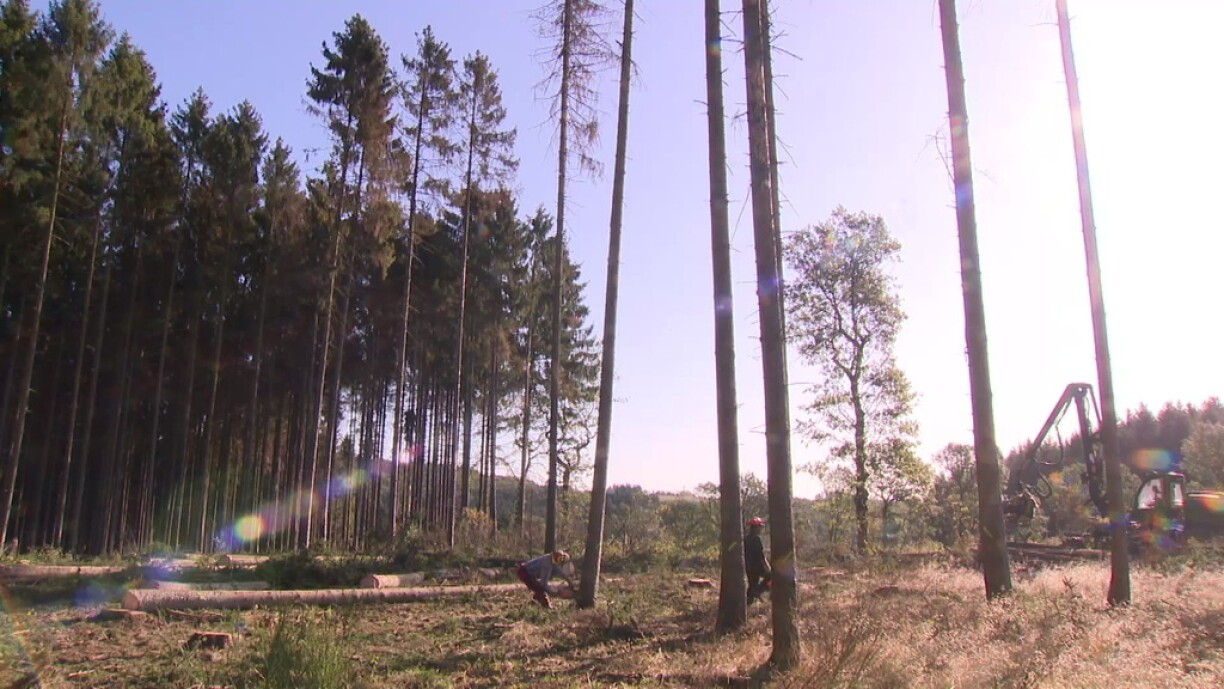
About half of the spruces in Luxembourg are affected and dead trees must be felled as quickly as possible.
RTL's Pit Everling met with with forest owners to discuss the issue. It is sadly too late for Jean Berns in Feulen: his spruces are dead must be felled, thanks to a tiny insect, the bark beetle.
However, Winfried von Loë, representing the 'Luxembourgish private forests' association, has long been familiar with bark beetles. The issue arising from the insects has been the main issue for the association for the past year and a half.
As von Loë explained, high temperatures consequently see bark beetle species multiply and spread, consequently attacking the spruces in the country.
The two main species to befall Luxembourg are the European spruce bark beetle and the spruce wood engraver. These insects drill their way through the wood of the trees, getting into the tree's water supply system and consequently killing the tree entirely.
In addition to the heat creating an environment in which bark beetle species spread, it also affects the tree's natural defence system, which is unable to function due to the dry and hot weather.
The first hints revealing that a tree has been infested by a pest include needles browning, holes in the bark, and sap leaking out.
If an arborist notices that a spruce is infested, they have to remove the tree as quickly as possible to prevent the insects from spreading to the next tree. They then plant different trees better adapted to future climate conditions in the same space.
Von Loë highlighted the need to ensure forests have a variety of trees, although this in itself is no guarantee against bark beetle infestations.
Affected forest owners are also able to have help in replanting trees, with subsidies having doubled in recent years according to the Nature Management Agency. The agency's director Frank Wolter told RTL that the situation is critical and could risk a pandemic.
Wolter is confident spruces in Oesling will survive the issue, but there is a good chance there may not be any spruces in Gutland in ten years' time. Spruces in general make up a quarter of Luxembourg's trees, and the wood is often used in the construction sector.
Unfortunately for Berns, his dried-out trees are not worth much. The average price for wood from a 60-year-old tree used to lie at €60 per cubic metre, but has since fallen to €20 per cubic metre. Berns described the issue as 'not just an economic loss, but the destruction of Luxembourg's landscape'. He added that it is always difficult to watch as a forest is felled, especially after having maintained it for decades.





