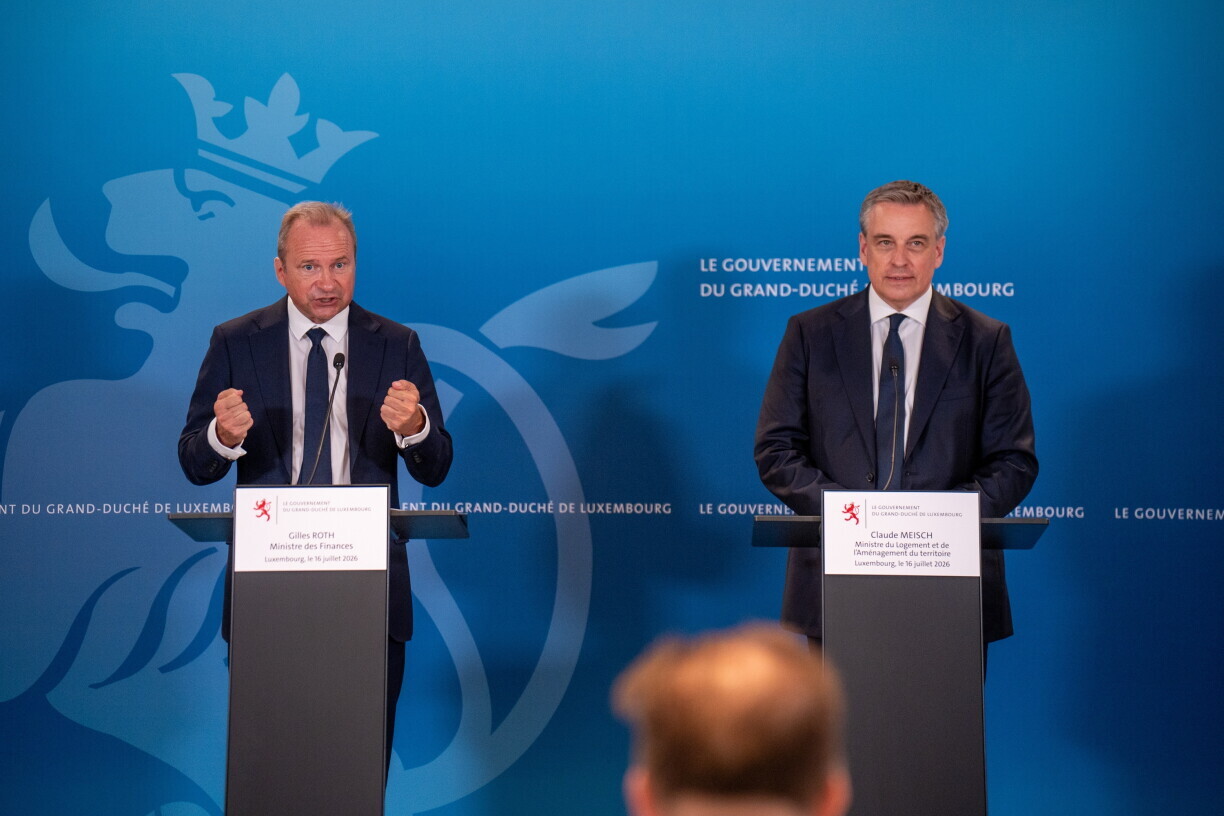
Minister of Finance Gilles Roth was joined by Minister of Housing Claude Meisch on Thursday to present their plan to boost construction to the Chamber committee, and later, the press.
The EU Commission has rejected the increase in the ceiling for super-reduced VAT from 50,000 to 100,000 euros. However, the ministers have found alternatives to stimulate access to housing and investment in rental property. They said they also want to learn from the past and keep an eye on the effect of the measures.
The ministers presented examples in the form of graphs, showing that someone purchasing a home worth 1 million euros – depending on the respective conditions and measures – could pay, for example, €5,000, €19,500, or up to €33,600 less.
The homebuyer tax credit on notarial deeds, known locally as the 'Bëllegen Akt', will be increased from €40,000 to €45,000 per person. The interest subsidy will no longer be calculated on a loan of €200,000, but up to €300,000, but only for first-time buyers under 35 years of age. The threshold may increase slightly due to the number of children.
Accelerated depreciation at a rate of 6% over six years will be reintroduced, although this tax benefit will now be capped at €600,000. The main measure in the "booster package" is that registration duty on off-plan home purchases (VEFA) will be reduced to 0% until the property is 80% complete.
Roth said in the question-and-answer session that it was "not a package to support developers who bought land at too high a price", but to get construction back on track. He said that before the pandemic, there weren't enough projects on the market, and that people wished to buy before they were authorised. Now, it's the opposite: there are many projects being authorised, but without coming to fruition.
Roth and Meisch asked for developers to meet them halfway, without asking for prices that are too high, as Roth warned any abuses could be subjected to further measures.
Measures aimed at boosting demand are understandable in this context. However, there is a risk that they could drive prices even higher if supply fails to keep pace. How much housing is built ultimately depends largely on decisions taken by municipalities.
Housing Minister Claude Meisch said he and the finance minister would closely monitor and evaluate the tax measures and report back to Parliament, allowing the government to intervene if necessary. He stressed, however, that the new measures would not operate in isolation, but would be accompanied by additional provisions designed to prevent them from pushing up prices.
Meisch also pledged to continue discussions with municipalities.
The main measures are expected to cost the state relatively little, with around €35 million in lost tax revenue. Finance Minister Gilles Roth noted that increased activity in the housing market could, in turn, generate additional revenue.
In addition, the government has agreed that 300 million euros will be dedicated to the state purchase of off-plan homes (VEFA).
Meisch said the state had so far committed €470 million and would now be able to take advantage of further purchasing opportunities. Roth also reiterated that a housing bond would be issued in early 2027.





