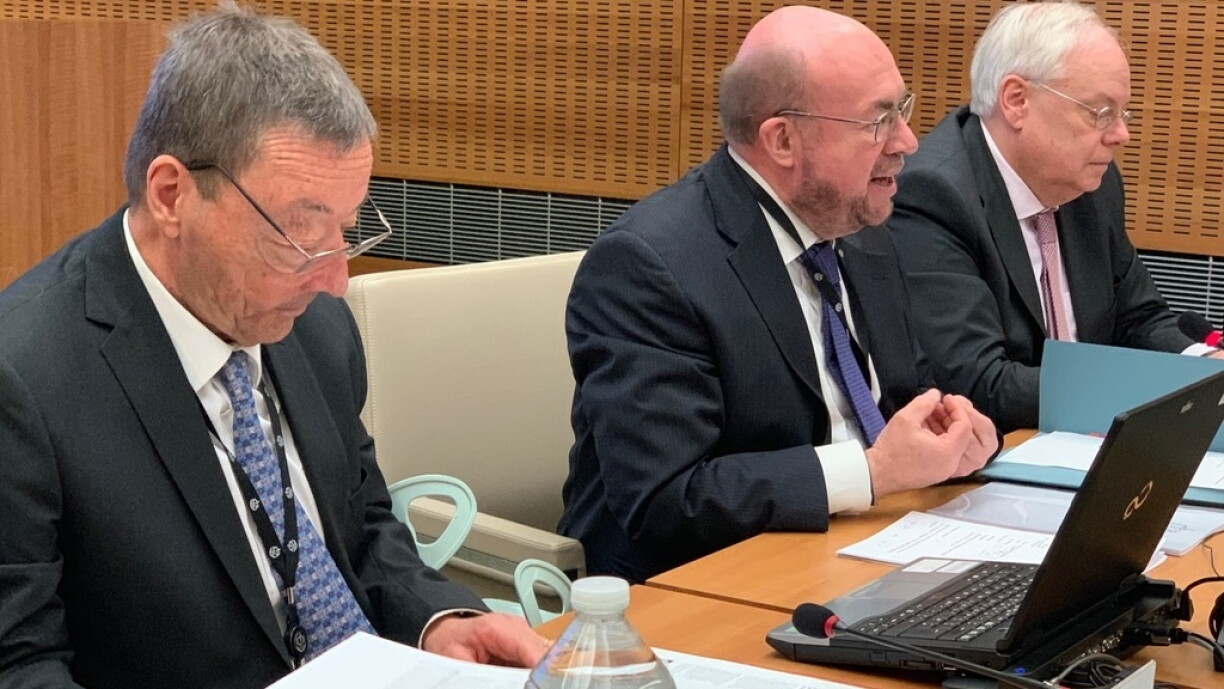
The agenda of the press conference mainly comprised the annual report from the previous year, but also included an update on the construction of the third European Court of Justice tower in Kirchberg.
The third tower is indeed starting to take on its intended shape. Given that the work is continuing as expected, the CJEU confirmed that its budget would not be exceeding the expected €145 million. The move into the new building is expected to occur between mid-July and mid-August.
As for the third tower's inauguration, the celebrations will take place on 19 September. Luxembourgish judge François Biltgen confirmed that the public would be able to have a look inside the new building exactly one month later, as the traditional Court of Justice of the European Union Open Day is scheduled for 19 October.
As for the third tower's purpose, Biltgen confirmed that it would be a permanent location for the CJEU translators, who are currently based out of a rented office building.


At the press conference, the CJEU representatives confirmed that they were pleased with the cooperation with the Luxembourgish authorities. The state is charged with building the building and the CJEU will rent the premises until they become the owners of the building. This will occur by 2036 at the latest.
Presenting the CJEU's work in 2018, the judges announced that the European Court of Justice dealt with 849 new cases. Amongst those were four preliminary rulings in response to requests submitted by Luxembourgish courts and tribunals. Preliminary rulings are decisions based on interpretations of European law and the requesting court or tribunal is obliged to implement the ruling.
President of the General Court Marc Jaeger confirmed that the General Court had also been busy over the past year, proclaiming verdicts in 1,009 cases. In examining the number of cases concluded in the General Court, judge Dean Spielmann explained that this suggested the 2016 reform had been a great success. The reform allowed judges to examine cases more swiftly.
The Luxembourgish representatives highlighted that the General Court and the Court of Justice, which are usually described as the administrative and constitutional courts of Europe, are increasingly having to deal with cases regarding civil rights.





