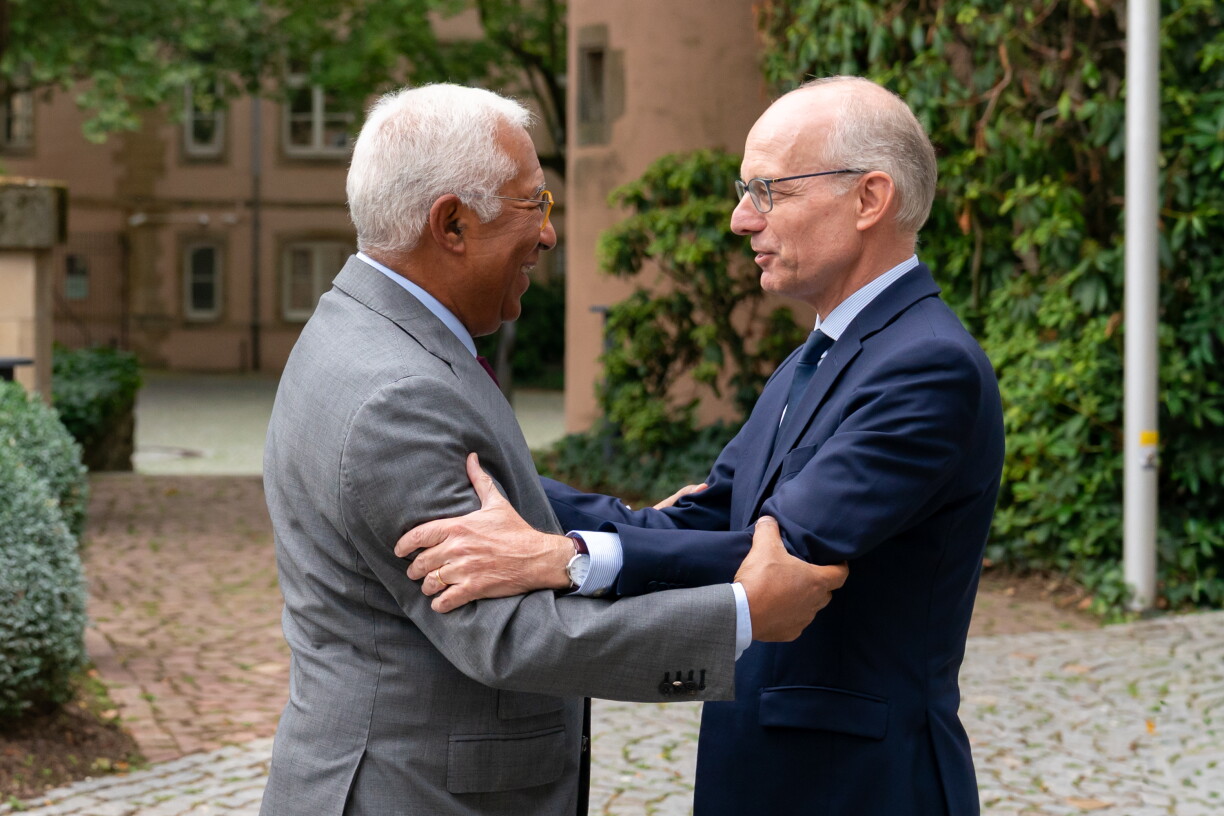
Public money alone will not be enough to make the investments the European economy needs. On that basis, there is broad agreement that the single market and the capital markets union should be developed further, with less red tape and a more business-friendly environment, according to Prime Minister Luc Frieden during Wednesday's meeting with European Council President António Costa in Luxembourg as part of Costa's ongoing tour of the EU's capitals.
If Europe wants to invest in innovation, Frieden said, if it wants a European artificial intelligence and if it wants to invest in defence, public money will indeed be needed. Public money, however, is limited, and private capital will also have to play its part. On that basis, he added, an agreement on the Savings and Investment Union should be reached by the end of the year.
Luxembourg would have an important role to play here through its financial centre, European Council President António Costa emphasised. The aim, he said, was to have an agreement on the table at EU level by the end of the year.
Another, more contested topic was the EU's Multiannual Financial Framework, or in other words the EU's budget for 2028–2034. Member states are split between those on the more frugal side of the argument and those who want to see a larger EU budget. That, Frieden made clear at the press conference, is no easy assignment for Council President Costa.
Costa nevertheless set himself the ambitious goal of hammering out a compromise at EU level by the end of the year. This meant, he said, securing robust funding for the EU's new priorities, including defence, security, competitiveness, research, innovation, and strategic resilience, while preserving the essential pillars of support for Europe's regions, in particular cohesion and agricultural policy.
Luxembourg finds itself in the thick of the debate, as Frieden explained. Investment is needed, he said, but not on the back of new borrowing or fresh taxes. His remarks came against the backdrop of his firm rejection of the EU's proposed tobacco tax, as reported by POLITICO.
Current geopolitical events were also on the agenda. Supporting Ukraine, both politicians argued, amounts to an investment in European security. Costa sharply condemned the recent incident at Leipzig airport. Russia, he said, had to understand that such threats, whether hybrid or otherwise, would not shift the European Union's position, since the EU's stance is grounded in the fundamental values of international law.
Many member states are calling for a tougher line towards Russia in the wake of the Leipzig incident. What exactly that will look like, however, remains to be seen.





