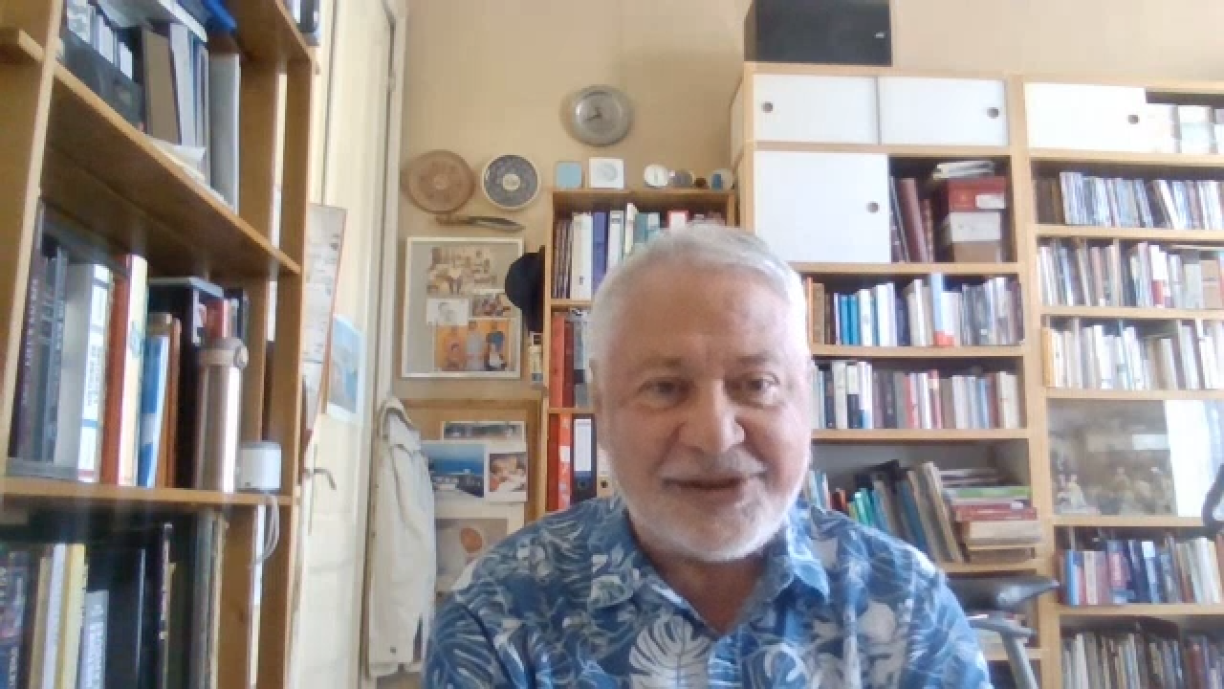
When Henri Bouillon appears on screen, his cheerful smile and Hawaiian-patterned shirt quickly capture one's attention.
Surrounded by shelves of books in his home office, Bouillon might not look like a typical retired academic at first glance. Officially, his name is Henri Joseph Bouillon, though he is widely known as Heinz.
Born in 1949 in Weywertz, a village in Belgium's German-speaking East Cantons, with Eupen as its administrative centre and near the well-known Vennbahn cycling route, Bouillon's roots reflect the interconnected histories of Belgium, Luxembourg, and the wider region.
Weywertz is around 40km from the Luxembourg border, and for many Luxembourgers the area is perhaps better known for the town of Sankt Vith.
Bouillon’s first name, Heinz, signals his German heritage, but his family history also ties him closely to Luxembourg: his father hailed from Hachy, known as Häerzeg in Luxembourgish, located between Arlon and Habay in the Luxembourgish-speaking part of Belgium’s Province of Luxembourg.
Bouillon explains that Luxembourgish was his father’s first language. Born shortly after World War I, his father shifted towards French due to the region’s changing political landscape.
He trained as a schoolteacher in Arlon, and after World War II, when many from Belgium’s German-speaking area fled to Germany, Bouillon’s father was sent there, which is where he met Bouillon’s mother and settled.
“The rest, as you can see, is sitting in front of you”, Bouillon laughs during our video call.
That broad outlook is evident in Bouillon’s choice of photos: he shares a Madagascar snapshot, grinning with what appears to be a monkey perched on his head, marking a testament to his travels both as a private individual and in his academic career.


Early exposure to multiple languages was pivotal for Bouillon’s professional path. He studied Germanic languages at the Université catholique de Louvain (UCL), earned a PhD in linguistics, and went on to teach at UCL from the late 1990s until 2016.
He also served as Dean of the Faculty of Philosophy and Letters between 2004 and 2009.
His courses ranged from “German Language” to “Didactics: German as a Foreign Language” and seminars on the economic, legal, social, and political frameworks of German-speaking countries.
The retired university professor has fond memories of a former student named Stéphanie, whose future as Luxembourg's Grand Duchess no one could have predicted at the time.
Whenever her name comes up, Bouillon expresses nothing but praise for his former pupil, emphasising her remarkable humility.
Yet, he was most struck by her performance during oral exams: "I was completely surprised. I saw a young woman with finely considered arguments and great subtlety. She spoke truly beautiful German. I have to say, I gave her one of the best grades I ever awarded at university". And that is officially recorded and appears on her diplomas, he concluded.
Bouillon emphasised that he only speaks publicly about her because she was “an exceptionally good student”, otherwise, he would never comment out of respect for privacy.
Finally, he highlighted his enormous admiration for her, as she is a "wonderful personality with great inner strength."
Bouillon’s influence extends far beyond the classroom.
As a long-serving representative for the German-speaking Community of Belgium in the Council for German Orthography, he played a pivotal role in shaping rules for written German across seven countries and regions: Germany, Austria, Switzerland, Liechtenstein, South Tyrol, East Belgium, and Luxembourg, which, while a participating member, does not have voting rights.
The Council is tasked with regulating German orthography in response to new linguistic questions and necessary adaptations. Over the years, debates have ranged from controversial comma rules to the complexities of gendered language.


Within that council, Bouillon consistently brought a didactic perspective to discussions, emphasising the practicalities of teaching and learning German.
Bouillon also advocated for the inclusion of local linguistic expressions, such as the word 'fritten' (fries), which, though rooted in Belgian and Luxembourgish usage, is gradually gaining ground across Germany.
He explained that the proposal to include 'fritten' in standard German vocabulary raised a few smiles in the Council. Some claimed the word was only used up to Cologne or the Rhine, but that is simply not the case.
Of course, there are more important things to be proud of, but 'fritten' is a good example, "especially given the quality of Belgian fries", he concluded."The word 'fritten' is now becoming increasingly established in Germany."
“We embrace multilingualism and rely on our flexibility”, he said.


A visit to a small exhibition at the parliament of Belgium’s German-speaking Community in Eupen reveals the breadth of local German variants and similarities to Luxembourgish German.
Bouillon sees Belgium’s linguistic diversity not as a problem, but as part of its evolutionary journey, with regions developing at their own pace. Recent successes at the Football World Cup, he noted, have even helped strengthen national unity.
“People have come together”, Bouillon observed, adding that cross-community visits between Flemings and Walloons are common, “but politics is another matter.”
Luxembourg and Belgium’s East Cantons maintain close ties, says Bouillon, who notes that “Nowadays, Luxembourgers are also our employers.”
Even the recent announcement of a new motorway vignette in Belgium, which is a sticker required for using the motorways, does not worry him.
He sees it as “one of the many ways the Belgian state raises funds”, necessary to address a €10 billion deficit.
Bouillon regrets the situation but understands the reasoning, as long as the measure is not discriminatory, and points out that Luxembourgers benefit from cheaper fuel: “You also have much cheaper petrol.”
In this spirit, Bouillon offers best wishes to Luxembourg’s Belgian neighbours for their national holiday.





