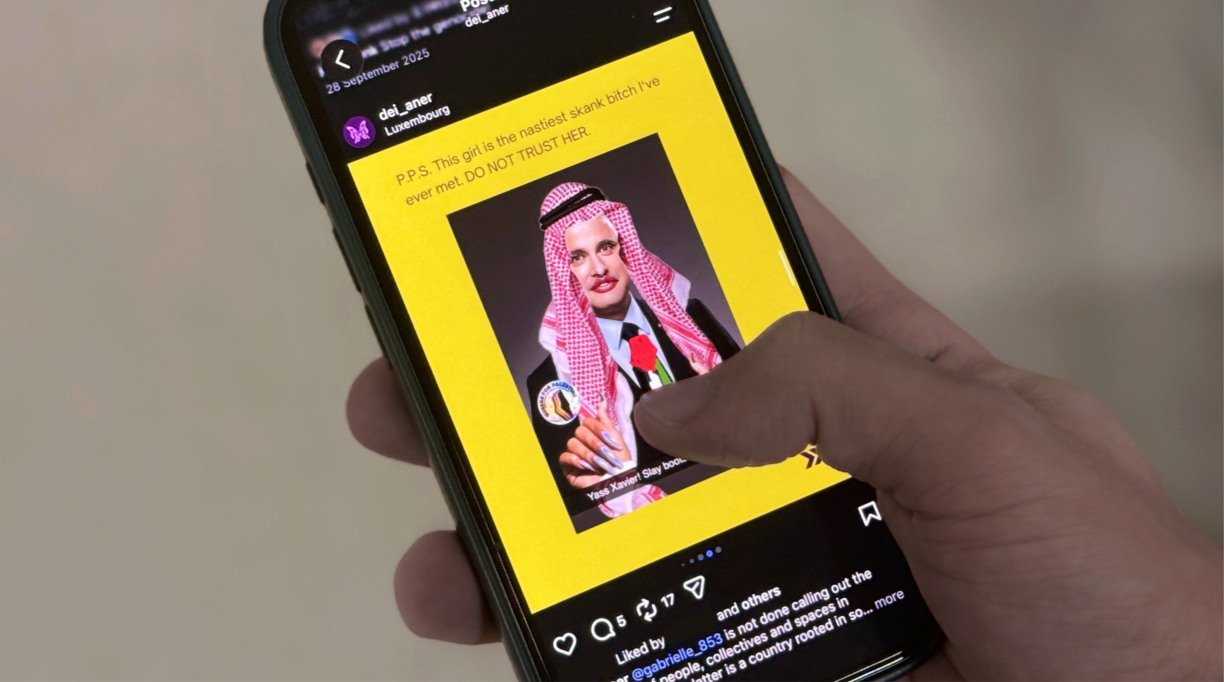
Déi aner, the queer and feminist collective activist Gabrielle Antar founded, was among the most vocal critics in Luxembourg of the government's response to the war in Gaza.
Luxembourg recognised the State of Palestine in September 2025. It was only in July 2026 that approval for Israeli Bonds was dropped, and in September 2026 that a ban on imports from the occupied Palestinian territories was confirmed.
On 26 September 2025, the collective published an article by Antar titled "Silence is complicity, and close to everyone in Luxembourg is complicit".
It decried the lack of "true anti-Zionist" spaces in the country: "We are very aware of your complicity in genocide. Yes, you read that right. Every single one of you who thought you could fade into the background and not take a stance because you didn't want to hurt your business or career—we see you."
The article, and the social media post that accompanied it, ended with a meme. In it, Foreign Minister Xavier Bettel, wearing a keffiyeh and a Palestinian-flag tie, gel nails, false lashes, and plumped lips.
The caption borrows a line from the 2004 comedy Mean Girls: "This girl is the nastiest skank bitch I've ever met. Do not trust her."
Antar might have written the blog post but was not the author of the meme in question.
In the weeks that followed, a video circulated showing Bettel being approached by pro-Palestinian activists while having lunch on a terrace in the capital with Economy Minister Lex Delles and DP MP Carole Hartmann. He was asked about a Luxembourg activist who had been detained by the Israeli military after the interception of a Gaza-bound flotilla.
Bettel replied that he had already commented on the matter, adding: "I'm eating." Someone off camera responded: "Enjoy your meal while other people are starving because you're a war criminal."
After the article, the meme, and the video had been published, the minister spoke out. Focusing mainly on the meme and on Antar, whom he described as "radicalised", he announced he would be taking legal action and donating any damages to an anti-radicalisation organisation.
For weeks, it was unclear who he was targeting: Antar, or déi aner. The ministry said at the time it could not confirm whether action was being taken against the collective or against the activist herself.
Within days, the post had become a national talking point, as politicians, experts, and the public engaged in a discussion on freedom of thought, conscience, religion, opinion, expression, and peaceful assembly or association.
Not everyone understood the pop-culture reference, and some read the portrayal of the minister as a jab at his sexuality. Among them: Paulette Lenert (LSAP), who showed support for Bettel's decision to sue.
In an interview with newspaper Wort, Lenert explained that to her the meme could appear to be mocking the minister's homosexuality, "which is definitely a taboo."
Following the article's publication, 'déi aner' spoke out, shaming Bettel's legal action as "an attempt to impair alternative voices who have chosen to openly criticise him".
The statement firmly rejected accusations of homophobia, explaining that as a queer and feminist collective, it would be categorically against their very foundation to mock anyone's sexuality. To further refute allegations, they added that the "yassified" style of the meme directly originates from queer communities in the United States.
It also clearly noted that Antar was not the artist behind the meme and that the editing of Bettel's image was to criticise the minister's "lack of action and solidarity with other marginalised groups".
The statement ended by raising a question: "Why is it that a writer or activist is considered too radical simply for supporting protests that demand more for people who are being slaughtered daily?"
"Public opinion has been made about me without me having any way to defend myself", Antar said.
At the time, Antar explained that while requests for comment were made, only one publication actually interviewed her: "I just feel like this is a case of an Arab woman who has a voice and we [the press] are not going to give it to her."
In November 2025, the National Women's Council (CNFL) confirmed that Antar, who had worked there full-time, was no longer an employee providing no reason or further details. Antar likewise declined to comment on how the organisation and her parted ways.
RTL contacted the council in November 2026, with the CNFL citing that "the necessary communications regarding this matter were already made", stating that "Out of respect for those involved and in accordance with the confidentiality obligations incumbent upon any organisation" they do not wish to make any further comment.
RTL also spoke to a former CNFL colleague of Antar, but they were reluctant to discuss the circumstances on the record, limiting their comments to Antar's good work at the council.
Since her departure from the CNFL, Antar has been relying on unemployment benefits.
A month later, the question of who Bettel was targeting was settled when police summoned Antar for questioning. The complaint was aimed not at the collective, but at the author of the text.
Finding legal representation also proved a challenge. "A good majority of [lawyers] refused to represent me", she says.
In April 2026 Antar was finally questioned as part of a preliminary investigation. The grounds listed were insulting and assaulting a member of the government in the exercise of his duties (outrage et violences contre un membre du gouvernement dans l'exercice de ses fonctions), stalking (harcèlement obsessionnel), and defamation (calomnie, diffamation), and discrimination.
According to Antar, the stalking offense was not only linked to the meme, but also from an article she wrote about the lunch confrontation.
"We have our right to protest, and he has a legal obligation to prevent genocide, which he has not done", she remarked on the matter.
On reports that the confrontation was allegedly violent, she explained that while there were insults and yelling, there "was no ounce of violence".
The questioning lasted three hours. Throughout, she says, the message was that actions have consequences: "There was a really clear message from the police that Xavier Bettel was extremely hurt by what I did."
According to Antar, the officer told her that freedom of expression has limits, and that "I should have expected consequences for my actions".
"The interrogation really shook something in my core", she added, "he was really adamant about this being such a terrible thing I had committed. I don't have the power or the money to fight such a situation. And I just feel like I have such a lack of agency on my own situation."
Finding new work in Luxembourg proved difficult. "I applied to one job where they basically told me I would not fit their work environment, even though they never interviewed me", she recalled.
RTL spoke to Amnesty International Luxembourg about Antar's case, and the organisation commented that they are concerned about her situation. They also noted that her case is not an isolated one.
Over the past years, the number of requests and testimonies from people who feel their freedom of expression or right to protest was restricted in Luxembourg has been growing, Amnesty noted.
The organisation has since set up a form for people to report possible violations.
Most of those testimonies, Amnesty says, relate to pro-Palestinian activism. People have reported being summoned by police – in some cases on grounds such as incitement to terrorism – being sent to deradicalisation courses, racing court cases, and losing their jobs.
Others say they were named in reports Amnesty considers poorly sourced, such as the RIAL report on antisemitism in Luxembourg, or were told by police what they could and could not say at protests.
Amnesty drew a line on how to distinguish legitimate activism from radicalism stating: "Our perspective focuses on human rights and international law. Legitimate activism promotes human rights and/or a clean, healthy, and sustainable environment without harming the rights of other people."
The public prosecutor's office confirmed to RTL that they would not be pressing criminal charges against Antar. After a year of uncertainty, Antar only received the written confirmation after the public prosecutor's response to RTL.
The letter, however, does not wipe the slate clean. The public prosecutor warns that should Antar's future conduct amount to a criminal offence, it could still lead to public prosecution.
The letter cites three of the original grounds: insulting and assaulting a member of the government, stalking, and defamation.
Discrimination, however, no longer appears in the communication. Sentences range from eight days to up to two years, with fines ranging from 251 to €3,000.
Upon request for comment the ministry said: "To this day, the minister has not been informed of the status of the procedure."
Antar on her side explained that while she's glad it's over, the experience "completely changed my life".


