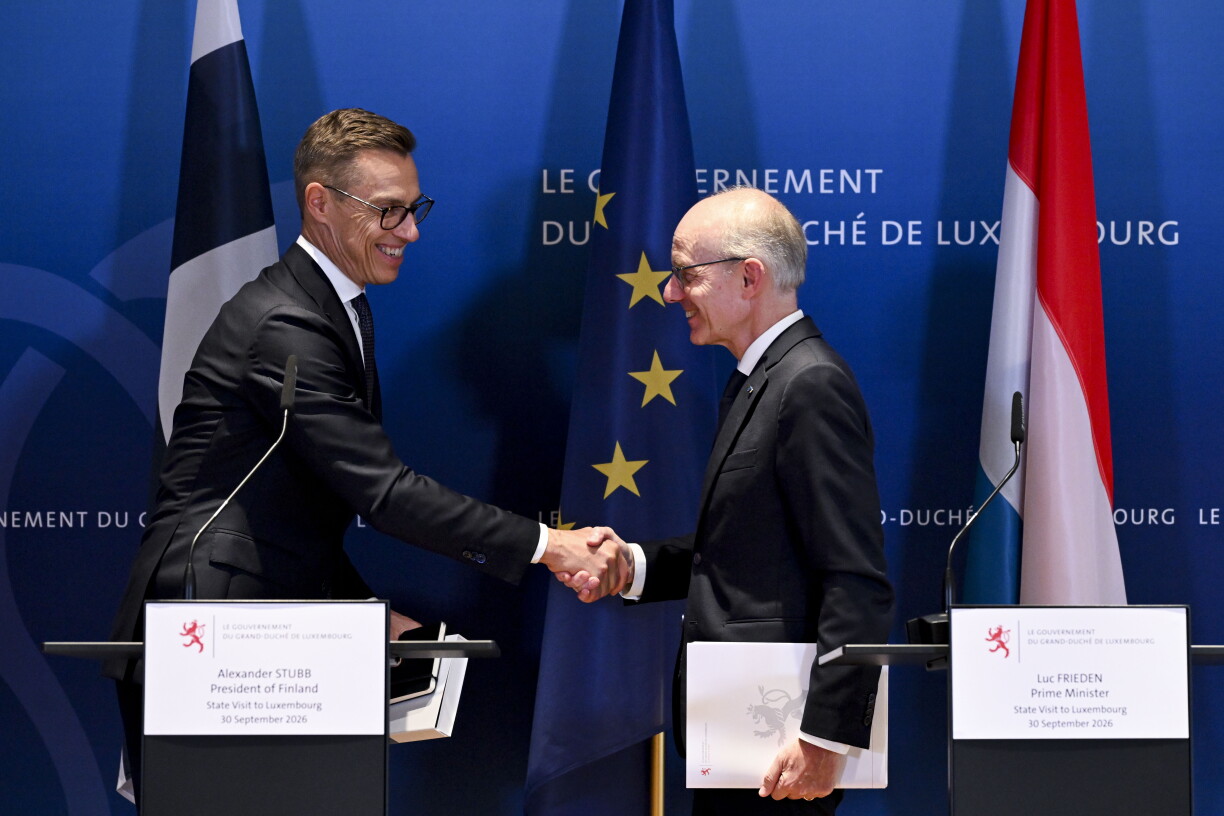
On his visit to the University of Luxembourg on Wednesday, Finnish President Alexander Stubb reminded his audience that there are currently around 65 conflicts around the world, more than at any point since the end of the Second World War.
In Stubb's view, two factors are driving the current moment: the technological revolution we are living through, artificial intelligence, and geopolitics, in which economics and politics have become increasingly entangled.
There were, he said, those whose values rested on great power politics, who therefore believed that a multipolar world of ad hoc coalitions, transactions and deals was preferable to a multilateral world built on institutions, rules and norms. That, he said, was what is playing out today.
Finland and Luxembourg, he added, were among the states that stood up for multilateralism, while others, whom he would not name on this occasion, were trampling international institutions underfoot. In a world where competition was writ large, the current climate was placing a great deal on conflict.
As for the handling of artificial intelligence, Stubb warned that AI would upend many things, from how we live, learn and work to how wars are fought. It was already too late to slow the evolution of AI itself, he argued. People, however, would have to set limits on it.
AI, Stubb said, was of such importance that he put it on a par with a nuclear weapon or a biological virus. It was a race, and if that was the case, then rules and control mechanisms had to be put in place so that the development did not spin out of control.
From the main auditorium of the Maison du Savoir, the group walked over to the Learning Centre at the University of Luxembourg. On the short walk, the Finnish head of state took the time to chat spontaneously with Finnish pupils from the European School, before taking a closer look at research projects in the fields of health, AI, and quantum technology.
The state visit wrapped up at SES, one of the flagships of Luxembourg know-how. Satellite technology is precisely the kind of area in which Finland and Luxembourg want to deepen their cooperation.
SES CEO Adel Al Saleh proudly ran through the group's various projects, including the "méo Sphere" project, a constellation of 18 satellites due to become operational in 2030, through which, for example, missiles can be flagged or the trajectory of missiles tracked.
Stubb was also given a glimpse of SES's control room, from which 100 satellites are managed and steered.
The Russian oligarch Mikhail Fridman, who was removed from the EU sanctions list at Luxembourg's request, drew backing from Stubb at the closing press conference.
As Stubb saw it, the pressure on Russia had been kept up, and Russia was feeling it too. The Fridman case, in his view, was by no means a sign of war weariness, but rather part of a game of "give and take", in which there were moments when a country had to act in its own interest.
That, in the Finnish president's view, was understandable and acceptable.
Stubb even went further, saying it was an exaggeration to conclude from the removal of two people from the sanctions list that this amounted to a form of war weariness. On the contrary, he believed Europe was actually picking up the pace.
Prime Minister Luc Frieden, for his part, emphasised that Luxembourg had strongly backed the extension of the sanctions list.
As the Finnish president had just pointed out, Frieden said, there were around 3,000 people on the sanctions list. The list had been extended by a joint decision of all member states, with no veto from Luxembourg.
The list had now also been extended for three years, which made it considerably more robust. On top of that, Frieden noted, the EU Council had added further names, he thought around ten, just a few days ago.
That, in Frieden's view, showed that Europe was ready to keep imposing sanctions on Russia.





