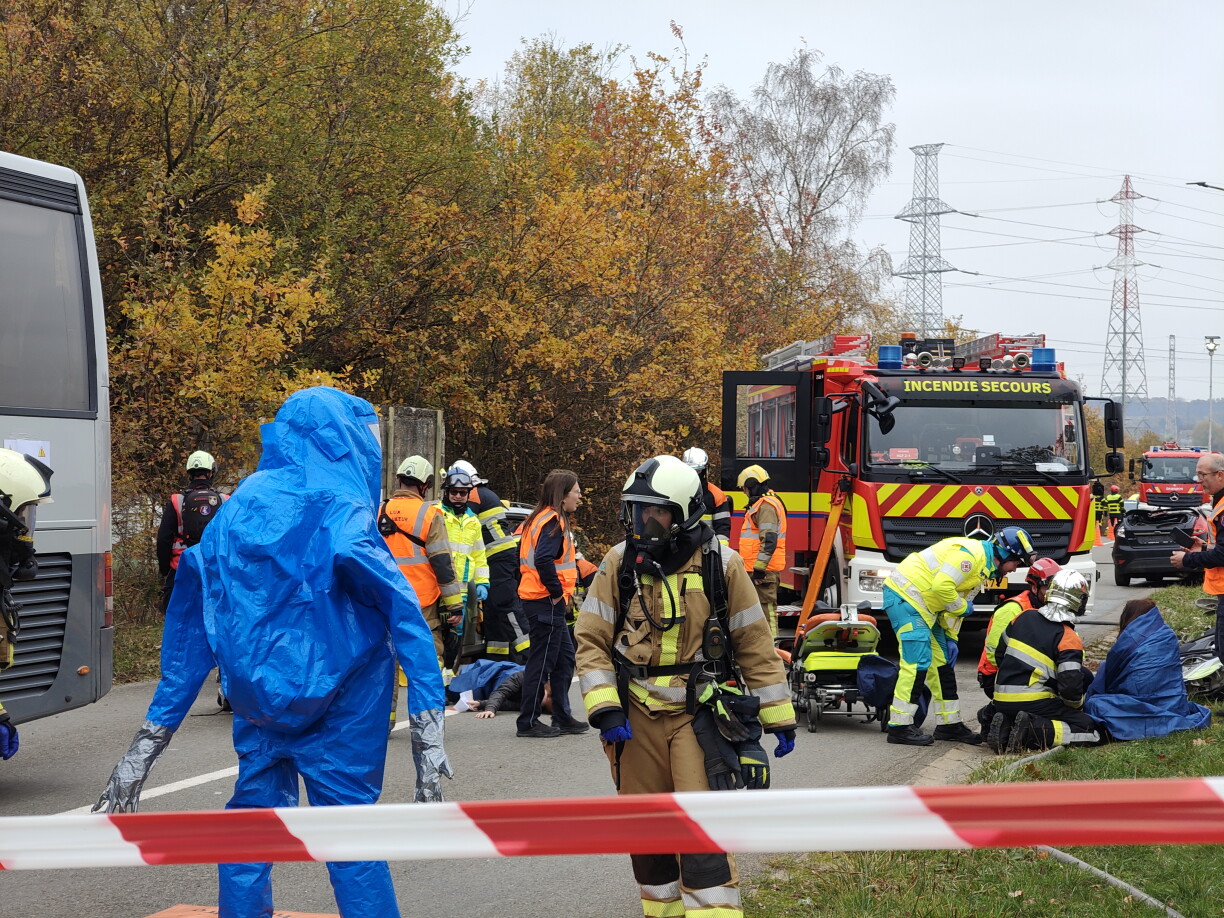
Sirens sounded and specialist teams in protective clothing took up positions in Aubange on Tuesday morning, but not because there was real danger; this was a carefully organised drill intended to be as realistic as possible.
Around 100 emergency personnel and 50 volunteers participated in the exercise, which simulated a major emergency incident.
While teams were active on the ground, command was centralised at the crisis centre in Libramont, where all information was gathered and coordinated under the direction of Olivier Schmitz, Governor of Belgium’s Province of Luxembourg.
This exercise involved a scenario with two separate incidents occurring in close proximity. First, a school bus crash causing multiple injuries among pupils, and further away, a lorry transporting chemicals was involved in a collision, bringing with it the added risk of chemical pollution.
But why this scenario and what risks is the region truly preparing for?
Schmitz explained that the region must prepare for both risks linked to climate change, which form the basis for emergency planning, and those associated with the dense network of motorways, railway lines, and freight routes passing through the area.
Heavy daily traffic on the motorways alone presents a significant risk, which needs to be addressed through such exercises, Schmitz highlighted.
Major accidents can easily cross borders, so teams from France and Luxembourg were also involved. Officials highlighted that cross-border cooperation has become much more effective thanks to existing agreements between rescue services and authorities.
In the past, support would have had to come from elsewhere in the province, costing precious time, whereas now, coordination with Luxembourgish and French teams offers a significant advantage.
The exercise also underscored the increasing importance of social media in crisis management. On one hand, these platforms allow crisis centres to receive valuable information from the public and thus help authorities form a clearer picture of the situation.
On the other hand, they provide a rapid means of issuing warnings and instructions to affected residents. However, reaching the population effectively, especially across national borders, remains a challenging task.
Coordinating communication during incidents, such as a chemical cloud requiring public warnings in both France and Luxembourg, is particularly complex, Schmitz continued.
Each country retains a degree of autonomy, both political and in public messaging, which can make uniform communication difficult.
To address these challenges, officials believe that further strengthening shared procedures is essential. This includes establishing very direct communication channels, such as dedicated phone lines, building personal relationships between counterparts in each country, making joint decisions, and directly connecting crisis centres.
Such practical measures can help ensure an effective and unified response.
Tuesday’s disaster simulation in Aubange was only a drill, but the experience will help emergency services across all three countries work more closely in future real-life incidents.
Additional joint exercises are already planned in the Province of Luxembourg and beyond.


