Organic farming is being championed as a key solution for better preventative health, according to campaigners.
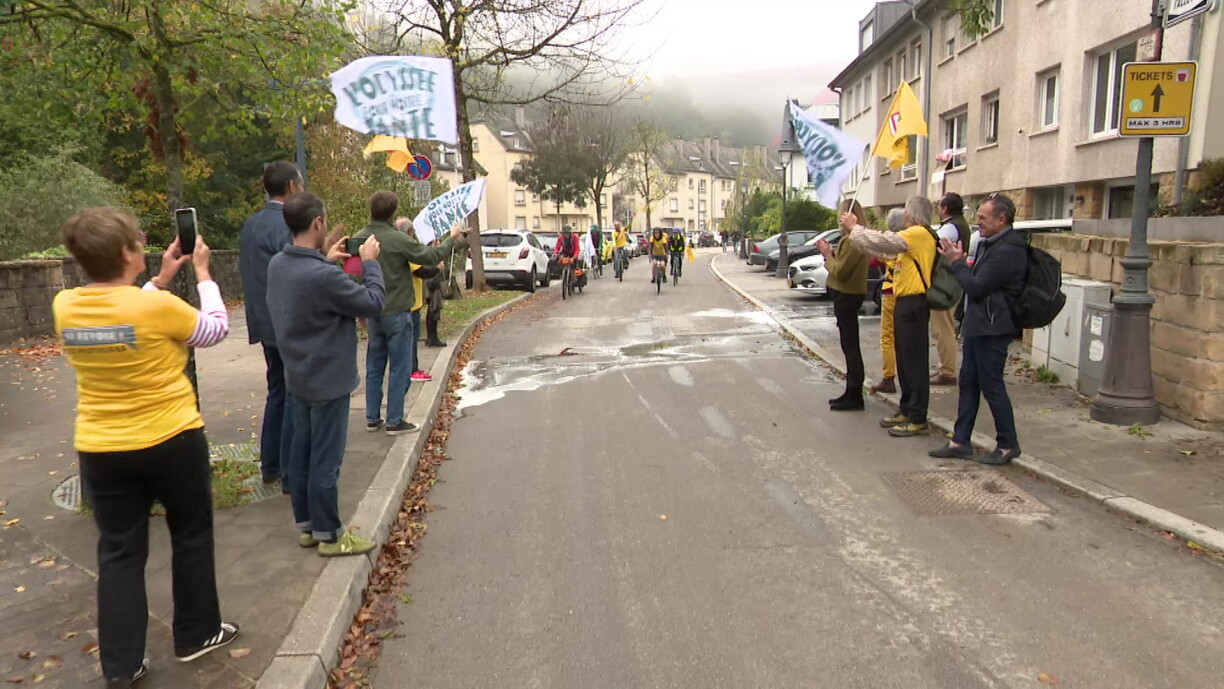
The Odyssey for our Health began in northern France and passed through Belgium before arriving at the Ökozentrum Pfaffenthal on Wednesday, 14 October. Some participants made the journey by bicycle, while most wore the distinctive yellow t-shirts of the 'Soutien aux victimes des pesticides' collective, which campaigns on behalf of people harmed by pesticides.
One of those taking part is Denis Benoit, who spent 10 years working in fruit production for a cooperative which, he says, prioritised quantity as well as quality. He recalls widespread use of pesticides, insecticides, fungicides, and herbicides. At the age of 59, he was diagnosed with prostate cancer, a disease officially recognised in France as an occupational illness for agricultural workers exposed to crop protection products.
Similarly, landscape gardener Daniel Bodénès joined the group for the Luxembourg leg of the journey. He suffers from Parkinson’s disease, a condition which has also been recognised as an occupational illness by his health insurer. Notably, his colleague and business partner received the same diagnosis just a year earlier.


Professor Dr Rejko Krüger, a Parkinson’s expert and researcher at the Luxembourg Institute of Health says that, by now, it is clear that there are environmental toxins, including pesticides, that are sufficient to trigger Parkinson’s disease.
He explains that these toxins are selectively absorbed by nerve cells affected by Parkinson’s, which normally is a process that, as an accelerated form of ageing, impairs cell function. The toxins specifically damage the cell’s ‘power plants’, crippling their ability to function and ultimately leading to cell death.
Martin Rieussec-Fournier, president of the Association Mutuelles pour la Santé Planétaire, which brings together 20 French and Belgian health mutuals, warns that the entire French population has been poisoned by pesticides, which are contributing to a rise in disease in France, particularly cancer across all age groups. He warns that more and more young people are dying from cancer; breast cancer is also increasing significantly, which is why the roots of disease – pesticides – are a clearly identified cause and must be tackled.
Despite mounting evidence, more research is needed into the cancer-causing effects of pesticides. Dr Guy Berchem, president of the National Cancer Institute, explains that for the past 10 to 15 years, epidemiological studies have shown a small increase in prostate cancer, as well as certain blood cancers like lymphomas or leukaemia, in people exposed to pesticides.
Among groups with particularly high exposure, the risk is elevated by 10 to 30%, and in some studies, even up to 50% compared to the general population. However, Dr Berchem stresses that these numbers are relatively low overall, but still advocates for adopting a precautionary principle to minimise exposure as much as possible.
This is especially important as the extent to which pesticides in our environment, food, and groundwater contribute to cancer rates remains unclear. The risk of breast cancer among young people has increased considerably over the last 30 years, but the precise causes are unknown.
Dr Berchem emphasises that he does not unequivocally blame pesticides; however, they are influences of some sort and have an effect, much of which remains unknown.
Blanche Weber, president of the Ecological Movement (Mouvement Écologique), is calling for politicians to finally recognise the scale of the problem. She argues there is a wide gap between rhetoric and real action.
Weber argues that authorities often claim that the issue of pesticides is being taken seriously and that they are doing everything possible to reduce their use. However, the countless analyses, including those carried out years ago by the Ministry of Health on children’s hair, reveal that the population as a whole remains exposed to pesticides.
For both the Ecological Movement and the Odyssey for our Health campaigners, organic farming is the path towards more effective prevention. Weber emphasises the essential role of prevention, stressing that the French health insurers participation points to their aim to ultimately reduce their costs. Hence, she argues that every euro invested in organic farming today will save costs down the line.
Campaigners warn it would be unacceptable for the proposed Omnibus legislation at EU level to simplify the authorisation of pesticides, with some products potentially being approved for much longer periods than before.


