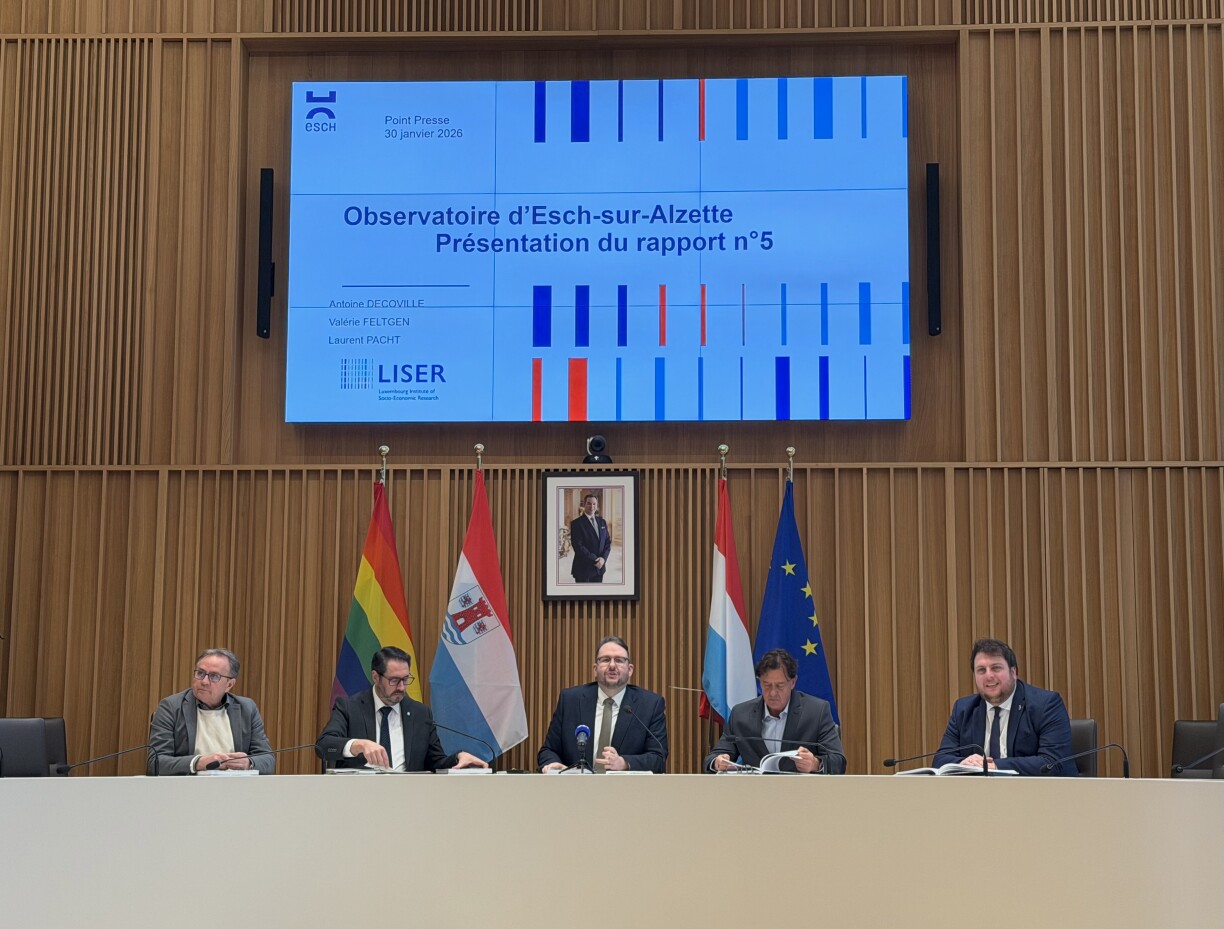
A new study commissioned by the municipality of Esch-sur-Alzette has highlighted significant trends in growth, the housing market, and rising inequalities within the city.
The report, titled the Social Observatory 2025 and produced by the Luxembourg Institute of Socio-Economic Research (LISER), provides a four-year review of the city's development. This regular publication tracks key indicators across themes such as housing, the job market, and social issues. The latest edition offers a detailed analysis of how various social phenomena are distributed across different neighbourhoods and demographic groups.
The data paints a picture of a municipality confronting a range of structural and social challenges that have intensified in recent years. The Observatory's analysis is based on 52 indicators spread across nine major themes, from demography and housing to health.
Following a brief downturn during the Covid-19 pandemic, Esch's population has resumed growing, a trend primarily driven by migration that is also making the city younger. According to Laurent Pacht from LISER, the city saw a demographic recovery between 2022 and 2024, with an increase of 1,280 inhabitants – an annual growth rate of 2%. This places Esch's growth roughly on par with the national average. Researchers noted that nearly all of Esch's neighbourhoods have gained population, particularly among families, young professionals, and students living in flats.
This growth has further strained an already tense housing market. While the supply of affordable housing is increasing, demand is rising faster, leading to longer waiting times. Although housing prices have fallen, this has not translated into a higher volume of sales, a trend attributed in part to sharply rising interest rates.
Valérie Feltgen from LISER explained that this is not a phenomenon unique to Esch but reflects a nationwide challenge. She noted that rental prices in Esch have increased largely because the properties available are extremely small. "The smaller the properties, the higher the price per square metre," Feltgen stated, pointing out that smaller units in Esch command prices around €32 per square metre, compared to €47 per square metre in Luxembourg City.
Despite an overall rise in average incomes, the report documents a widening of inequalities across neighbourhoods, nationalities, and gender. These disparities are underscored by a growing reliance on social support, with more than a quarter of the population now receiving the cost-of-living allowance and demand at the Social Welfare Office having increased sharply.
These social inequalities have a direct correlation with public health outcomes. The study finds that in less privileged neighbourhoods, issues such as childhood obesity and incomplete vaccination rates are observed more frequently, indicating a close link between social conditions and health from an early age.
In response to the report's findings, Esch's municipal council has announced its intention to develop targeted measures to address these challenges.
Mayor Christian Weis acknowledged the severity of the situation. "It's a worrying situation, because if you want to have good social cohesion and good community spirit in a city, it's simply important to have a certain level of equality," he stated.
He added, however, that the data also brings a degree of clarity and that it is a form of comfort to know the city's social services are being accessed by residents in need.





