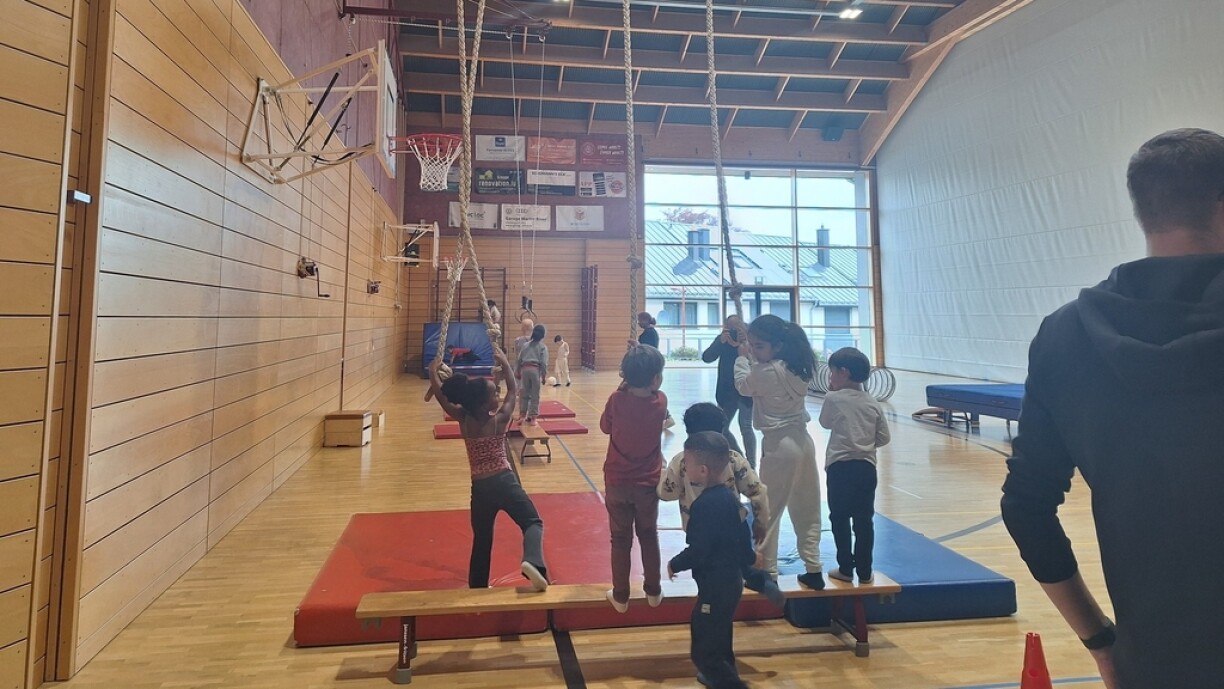
Mobile phones are already banned in primary schools, and secondary schools are now required to implement clear policies on mobile phone use. The focus is also shifting to after-school care facilities, known locally as maison relais, where the aim is to strike a better balance between screen time and real-world activity. To support this, the Ministry of Education, Children, and Youth has launched a new campaign that puts physical movement and sports front and centre, encouraging children to spend less time in front of screens.
The campaign has a clear objective: to embed daily physical activity into the routine of children in after-school care facilities.
In a world where screens demand increasing amounts of children’s time and attention, the Ministry wants to counteract this trend by promoting daily physical activity in every maison relais – through sport, movement, and exercise.
Under the campaign slogan “Screen-Life Balance, manner Ecran, méi Beweegung” [ed. note: 'less screens, more movement'], facilities will be encouraged, starting from the next school year, to offer two movement-based activities each day, including during school holidays.
To see how this is already being put into practice, Education Minister Claude Meisch is currently visiting three maisons relais, located in Wiltz, Mondercange, and Bissen, that already offer two daily sports sessions. These visits are intended to show that such activities are not only feasible but also highly motivating for children.
In Wiltz, the programme is known as 'Aktiv Wooltz', an initiative by the association Kannerhaus Wooltz. The focus here is on non-competitive activities designed to foster enjoyment and physical development rather than performance. Children can choose from activities such as trampolining, gymnastics, volleyball, cycling, swimming, and obstacle courses. When asked which they preferred – sport or smartphones – opinions among the children were mixed.
Carmen Schmit, deputy head of the maison relais in Wiltz, explained that children there are not allowed to use mobile phones during their time at the centre. "When they arrive, they hand in their phones straight away", she said, adding that sports are a popular part of the daily programme and that the sports workshops are always well attended. According to her, there’s little demand for tablets or smartphones, particularly from Cycle 3 pupils, who are the ones required to hand in their devices.
In Mondercange, the maison relais collaborates with local sports clubs to introduce children to a variety of sporting disciplines. Meanwhile, in Bissen, the centre works closely with the Luxembourg League of Primary School Sports Associations (LASEP) to integrate physical activity into children’s routines through playful, engaging approaches.
All three initiatives reflect a shared mission: to make movement a natural and essential part of daily life in after-school care. According to the Ministry, regular physical activity benefits not just children’s physical wellbeing, but also their emotional, cognitive, and social development, especially in a world increasingly shaped by digital habits.






