Luxembourg's PISA results rang alarm bells for teachers, parents, and lawmakers alike. The Centre de Logopédie (CL), Luxembourg's speech therapy centre, now weighs in on the debate, illustrating how reading difficulties do not just begin at school.
The first years of a child's life are extremely important for language development. So what can be done to prepare children better for school?
The answer, in principle, is a simple one: play together more, read, cook, tidy up. What one actually does matters less than the fact that it is done together, with real interaction with the child and, crucially, without constant distraction.
Keyword here: the smartphone. What sounds obvious is not always so easily put into practice. Time, in Marc Schmidt's view, is a big problem, since parents are often not with their kid as much.
The director of the Centre de Logopédie (CL) also points out that smartphones play a major role. Sometimes, he said, it would make more sense to put the phone away. But the issue is a societal one.
The figures from the centre show a clear trend of their own. Nearly 3,000 children are now treated in the outpatient clinic, almost double the number from the 2018/19 school year.
The number of specialised diagnoses has also risen. Here, various professionals work with the children for two weeks on school matters, while a diagnosis is drawn up at the same time.
The number of such diagnoses has tripled since the 2017/18 school year. In the field, Schmidt notes, specialists are also seeing not only language development issues in children, but often also difficulties with concentration or listening.
Where a congenital disorder is involved, or in cases of serious language development problems, children can also be schooled at the centre itself.
Most of them, Schmidt explained, can then be integrated into a mainstream school after the equivalent of what used to be the second year.
Targeted support can therefore help children to improve their academic performance. Certain skills, however, are best developed at a very young age, in particular picking up a first language, whichever it may be.
If a solid foundation of this kind is lacking in one or perhaps two languages, becoming literate later on in a foreign language such as German or French becomes much harder.
To learn one or more first languages well, plenty of interaction is needed. And once again, that brings things back to play.
The problem, as already noted, is not an individual one but a societal one. Time is scarce, and so, too, is the time to do something with the children.
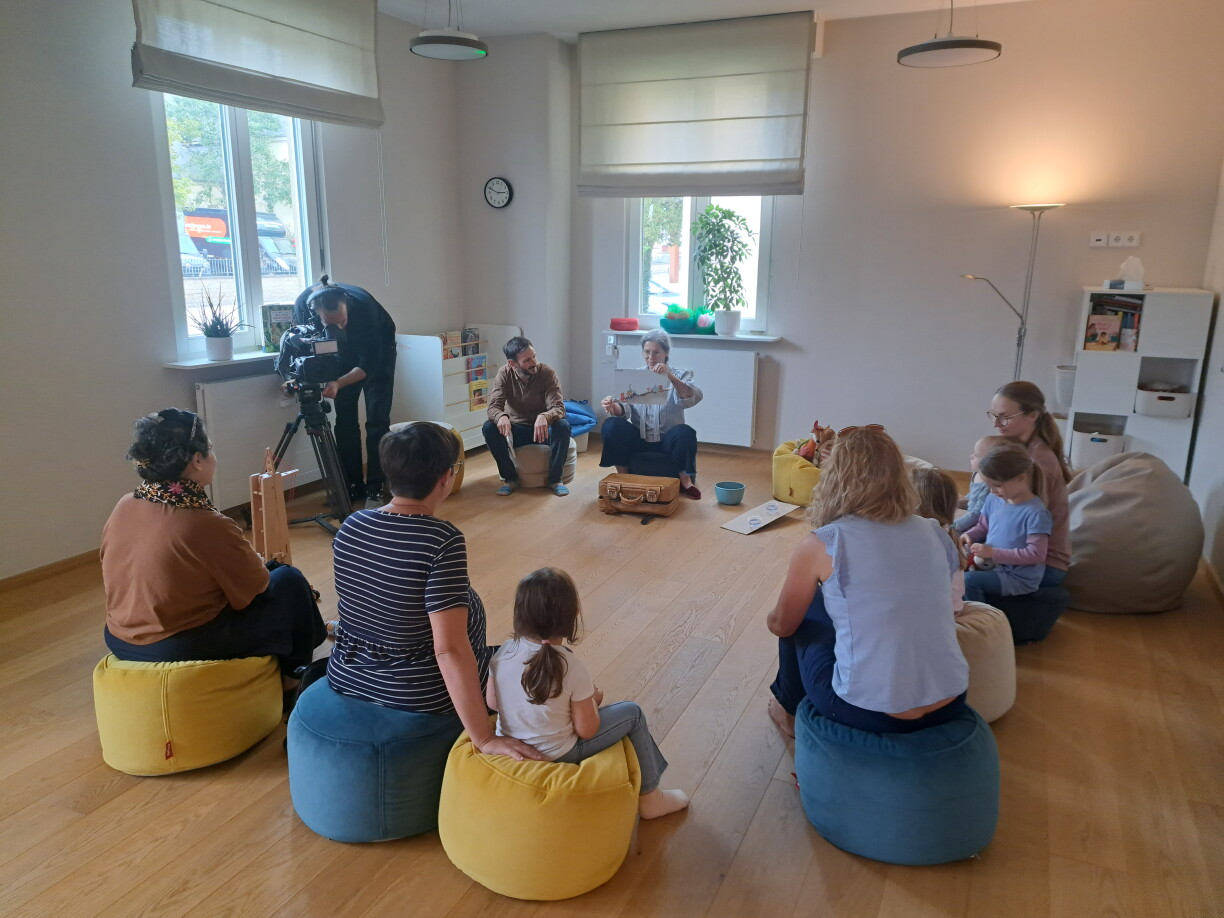
Outside the home, however, things often go better, as Renée Fretz, coordinator for the structures at the centre, pointed out in the parents' forum. Life without play, she said, is not really possible, and yet parents forget this. As adults grow up, they forget how to play, because they are so caught up in everything else, she continued.
At the parents' forum, she noted, parents naturally join in, dancing, doing crafts or singing, because they are not worried about using their time to get chores done at home.
Both children and parents can take home the ideas sparked by these activities. Fretz insisted that the end goal is not to read aloud flawlessly or constantly serve up a full menu of pedagogically valuable activities.
It is often the simple experiences that stay with children. Thinking back to what one personally enjoyed doing as a child, she added, is often where the best ideas come from.





