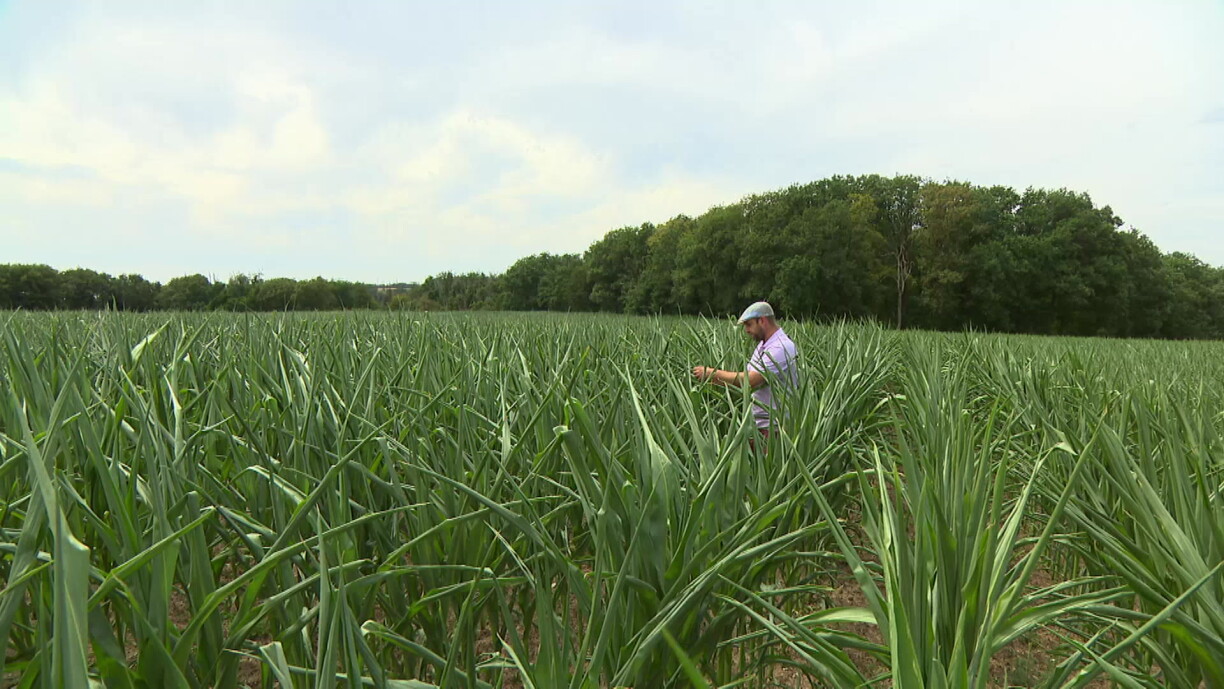
Luxembourg's farmers are facing growing pressure from the prolonged dry spell, with crops already showing clear signs of water stress and concerns mounting over the months ahead.
Corn fields are suffering particularly badly, while farmers are also expecting significant losses in winter crops. Unless enough rain falls in the coming weeks, the consequences could eventually be felt in livestock farming as well.
For farmer Christian Hahn of Roodt near Ell, the situation is clear. The effects of the past few weeks are immediately visible in his fields: corn leaves are curling, their tips are turning brown, and the plants are developing far more slowly than usual.
"We have had roughly half the normal amount of rainfall over the past two months", he explained, adding that the situation was particularly problematic on lighter soils. Although some moisture reserves remained after the winter, they were now being depleted increasingly quickly, he said. "So far, we have had almost no rain at all in July."
The drought has also arrived earlier than in previous years, and at a particularly sensitive stage in the corn-growing cycle. The plants should now be developing their tassels, which later pollinate the ears. If growth is stunted by a lack of water, far fewer kernels may form.
The effects of the drought have already been visible in fields for several weeks. Winter crops such as wheat and barley were harvested significantly earlier than usual this year, which Hahn said was not a good sign.
"The grain was forced to dry out", he explained. As a result, kernels remain smaller and also lose quality. Initial estimates point to losses of between 25% and 30%. The situation for corn could prove even worse.
"Unless something changes soon, plants could start dying", Hahn warned. "It is still too early to give definitive figures, but the losses could be even greater than for winter crops."
Farmers are now pinning their hopes on the weather, but a few litres of rainfall will no longer make much difference.
"If we get five litres per square metre now, that will achieve almost nothing", Hahn said. "What we really need is a sustained period of rain with substantial amounts."
Forecasters have repeatedly predicted rainfall in recent days, but it has continually been pushed back. For farmers, time is increasingly running out.
The drought is not only affecting harvests but could also have serious consequences for livestock farming. Corn is one of the most important sources of winter feed for cattle.
"If we really end up with only half the corn crop, then we will also have only half the feed for the winter", Hahn warned. That could force some farmers to sell or slaughter beef cattle before winter because they can no longer guarantee sufficient feed supplies, according to Hahn.
Hahn added that milk production could also suffer in the heat. He explained that dairy cows generally produce slightly less milk during periods of high temperatures, while prices for cattle destined for slaughter have also come under pressure in recent weeks.
Ordinarily, farmers could compensate for shortages by buying additional feed from France, Germany, or elsewhere in the Greater Region. But that may prove difficult this year.
"The news from neighbouring countries is not good either", Hahn said. "If their harvests are just as poor, there will also be less corn and less animal feed available there." That would not only mean reduced supply but could also lead to significantly higher prices.
For Hahn, this summer highlights the growing importance of diversifying farms. After two exceptionally wet years, Luxembourg is now facing another extremely dry season.
"It is becoming increasingly important to grow different crops", he said, explaining that losses in one crop can then be at least partially offset by others. But even diversification has its limits when an entire region is suffering from a lack of water.
For now, however, hope has not been lost. If enough regular rain falls in the coming weeks, corn crops could still partially recover. But if the drought continues, this summer could become one of the most difficult in recent years for many of Luxembourg's farmers.





