
Last year saw nearly one million people worldwide become US dollar millionaires – the equivalent of 2,600 people a day, according to the bank's estimates.
The United States accounted for almost half of new millionaires in 2025, adding more than 440,000 individuals, followed by China, Japan, Germany, Britain, and France, which each count more than two million millionaires in total.
Switzerland's biggest bank, which is among the world's largest wealth managers, produces the annual UBS Global Wealth Report, which assesses personal wealth trends.
It covers all financial and non-financial assets, primarily property, minus debts, with asset values converted into dollars.
"The real story is one of continued expansion: more people moving up the wealth ladder", the report said.

"The gains... point to a world that kept building wealth, deepening its affluent population and extending a long-running upward trend."
UBS said that in 2025, global personal wealth rose by 10.8% in dollar terms, significantly outpacing growth seen in 2024 (4.6%) and 2023 (4.2%).
Wealth growth was strongest in Europe, the Middle East and Africa, at 17.5% – helped by a weaker dollar – followed by the Americas at 8.5%. Asia‑Pacific recorded growth of 5.9%.
Over half of global personal wealth remains concentrated in the United States and mainland China combined.
Since 2020, South Korea has led growth in real average wealth per adult across the 56 analysed markets, with gains above 50%. There have been increases above 25% in Croatia, Norway, Latvia, Taiwan and Bulgaria.

Switzerland tops the list, with an average net worth per adult of $910,382, followed by the United States on $696,277 and Luxembourg on $654,732. France comes in 15th, with an average net worth of $341,359, behind Germany on $346,613 but ahead of Taiwan on $332,533.
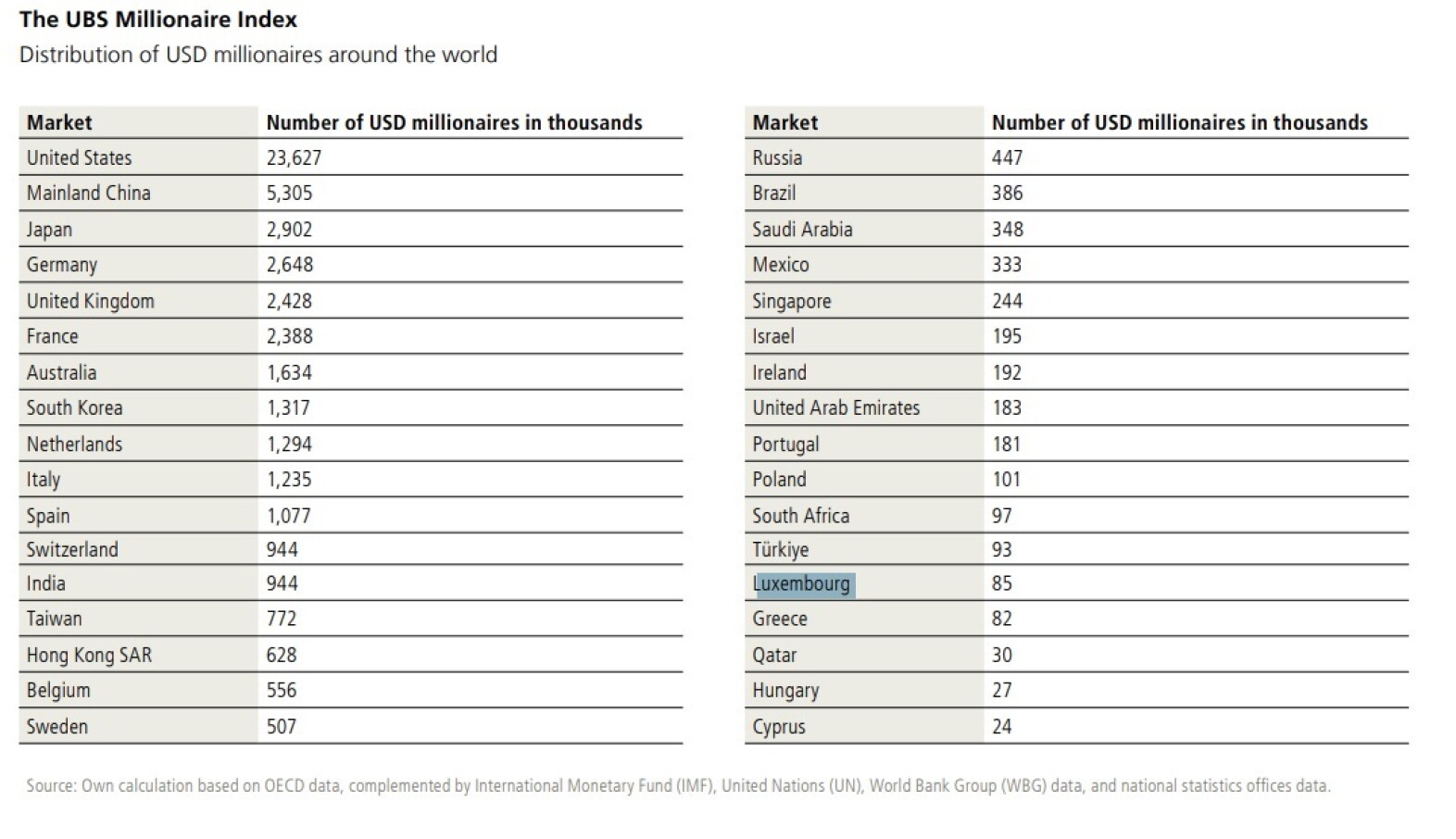
UBS also estimates the number of millionaires in each country. The top three are the United States with nearly 23,627,000 millionaires, followed by China with 5,305,000 and Japan with 2,902,000. Germany ranks 4th with 2,648,000 millionaires, France 6th with 2,388,000, Belgium 16th with 556,000, and Luxembourg 30th with around 85,000.
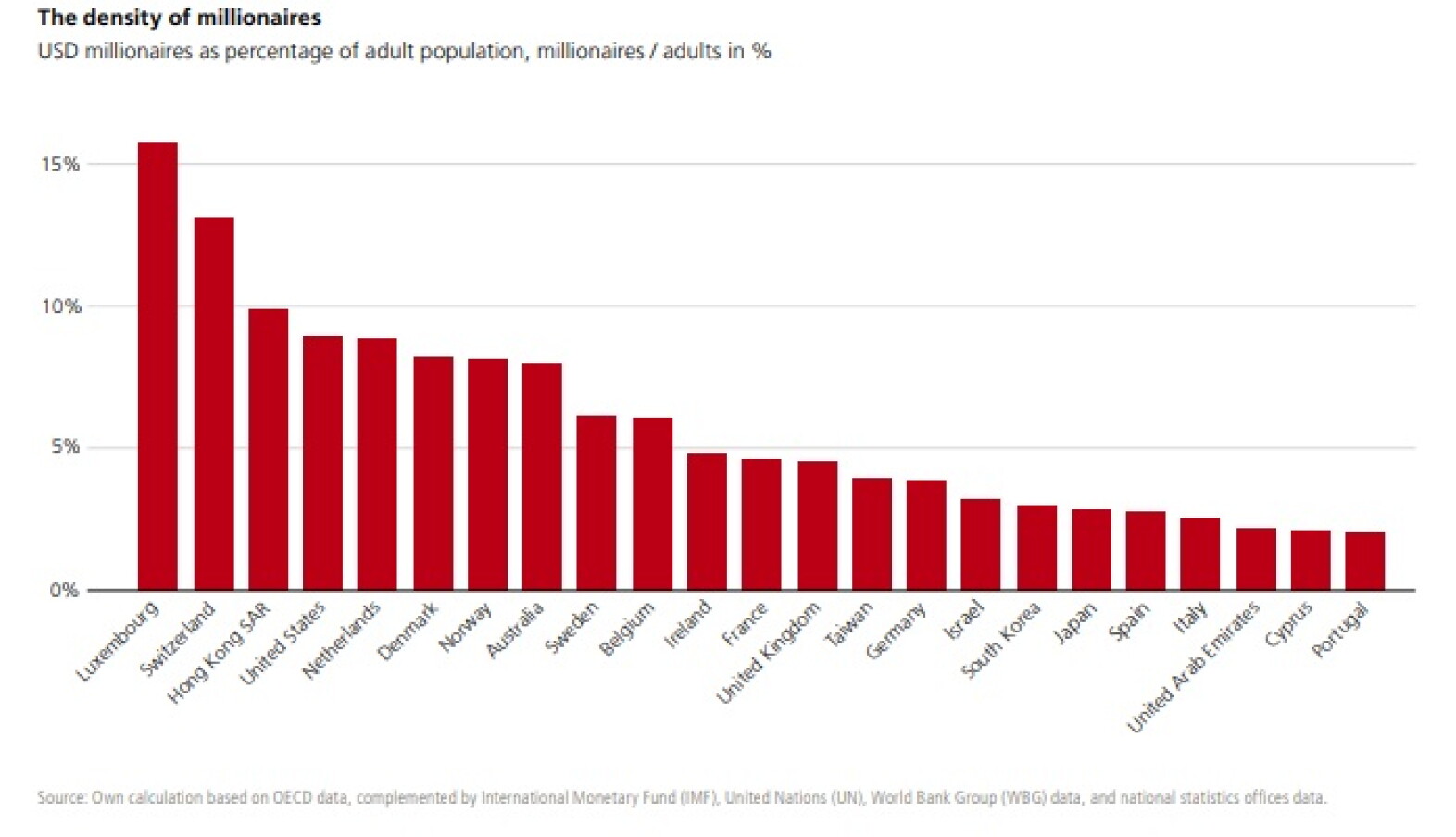
That 30th-place ranking, however, masks another reality. Given that on 1 January 2025 the Grand Duchy of Luxembourg counted close to 680,000 inhabitants, the figure means that almost one in ten people, or around 12%, in Luxembourg are millionaires.
Narrowing the count down to the adult population alone, Luxembourg even sits atop the podium. UBS writes that the previous year's report had pointed out that more than one in seven adults were millionaires in dollars in Luxembourg and Switzerland, but that in fact in Luxembourg the ratio is now closer to one in six by the end of 2025, making it a world record, ahead of Switzerland and Hong Kong.
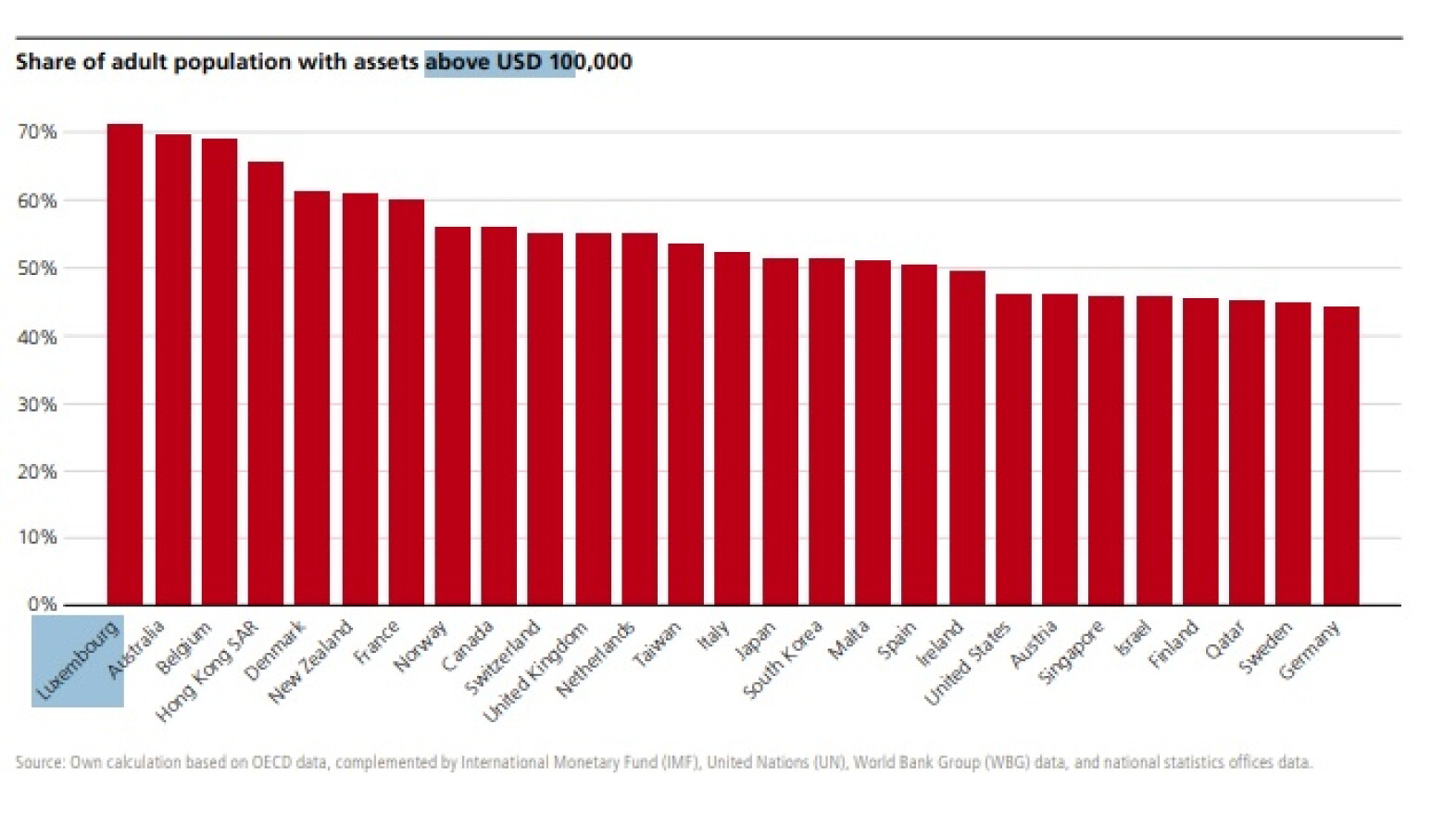
Luxembourg has also broken another record, namely the share of its adult population with assets exceeding $100,000. More than 70% of residents fall into this category, ahead of Australia and Belgium.


A study published earlier this month by Capgemini found in similar vein that the number of millionaires worldwide and their combined wealth continued to climb in 2025, reaching new records. After a dip in 2024, the number of millionaires in Europe rose by 6.5% in 2025, and by 13.5% in Luxembourg.
The number of millionaires in a given market does not always reflect its size, its economic clout or even its average level of wealth per capita, UBS notes, since this depends largely on factors unrelated to economic power, such as home-ownership, private retirement savings, and the existence of tax incentives for saving and investing.
In other words, it can come down to the prevailing investment culture. By that yardstick, Luxembourg appears to have hit the right formula.





