
Cannabis buds marketed as containing THCA are being sold in Luxembourg through a company specialising in hemp products, raising questions about legality and safety. While CBD (cannabidiol) is a non-psychoactive compound permitted under strict conditions, THCA (tetrahydrocannabinolic acid) is a precursor to THC, the main psychoactive substance in cannabis. Though THCA itself does not produce a 'high' in its raw form, it converts into THC when heated. We conducted a sample test and notified the relevant authorities as well as the company that distributed the product.
These types of products have been available abroad for several years, often taking advantage of THCA’s non‑psychoactive status despite its easy conversion into THC when smoked, baked, or vaporised. In some jurisdictions, this places THCA in a legal grey area, but this is not the case in Luxembourg.
Upon our request for comment, the Ministry of Health said it was not aware of THCA products being sold in Luxembourg, adding: "Products containing THC are classified as narcotics and are therefore illegal."
The Ministry of Economy, on the other hand, stated that cannabis products are subject to strict regulation, especially when containing THC, and that this also applies to THCA. Their sale, possession, or distribution is prohibited, except in strictly regulated cases such as medical use or domestic cultivation of cannabis. The tobacco tax stamp found on the packaging is issued by the Registration Duties, Estates and VAT Authority (AED), the Ministry of the Economy clarified after the publication.
While CBD products can be commercialised with a low THC content, below 1%, and CBD‑containing edibles can be sold under the EU novel foods regulation with prior authorisation, the sample we tested did not match what was advertised.
RTL Today obtained a product labelled as THCA cannabis from one of the vending machines and brought it to Pipapo, a service run by the NGO 4motion that focuses on safer partying, drug use and sexual practices. As part of its harm‑reduction approach, Pipapo offers drug‑checking through its Pipapo DUCK service.
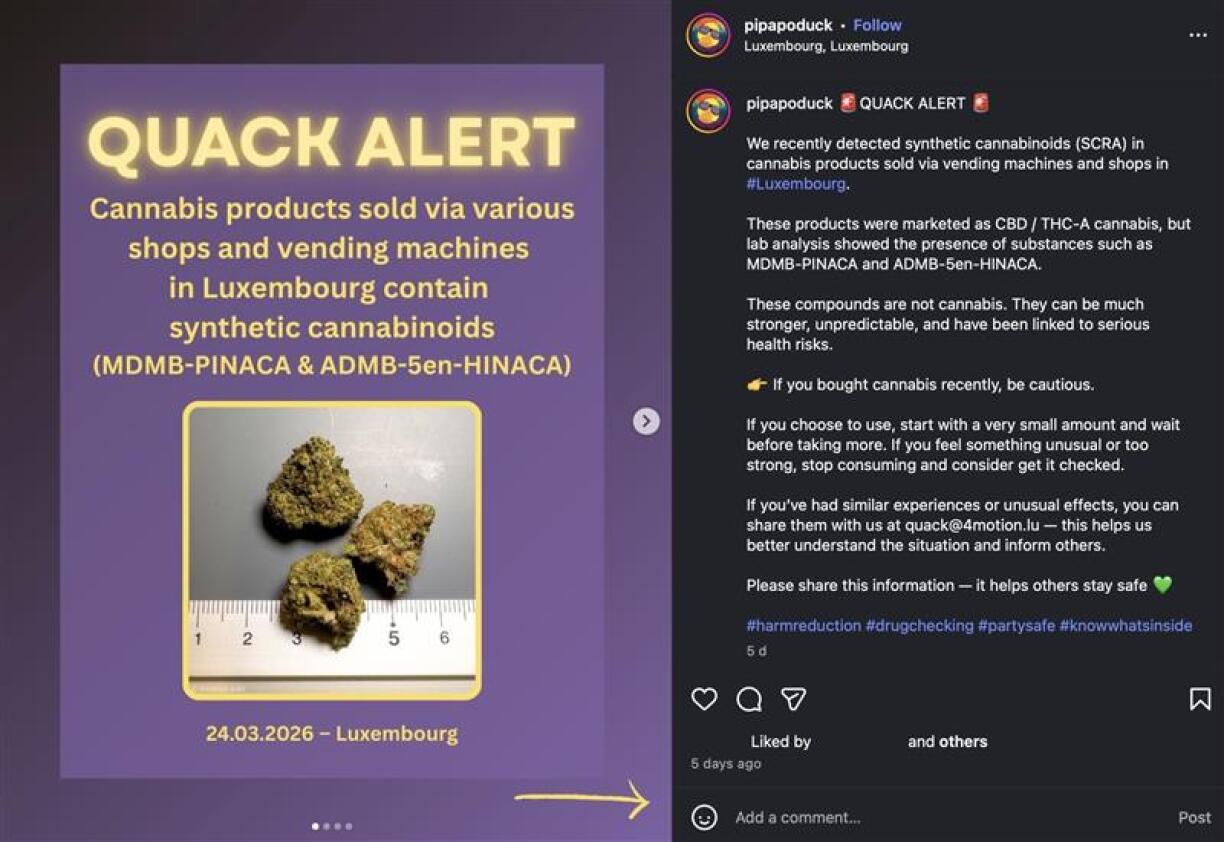
The sample, AED's tax stamp and the usual "Smoking this product is harmful to your health" label, came back with a major warning.
In its results report, Pipapo states that the sample was not THCA cannabis: “It is actually CBD cannabis that has been mixed with synthetic cannabinoids.” So, instead of the alleged “harmless” predecessor to THC, the product turned out to be CBD, which is legal in Luxembourg under certain conditions, sprayed with illegal and harmful substances.
Alongside an unknown concentration of CBD, some traces of THC and one unknown substance, the synthetic cannabinoid that stood out was MDMB‑PINACA, a highly potent lab-made compound that mimics THC but carries significantly higher risks.
In the sample report, Pipapo underlines the dangers linked to consumption: “These substances are highly potent and can bring very unexpected risks.” These can include nausea, change in blood pressure, cramps, panic or even acute psychosis. Pipapo also points out that, due to unequal distribution of the sprayed substances, it is easier to consume an overdose adding that there have been deaths linked to synthetic cannabinoids in Europe.
Like most of their natural counterparts, synthetic cannabinoids are illegal in most European countries and are part of a broader group of substances used to exploit legal loopholes where they are not yet explicitly banned. With effects similar to natural cannabinoids like THC, they can be 50 to 100 times stronger.
What is clear is that neither THCA nor synthetic cannabinoids are allowed to be sold in Luxembourg. What remains unclear is how such products, sold as THCA cannabis, ended up containing synthetic cannabinoids and still reached consumers through vending machines.
In response to our request for comment, the manager of the company allegedly linked to the product’s sale said that all items offered “are sourced from established suppliers and are accompanied by laboratory analyses. In addition, we systematically verify batches before making them available for sale,” stressing the company’s commitment to regulatory compliance and product safety. They added that “any product that raises uncertainty or does not fully meet our internal standards is immediately withdrawn from sale as a precaution.”
Addressing the legal status of the products, the company stated: “At no point do we knowingly sell products containing illegal or synthetic substances. Any potential irregularity would be treated with the utmost seriousness and investigated accordingly.” They also claim that, at this stage, they have not received documentation confirming a verified link between the tested sample and their business.
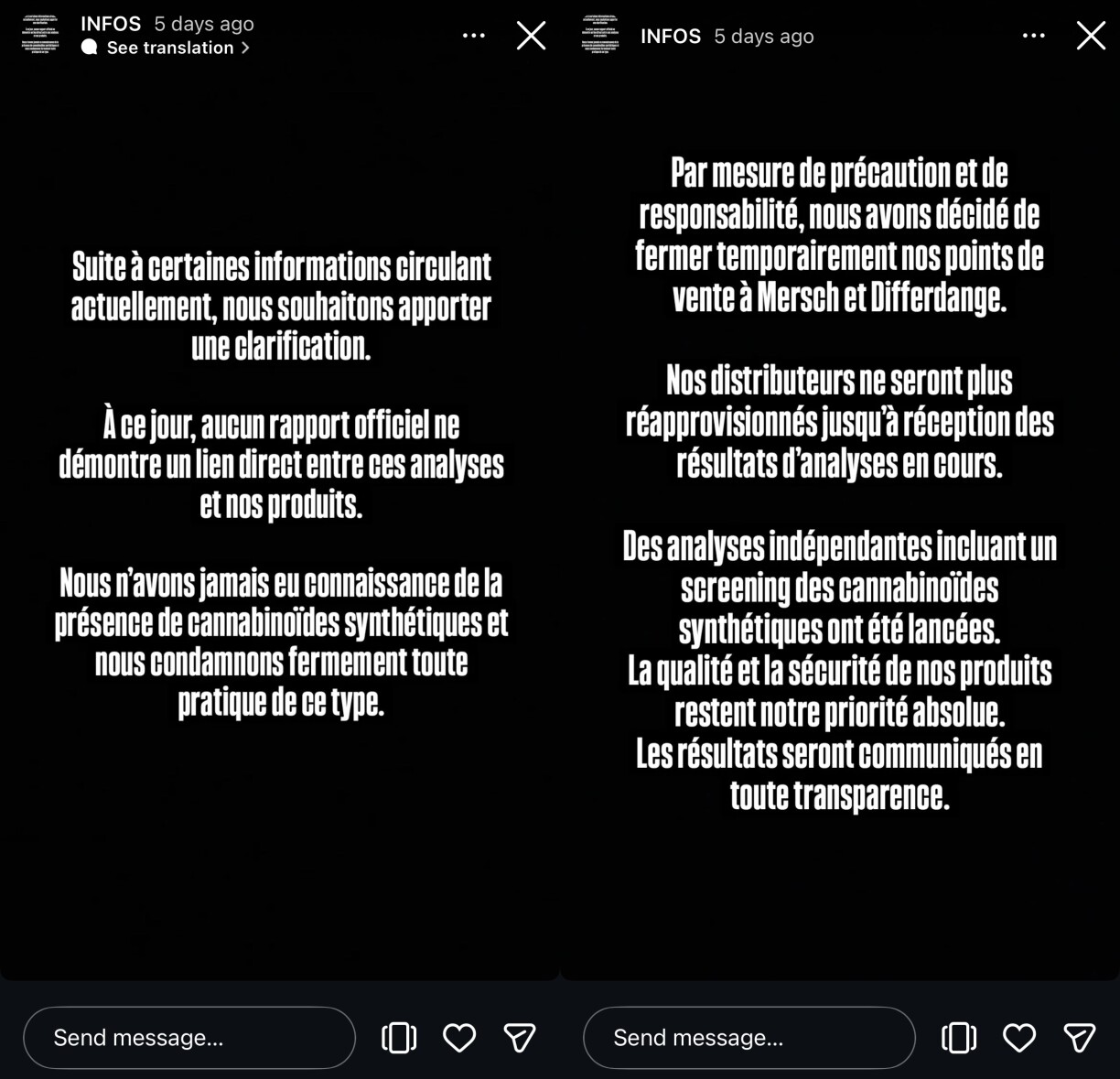
Meanwhile, the location housing the vending machines from which the tested sample was obtained has since been marked as temporarily closed. The company has also issued a statement on social media following Pipapo's warning, stressing that no official link has yet been established and that an independent analysis has been launched.
If you or someone you know recently bought similar products, RTL Today strongly advise against consuming them. Those who would like to have a sample tested can contact Pipapo or visit their weekly drop‑in sessions on Tuesdays from 4pm to 8pm. The Pipapo team also offers regular information sessions, one‑on‑one discussions with and without appointment, and is present at events throughout Luxembourg.





