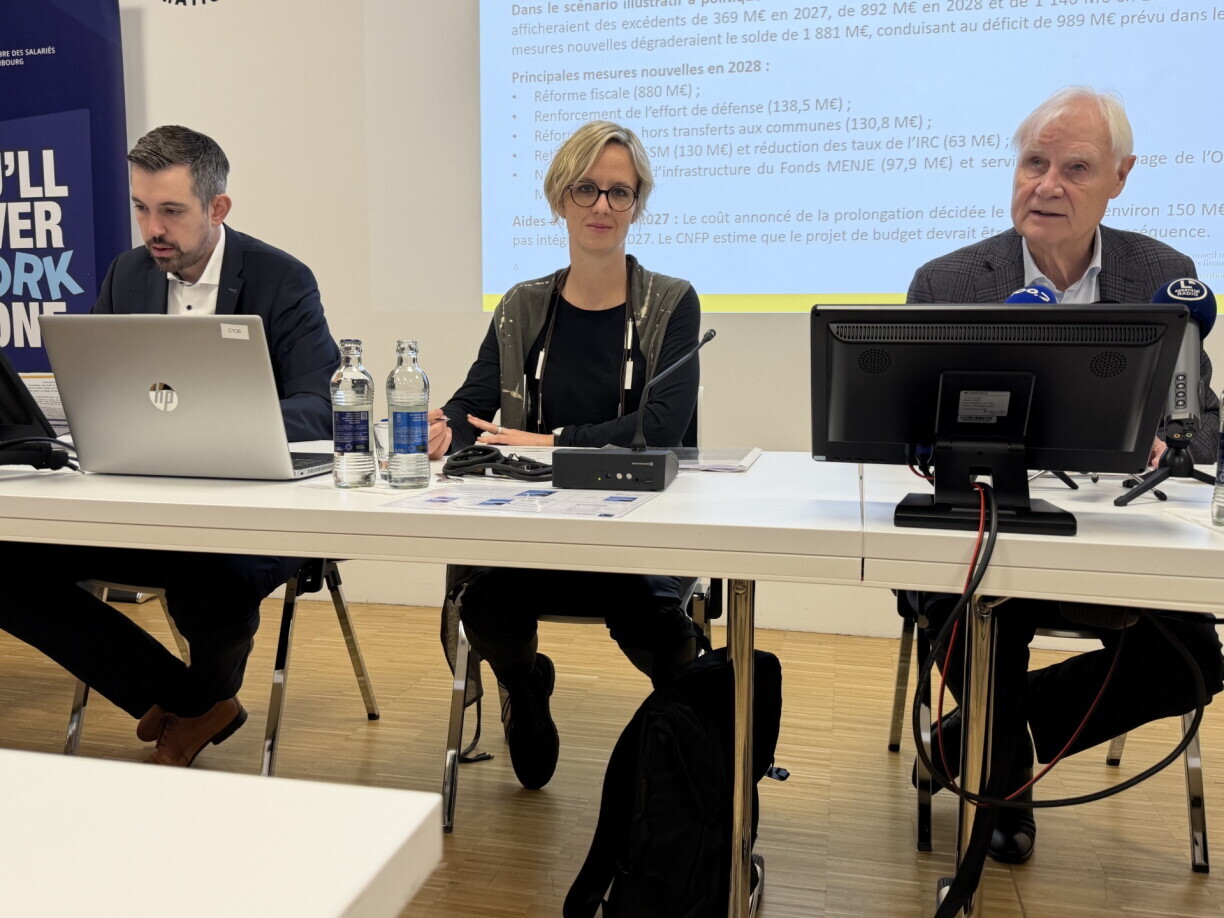
Romain Bausch, President of the National Council for Public Finance (CNFP), has proposed the reintroduction of a strict "budget rule" to control the growth of state expenditures in Luxembourg.
Speaking to the Parliamentary Finance Committee and subsequently to the press, Bausch presented the CNFP’s opinion on the state budget.
He warned that while state revenues are currently rising, expenditures are increasing at a faster pace, inevitably leading to a deficit. Coupled with economic and labour market growth remaining below historical levels, Bausch stated he is "fairly certain" that a return to past growth rates is unlikely, necessitating structural budgetary adjustments.
Current government plans appear to move in the opposite direction of fiscal consolidation. The upcoming tax reform is projected to reduce state revenues by nearly €1 billion annually starting in 2028, alongside a planned €1.6 billion increase in defence spending by 2035. Consequently, public debt is forecast to rise by €10 billion by 2030, with associated interest costs approaching €1 billion.
While acknowledging that Luxembourg still maintains the second-lowest public debt in Europe, Bausch stressed the urgent need for lawmakers to rebuild budgetary margins.
Looking ahead to 2029, the CNFP warned that corrective measures will be necessary, extending beyond just pension system reforms. Bausch advised against cutting public investments, arguing they are not the primary driver of the negative fiscal trend. Instead, he advocated for reining in current administrative costs.
He suggested that the integration of digitalisation and artificial intelligence should allow the state to operate more efficiently without expanding its workforce. Between 2015 and 2025, the number of state employees grew by 53%. During the same period, the central government’s wage bill rose by over 80% (excluding wage indexations), and by 130% when indexations are included.
Bausch recalled that during the 1970s and 1980s, the Ministry of Finance utilised a "budget rule" stipulating that expenditure growth must not exceed the sum of economic growth and inflation. He suggested revisiting this principle to ensure long-term fiscal discipline.
In a bulletin published in spring, Finance Minister Gilles Roth initially aimed for a maximum expenditure increase of 4.5% this year. The actual figure reached 6.5%, however, the multi-year budget once again reiterates the 4.5% target. When asked if this target would again be missed, Bausch remarked calmly that one could "just as well assume that it will be achieved".
He also noted wryly that a decade-old CNFP projection of public debt reaching 161% by 2060 remains a distinct possibility, adding, "The figures have not improved."
To improve fiscal oversight, the CNFP reiterated its call for tighter control over the growth of state expenditures. It also recommended separating the multi-year budget from the annual state budget, allowing for a dedicated debate on the government’s medium-term financial planning next spring.
The council further advocated using Gross National Income (GNI) rather than Gross Domestic Product (GDP) as the reference metric. Bausch noted that, measured against GNI, Luxembourg’s public debt would stand at 45%, compared with just under 30% when measured against GDP.
Finally, the CNFP expressed caution over projections that municipalities will be able to slow the growth of their expenditures in the coming years, suggesting that these assumptions may be overly optimistic.


