General Robinet describes his leadership style as "authoritarian", but in the classical Latin sense of the word, meaning to elevate others, to lead by pulling people upwards.
It is half past seven on Thursday morning at Herrenberg, the Luxembourg Army’s headquarters. Just one week has passed since Claude Robinet took over as Chief of Defence. He spent the previous six months preparing for the new responsibilities.


The day begins with a meeting alongside his secretary, Patricia Strasser. Together they review the agenda, discussing appointments and visits, and determining which uniforms are required for each event. These are practical and organisational matters that Strasser knows inside out; after all, General Robinet is the sixth Chief of Defence, known internally as CEMA (Chef d’État-Major), she has worked with, each of whom, she says, has brought a distinctly different style to the post.
Robinet, relaxed and approachable, greets us in a manner far removed from the modern notion of "authoritarian". No sooner has he settled in than Colonel Christian Simon arrives to discuss preparations for a meeting with a four-star NATO general. High on the agenda are plans for NATO’s north-eastern flank and Luxembourg’s role as a so-called transit nation.
Robinet explains that Luxembourg is a country through which troops could transit if reinforcements were needed from the west, which entails that Luxembourg would also need to be able to temporarily accommodate personnel as they pass through.
These contingency plans are standard procedure within NATO and are not directly related to the current threat from Russia, Robinet says. Such plans are routinely coordinated among member states and are, he insists, nothing out of the ordinary. He stresses that there is no reason for excessive concern at present, but it is essential to have plans ready and waiting just in case.


Nevertheless, how prepared is Luxembourg should tensions with Russia escalate?
Robinet stresses that Luxembourg's position is crystal clear: it does not want war, which is why it focuses on deterrence. Luxembourg is building its capabilities so that if conflict were ever to arise, the country could fulfil its defence commitments as part of the alliance.
As Russia’s war of aggression against Ukraine continues to intensify, Robinet notes that Moscow is also waging a hybrid war against Europe. He assures that both NATO and individual countries are taking the situation seriously. For Robinet, who is married and the father of three, it was pragmatic reasons that convinced him to take on the army’s top job in such uncertain times.
In 2023, he established a special department to oversee the fundamental transformation of the Luxembourg Army, including the creation of a joint battalion with Belgium. During his career, he has worked closely with the A400M air unit shared by Luxembourg and Belgium, spent several years in Brussels at NATO, where he focused on cyber and space domains, and sees this diverse experience as invaluable for his new post.
General Robinet leads us up the hill to the satellite antennas, vital for maintaining communications with Luxembourg contingents in Romania, Lithuania, and elsewhere. Earlier in his career, he served as commander of Luxembourg’s KFOR detachment in Kosovo in 2002, and was later deployed in Afghanistan.
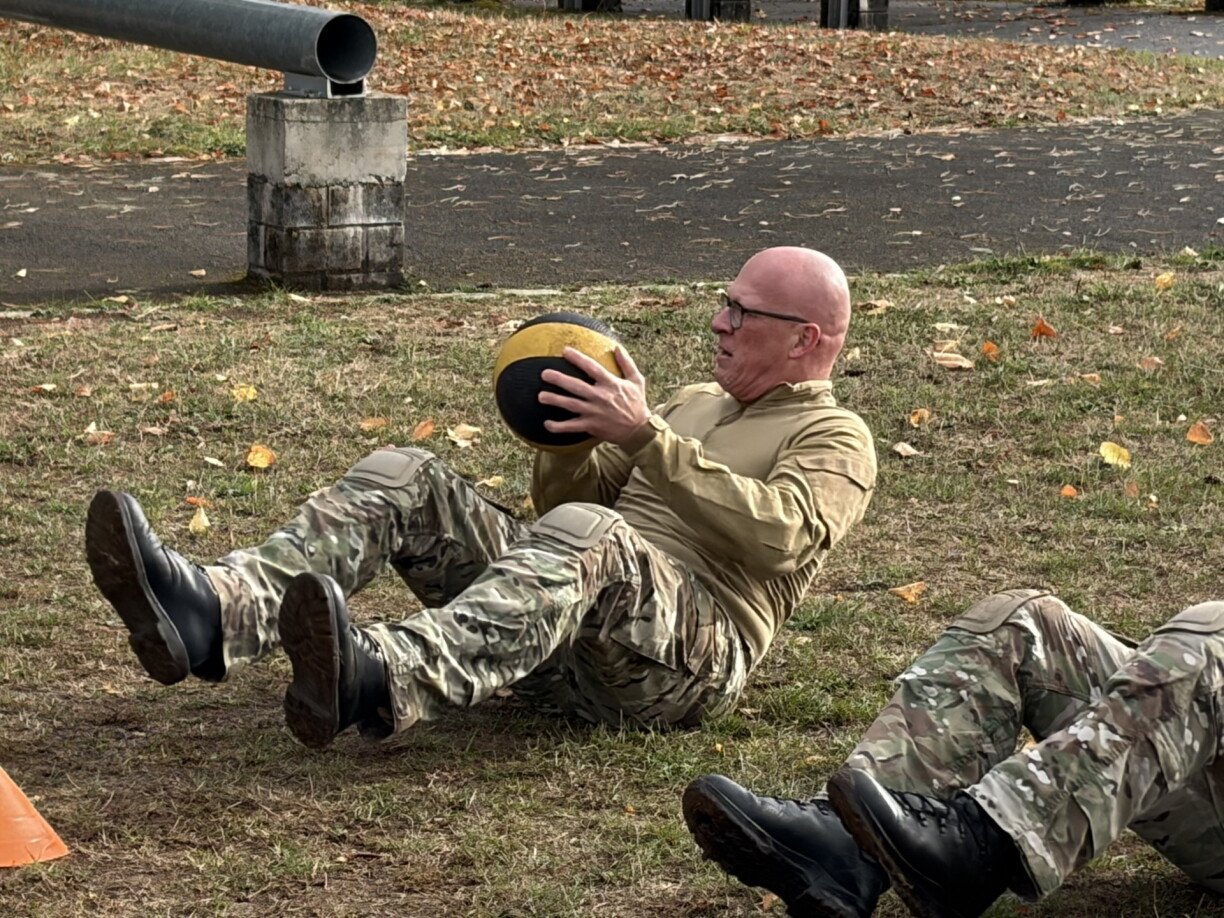
A few metres higher, at the “Botterweck”, a platoon of soldiers awaits him for a joint training session. Today’s programme is high-intensity interval training: strength exercises, vaulting over walls, push-ups, lifting weights, climbing ropes, all in rapid succession. Robinet, slightly out of breath, admits it is unusual for him to participate as he seldom has time for such training, but aims to work out twice a week.
He emphasises that nutrition, exercise, and recovery are all essential to perform this job well.
Robinet has always been athletic: he played handball and was active in the Scouts. Team spirit, he says, has played a central role throughout his life. The prospect of a varied career with opportunities, including abroad, led him to join the military.
He surprisingly describes his leadership as “authoritarian”, again in the old Latin sense, “to raise people up”. He stresses that he relies on the people who work for him, and, in turn, everyone receives the trust they need to do their job in their area of responsibility.
The new Chief of Defence has set himself a guiding principle: DO-IT. D stands for diversifying personnel. O is for operationalising capabilities. I is for integrity; since the army will continue to grow, it needs to stay united and aligned in everything we do. And T is for technology, which is indispensable these days.
Robinet can expect no shortage of challenges or variety as he leads the Luxembourg Army into a new era.





