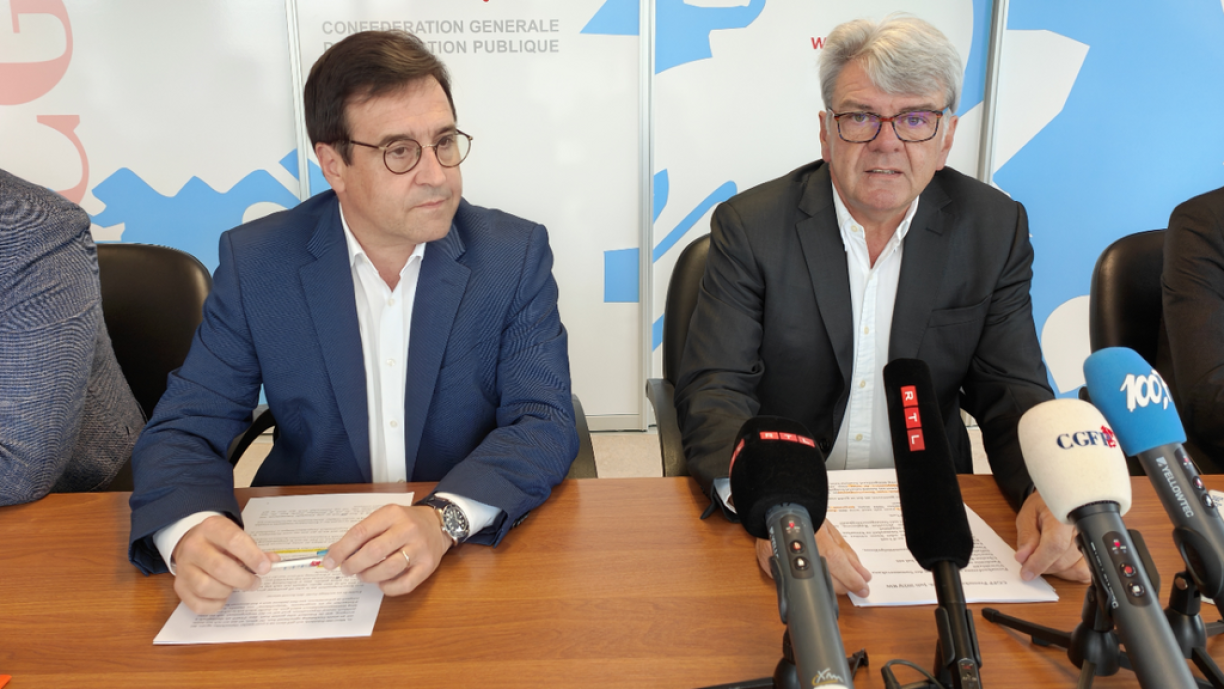
The General Confederation of the Civil Service (CGFP), Luxembourg's civil service union which considers itself to be "politically independent and ideologically neutral," points out that it did not give any voting recommendations for the legislative elections on 8 October.
"This does not mean, however, that the CGFP has no expectations of the new government. On the contrary," the editorial notes. The CGFP, alongside other social partners, was recently invited to the negotiation table for discussions with the delegations of the Christian Social People's Party (CSV) and the Democratic Party (DP).
At the top of the CGFP's list of priorities is the call for a comprehensive tax reform. The trade union deems it unacceptable that households bear 75% of the direct tax burden, while businesses contribute only 25%. "That doesn't sound like tax justice," according to the CGFP. "There can be no far-reaching tax reform without abolishing tax class 1A and bringing the tax scale into line with inflation," the trade union says.
Regarding housing construction, the CGFP leaders acknowledge that the previous government cannot be solely held responsible for shortcomings in this domain. They argue that the housing issue predates the recent three-party coalition and believe that lessons must be drawn from past experiences on these pressing matters. The CGFP emphasises, "This is crucial for maintaining social harmony within the country."
The editorial also highlights the change of direction taken by Frieden, who went from a stance of reducing taxes for all to acknowledging an extremely difficult financial and economic landscape, which opens the way to speculation on future financial policy. In any case, the CGFP firmly opposes austerity measures. "Every economics student learns in their first year that in difficult times, only an anti-cyclical fiscal policy can give the economy the impetus it needs to achieve stable, long-term economic growth," the trade union argues.
The CGFP also advocates for an end to the perceived "confrontation" between the private and public sectors.
They believe that addressing the challenges of the future requires a robust civil service and view the CGFP as a "responsible and dependable" social partner in this endeavour.





