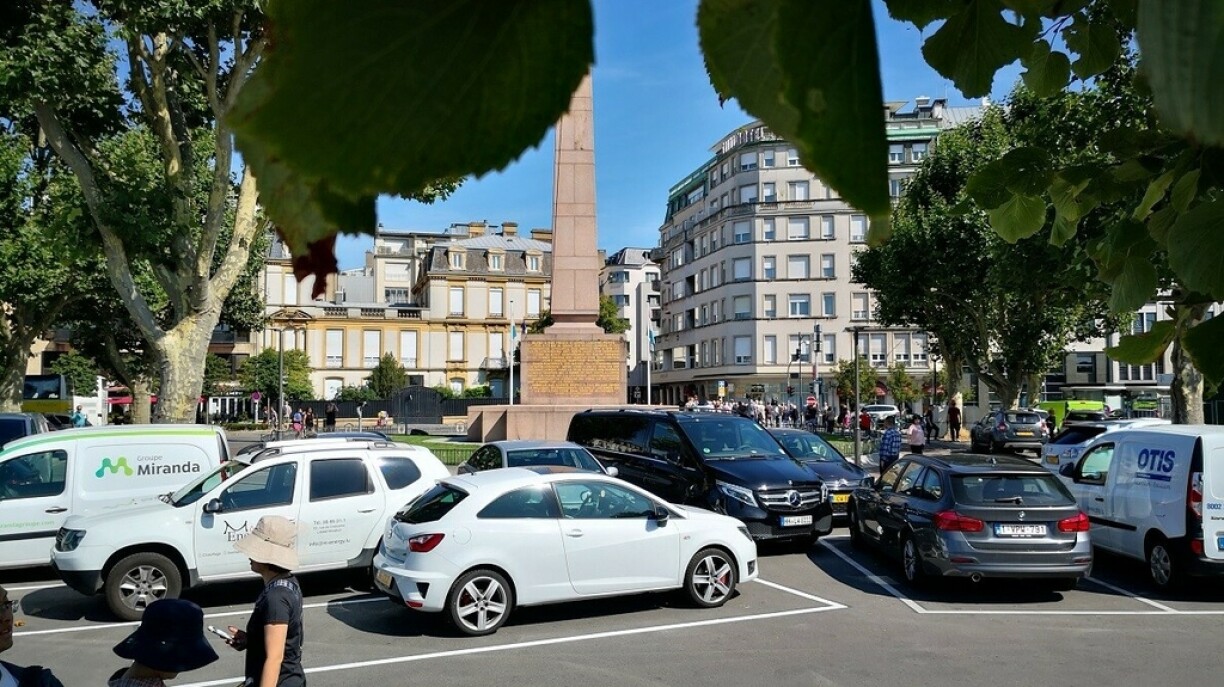
Previously, the location served as the central outdoor car park in the Ville-Haute neighbourhood, with convenient access for tour buses parking adjacent to the monument. However, the landscape changed significantly in early 2024.
"After the closure of the Christmas market, Place de la Constitution was not reopened to cars," explains Laurent Schwaller, an urban planner at the municipality of Luxembourg City.
Presently, the square remains largely vacant, save for a few taxis. Plans for the upcoming spring and summer seasons include repurposing the space for various activities. Benches will be reintroduced, accompanied by the installation of food stalls and a beach-like ambiance. Additionally, organisers are gearing up for a public broadcast of the Olympic Games on a giant screen later this summer. These initiatives are part of a transitional phase, as the full-scale redevelopment of the square is not yet imminent.
When the Gëlle Fra monument was inaugurated in 1923, the iconic statue was surrounded by a verdant park on Place de la Constitution, as archive images from the time show. However, the landscape shifted in 1957 with the construction of a car park. Afterwards, ideas were quickly put forward to free the square of cars.
Robert Philippart, UNESCO site manager at the Ministry of Culture, recalls proposals from the 1970s for ambitious projects like an underground bus station and a second car park. However, these plans, deemed too intrusive for the site's historical integrity, were ultimately discarded. Despite efforts to preserve the rock formation, cars continued to dominate the space.
In 2019, plans for the square's redevelopment were unveiled, which included the installation of a lift connecting the town centre to the Pétrusse valley. "It's important that the lift actually enhances urban mobility and is not just a tourist attraction," Schwaller emphasises.
The lift inside the rock was originally planned to preserve the aesthetics of the UNESCO site. But that could still change. While the UNESCO Commission emphasises the importance of respecting the historic architecture, it also notes that any plans must be compatible with the daily life of the capital's inhabitants. "A historic site must be authentic," Philippart stresses. For this reason, authorities must carefully weigh what is best for the site against the impact the works will have on the area.
As studies explore feasible options for the square's redesign, the exact cost of the project remains unknown. But one thing is already certain: the Gëlle Fra will remain in its place. According to Schwaller, after its eventful history, the monument is inconceivable anywhere other than Place de la Constitution.
-> 100 Years 'Gëlle Fra': Uncovering the hidden side of the Golden Lady
Regarding the future presence of taxis on the square post-redevelopment, Luxembourg City's urban planner indicates that decisions will be guided by the overarching goal of achieving a cohesive and balanced urban concept.
Full report by RTL Télé (in Luxembourgish)





