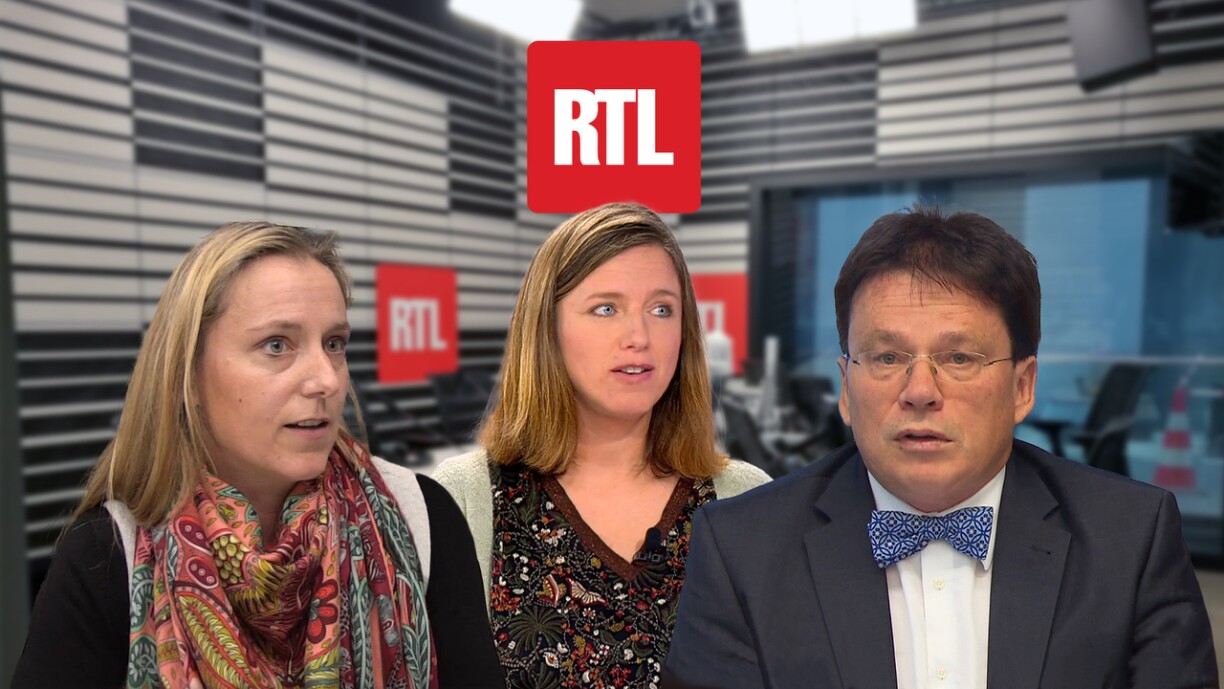
The world is in the middle of a great disruption. The war between Ukraine and Russia not only affects supply chains and leads to even higher prices but will also likely lead to higher defence and military spending. This at least is the opinion of Serge Allegrezza, the director of STATEC, who participated in a roundtable discussion on RTL Radio on Saturday afternoon. The discussion focussed on rising energy prices, the loss of purchasing power, and the consequences of inflation on low-income households and companies.
Besides the head of STATEC, Carole Muller, the director general of Fischer, and Carole Reckinger from Caritas also participated in the discussion.
During the pandemic, the oil price hit a record-low, which naturally makes the current price explosion all the more pronounced. It does not come as a surprise that a serious, worldwide recession is followed by a boom and that the demand exceeds the offer. This all leads to the current tensions related to resources, Allegrezza explained, adding that the Ukraine crisis certainly does not improve the situation. In terms of energy costs, households should expect to pay on average €190 more in 2022 compared to the previous year. In comparison to 2019, however, the difference is even as high as €415, according to the STATEC director.
"At the moment, there are no products that don't give us a headache," Carole Muller, the director general of the bakery chain 'Fischer', said. Resources are hard to come by and on average 20% more expensive. In addition, the company struggles to find new employees. The combination of all these factors and the lack of predictability causes significant problems for companies. Especially after two years of pandemic, when most actually expected an economic upturn, Muller explained.
An increasing number of people start to feel the high energy prices, as they also lead to higher prices for food, insurance, and housing, according to Carole Reckinger. The head of social policy at Caritas stressed that the issue of energy poverty is becoming worse and worse and still only rarely at the centre of public discourse. Important figures are also often unavailable in the short-term. Additional staff members must be recruited for Luxembourg's social welfare offices so that they can provide better information, Reckinger demanded.
Inflation is above all else also a social problem. Among the bottom 25% of people with the lowest incomes, energy bills account for 10% of their total expenditure, while for the top 25%, it is only 3%, Allegrezza explained. The impact of energy prices is "unequal". Some are hit harder than others.
Despite the fact that the government praised itself during the last debate on purchasing power for all the measures it implemented over the past years, these measures so far have been far from sufficient, Reckinger criticised, adding that this will become evident over the upcoming months. Over the years, households have lost purchasing power since the family allowance and the cost-of-living benefit have not been integrated into the wage indexation. In addition, it is necessary to look for long-term solutions, particularly regarding climate neutrality and energy prices. More often than not, low-income individuals are not homeowners and are thus unable to commission energy-efficient renovations, which in turn leads to them having a higher consumption of electricity/gas/heating oil. To this end, the government should provide targeted incentives to landlords while ensuring at the same time that this does not lead to increased rents.
The climate protection measures are important and necessary, the head of Fischer acknowledged. However, she stressed that companies require the necessary time to transition. More dialogue ahead of certain decisions would also be welcomed, Muller stated. She also argued that it should be questioned whether the index, which in this particular form only exists in two countries, is the right tool to adjust wages for inflation, as it is an "enormous burden" on companies and "detrimental to competitiveness". Salaries make up 60% of her company's costs, Muller revealed. For 950 people employed by Fischer and Panelux, this equates to €400,000 in the end, according to Muller.
For his part, the director of STATEC confirmed that a new wage indexation is indeed coming. However, he declined to comment on whether this would be a matter of weeks or months. Allegrezza did state that if inflation remains at this level, it is highly likely that there will be two wage indexations in 2022. In this event, the STATEC director thinks that it should be discussed what could be done to help companies stay competitive.





