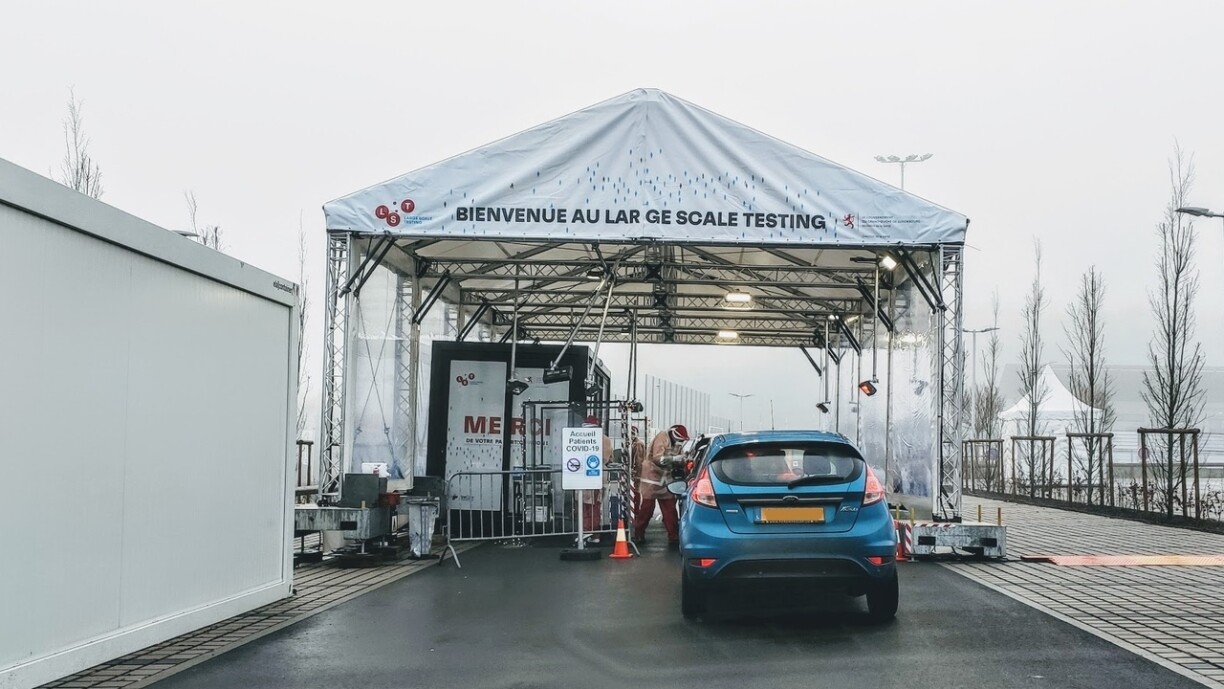
Last week, the Court of Auditors presented its Covid-19 pandemic report to the parliamentary budget control commission, resulting in significant criticism from lawmakers against the strategy, calling it chaotic, financially wasteful, and ridden with mistakes. The report did not, however, have the aim of assessing the epidemiological effectiveness of the large-scale testing programme but rather if public funding rules were respected.
The three phases of the programme cost a total of €134 million – excluding VAT.
The Auditors Court criticised that the programme was oversized in all three phases. The maximum capacity designed for the programme was not used, indicating that fewer tests – including PCR tests – were performed than initially planned. This is linked to a significant number of patients who were invited for voluntary testing but did not make use of the opportunity.
The Auditors Court also stated that elevated costs stem from the way accounts were settled: not by counting the real number and cost of tests but rather through a flat rate. It noted that the first phase of the programme, which was organised by the Luxembourg Institute of Health (LIH), did not establish precise criteria for programme expenses.
This means that there were no criteria that served as a guideline to allow for invoices to be declined. As such, Laboratoires Réunis charged 26% for general expenses with a profit margin of 15%.
In the second phase, as the Ministry of Health took over, the bill of specifications for the public tender provided that a larger portion of the payment should be linked to the actual number of tests. However, the tender was cancelled after only one offer was made.
This was a joint offer by three Luxembourg private laboratories and far surpassed the designated budget of €60 million.
A public tender was then negotiated with Laboratoires Réunis. According to the Court of Auditors, the main difference between the tender and the negotiated contract was that the state would assume responsibility for any financial risks. Furthermore, a higher share of fixed costs and a smaller variable share was agreed upon on the basis of performed tests.
Laboratoires Réunis pooled the samples, meaning four were combined before testing. If the result came out negative, there was no need to further test any of the samples.
Therein lay a difference with the samples of patients who were tested with a doctor's prescription, as these were tested individually in the laboratory. The Court of Auditors believes that the calculations of Laboratoires Réunis lacked consideration of the expenses saved by pooling.
Laboratoires Réunis charged close to €100 million for the PCR tests, but the Court of Auditors claimed that by taking into account the pooling mechanism, the costs are estimated to actually be €41 million.
Laboratoires Réunis set up test stations with its subcontractors in order to reach the maximum capacity for testing. However, the financial statement of the laboratory shows a 4% profit margin in 2019, with an increase to over 18% in 2021, meaning that Laboratoires Réunis made significant profits.
In the report, the Ministry of Health did not provide an official statement with regard to the infliction of penalties due to non-compliance with performance indicators. During the second phase, due penalties of €2 million were reduced to €270,000.
A possible explanation is that the guidelines for large-scale testing and for patients with a doctor's prescriptions contradicted each other. This could have been the case as one of the performance indicators was based on having test results ready within an expected deadline.
However, with the sudden increase of infections, more patients with doctor's prescriptions had to submit themselves to a test, which had priority in relation to the large-scale testing programme. Therefore, the test result deadlines could not always be attained.
This development was taken into account in the third phase of the large-scale testing programme by adjusting the test result deadlines according to the number of infections after a certain threshold.
The High Commissioner of National Protection donated millions worth of PCR tests to the large-scale testing programme to keep the programme under the €40 million threshold. Surpassing this threshold triggers the need to pass a special financing bill.
Except for the public tender in the second phase, the Court of Auditors argued that there was sufficient time to tender the third phase of the large-scale testing programme. Instead, the contract was once again negotiated with Laboratoires Réunis, a decision the Court criticised.





