
On 17 February 2025, Luxembourg exhausted all the natural resources allocated to it for the entire year, according to a joint statement by Greenpeace and Doctors Without Borders (MSF), which sharply criticised the country’s resource consumption. Both NGOs warned that reaching Overshoot Day so early in the year poses not only a threat to biodiversity and ecosystem balance but also a direct risk to public health.
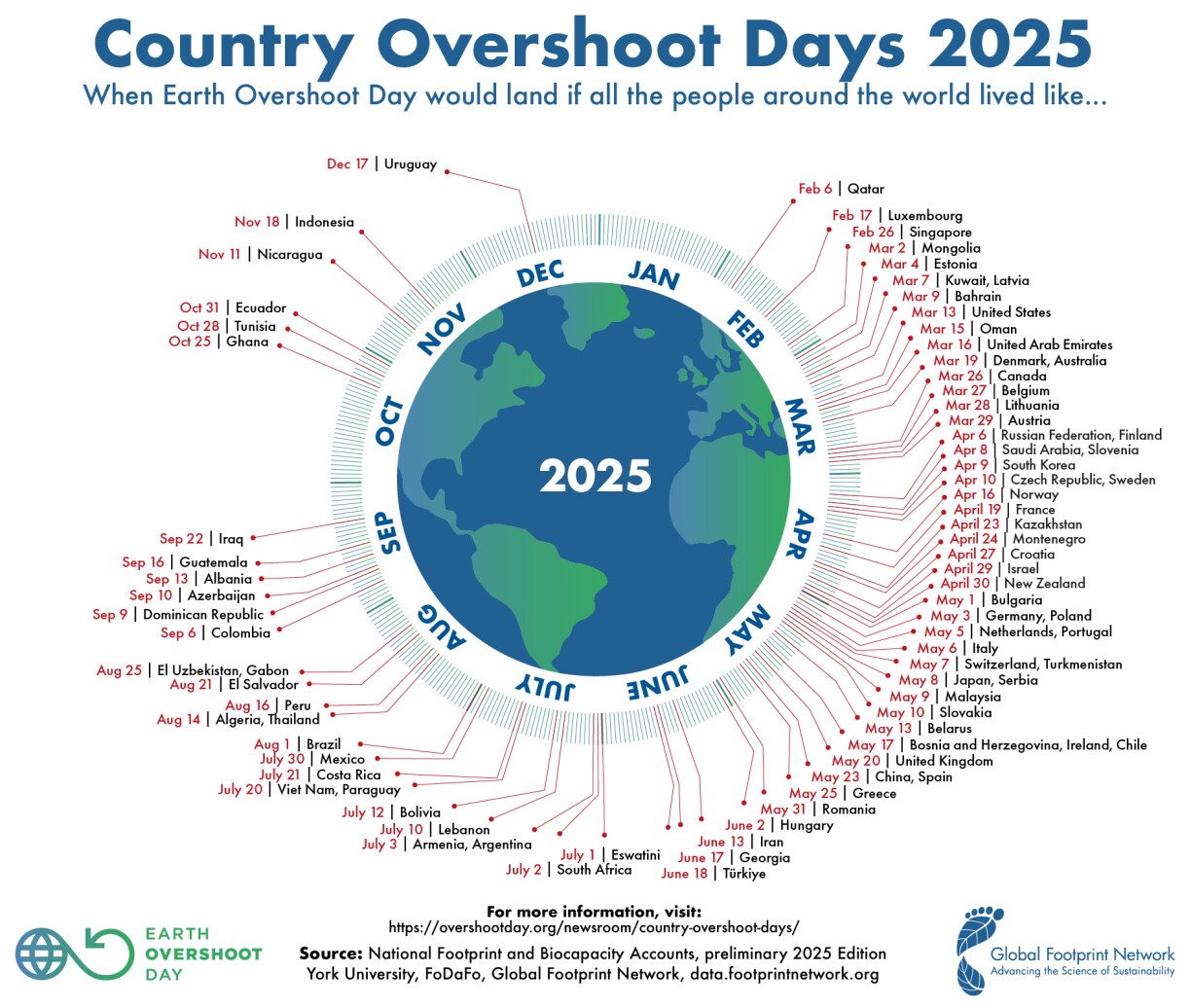
Luxembourg's Overshoot Day remains among the earliest worldwide, surpassed only by Qatar, which reached its threshold on 6 February. Compared to 2024, Luxembourg achieved this milestone three days earlier. Meanwhile, the countries with the latest Overshoot Days this year include Uruguay (17 December), Indonesia (18 November), and Nicaragua (11 November).
According to the Footprint Network, countries that do not exceed their annual resource budget are not included in the ranking, nor are those lacking sufficient data for precise calculations. In total, 86 nations are listed.
If the global population consumed resources at the same rate as Luxembourg, the most recent complete figures from 2022 indicate that humanity would require 7.26 Earths to sustain such a level of consumption.
While Luxembourg's high consumption levels are a major factor, the way Overshoot Day is calculated also plays a role. As a small country with a strong economy, Luxembourg's results are significantly affected by fossil fuel use, particularly cross-border fuel tourism, which inflates its CO2 emissions. Additionally, its position as a major European hub for air freight further contributes to its environmental footprint.
Despite free public transport, Luxembourgers primarily rely on private cars. The country also has high average energy consumption and a diet heavily dependent on meat, according to Greenpeace and MSF. While efforts such as increased solar energy use, the introduction of a carbon tax, and the renewal of the vehicle fleet have been implemented, their impact is not yet reflected in the calculations, which rely on older data.
"If everyone consumed like Luxembourgers, we would need over seven Earths to sustain it", said Xavier Turquin, Director of Greenpeace Luxembourg. "With 2024 being the first official year we exceeded the 1.5-degree Celsius global warming threshold, we now see climate action losing urgency."
MSF’s Director, Thomas Kauffmann, warned that the climate crisis is also a health crisis. Crop failures due to erratic rainfall can lead to famine, while rising temperatures fuel the spread of diseases such as respiratory infections and malaria. He also noted the link between environmental pollution and cancer.
Extreme weather and declining biodiversity are already evident in Luxembourg. Given the scale of the crisis, both NGOs stress that collaboration is essential. "We can no longer tackle this alone", their directors stated. To raise awareness, MSF and Greenpeace have launched a joint website in Luxembourg to better inform the public about the crisis.






