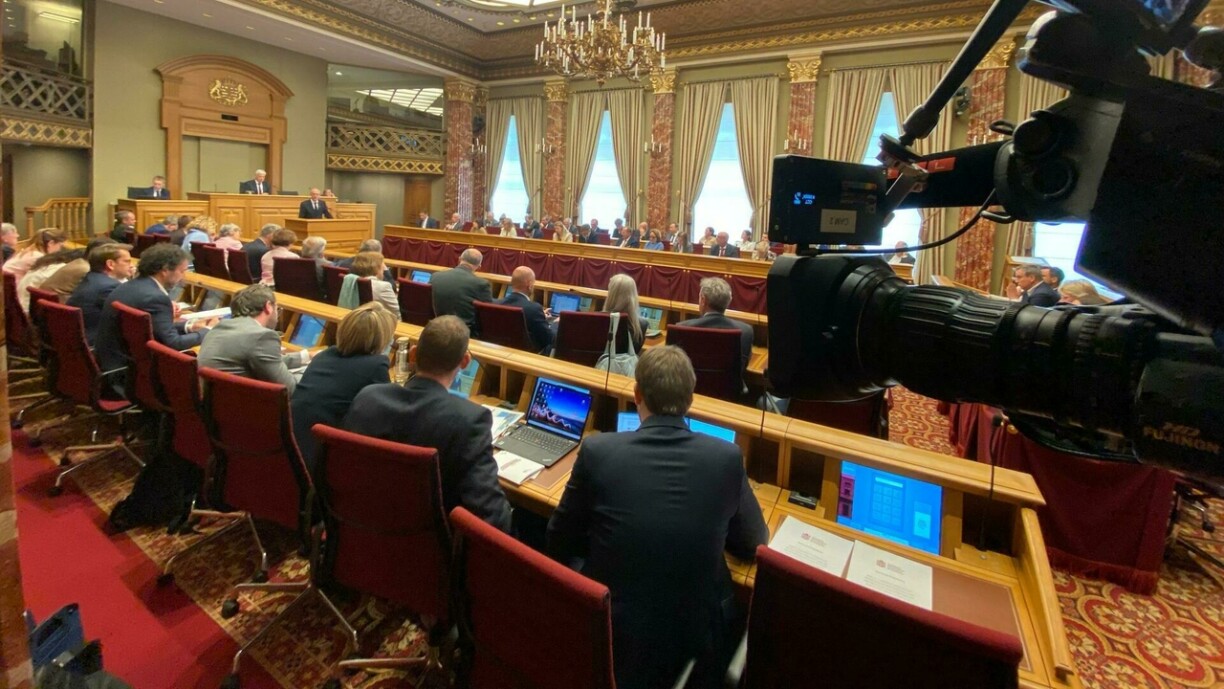
Prime Minister Luc Frieden held his inaugural State of the Nation speech in the Chamber of Deputies on Tuesday, garnering varied reactions from members of parliament. Since Frieden declined to distribute copies of his speech prior to the event, MPs had to listen carefully to form an opinion on the announcements made by the CSV president.
But many of them found there was little in terms of newness, while others expressed concerns at the funding for the various coalition promises.
Taina Bofferding, co-president of the Luxembourg Socialist Workers' Party (LSAP), was looking forward to hearing the government's plans to tackle poverty – one of the coalition's declared priorities – but said she was ultimately disappointed.
"The only solution to this problem appeared to be a simplification of procedures. It's good they want to remove bureaucratic hurdles, but that won't solve the issue. What about people living on the streets? In the Chamber we have had many talks about 'housing first concepts', what about increasing the minimum wage, what about making it tax-free, that is what we demanded. And the government always put us off, saying they were working on a national action plan to combat poverty. But in the end [Frieden] didn't utter a single word about that", lamented Bofferding.
Fred Keup of the Alternative Democratic Reform Party (ADR) said Frieden's speech was that of a bureaucrat and that he had missed an opportunity to address issues directly.
"Safety, security, crime... Migration wasn't even mentioned. Integration and language, in a country which has so many foreigners... not a single word in a State of the Nation speech by a Prime Minister on these topics, I can't even imagine that. The role of the family, all of that was missing."
Keup added that there was little clarification on how certain measures, such as the index adjustment of the tax scale, should be financed.
Gilles Baum, who leads the parliamentary group of the Democratic Party (DP), said it was a good and complete speech and particularly praised the 10-point plan for housing, the measures to combat poverty, and those to accompany the ecological transition.
In response to criticism from the opposition that many of the measures featured had already been planned by the previous government, Baum said: "There is certainly some continuity because one of the previous coalition parties is still in government. We didn't write off the last decade of course – we had good approaches and ideas, but didn't get everything done within those ten years. For me it's therefore normal that we finish those things instigated by the LSAP or the Greens which may still appear within these new procedures. For me this is a very normal process.
As for financing the announced tax measures, Baum said the start of 2024 had been better than expected. A further assessment of the government's budget is expected at the end of June.
Sam Tanson, Chamber spokesperson for The Greens, said the speech did not contain anything new: "The announcements mainly focused on reductions of current subsidies, for mobility, or climate housing subsidies. There will be a new adjustment to the tax table, but we didn't hear anything about additional counter-financing to already announced tax reductions. Much of the talk discussed simplification of administrative procedures, but without any clear direction."
The Greens estimate the further adjustment of the tax scale by 2.5 index instalments next January will cost in the region of €300 million.
The Pirate Party's Sven Clement echoed Tanson's impressions, saying he had not heard many new measures: "The proposals with details were more negative in nature. Fewer subsidies for electric vehicles means this government appears not to believe in electric cars ... However, the question I am asking myself amid these fairy tales is how they are to be financed? We'll buy more and offer more tax breaks, these are all welcomed, but at the same time we received a statement from the National Council of Public Finances yesterday saying that this year's deficit will be close to twice as high as the estimates."
Spending more with a higher deficit does not make sense, Clement concluded.
The Left's Marc Baum said it was less a state of the nation speech than a speech on the simplification of procedures: "It sounded like a CEO discussing a change in administrative procedures to solve a company's problems. Combating poverty is just a case of administrative simplification, as is housing, it seems. However, all studies say that housing issues are linked to taxes which support speculation on land. They support the retention of the landowner, but no one brings this up."
Baum also criticised the tax relief for businesses and various financial products.
Marc Spautz, faction head of the Christian Social People's Party (CSV), approved of Frieden's speech and said it was proof of the ministerial work conducted over the past few months. He was less concerned with the question of budget and said the state finances would be assessed at the end of June.
"I imagine there will be answers to all the questions raised now, and the Finance Minister will clearly explain how financing will take place."





