It seems that all we hear anymore is that Luxembourg is in crisis and the country's economy is taking a beating. In fact, the Idea Foundation's latest findings, released on Thursday, indicate a confirmation of recession forecasts in the Grand Duchy, attributed to successive shocks following the coronavirus pandemic.
Factors such as inflation, rising interest rates, and supply chain disruptions are highlighted in the Foundation's annual publication at the end of March, pinpointing sectors hardest hit by these challenges.
Vincent Hein, director of the Idea Foundation, confirms that it is in the construction sector that the most jobs were lost in 2023. However, according to data by the National Institute of Statistics and Economic Studies (STATEC), it is the logistics sector (transport and warehousing) that has seen the biggest drop in activity (7.7%).
Read also: Emergency measures: Construction sector officially in state of crisis as of 1 February
Other sectors experiencing notable declines in activity include financial and insurance activities (-7%) and construction (-7.4%). However, despite these setbacks, economists like Jean-Baptiste Nivet of the Idea Foundation emphasise that "the Grand Duchy remains the land of good news." The country's economy did indeed prove particularly resilient during the pandemic.
This latest crisis is "harder to swallow," admits Vincent Hein, while highlighting pockets of success within the Luxembourg economy. Notably, the IT sector continued to grow in 2023 (+7.1%), and is in fact becoming an increasingly important part of the country's economy.
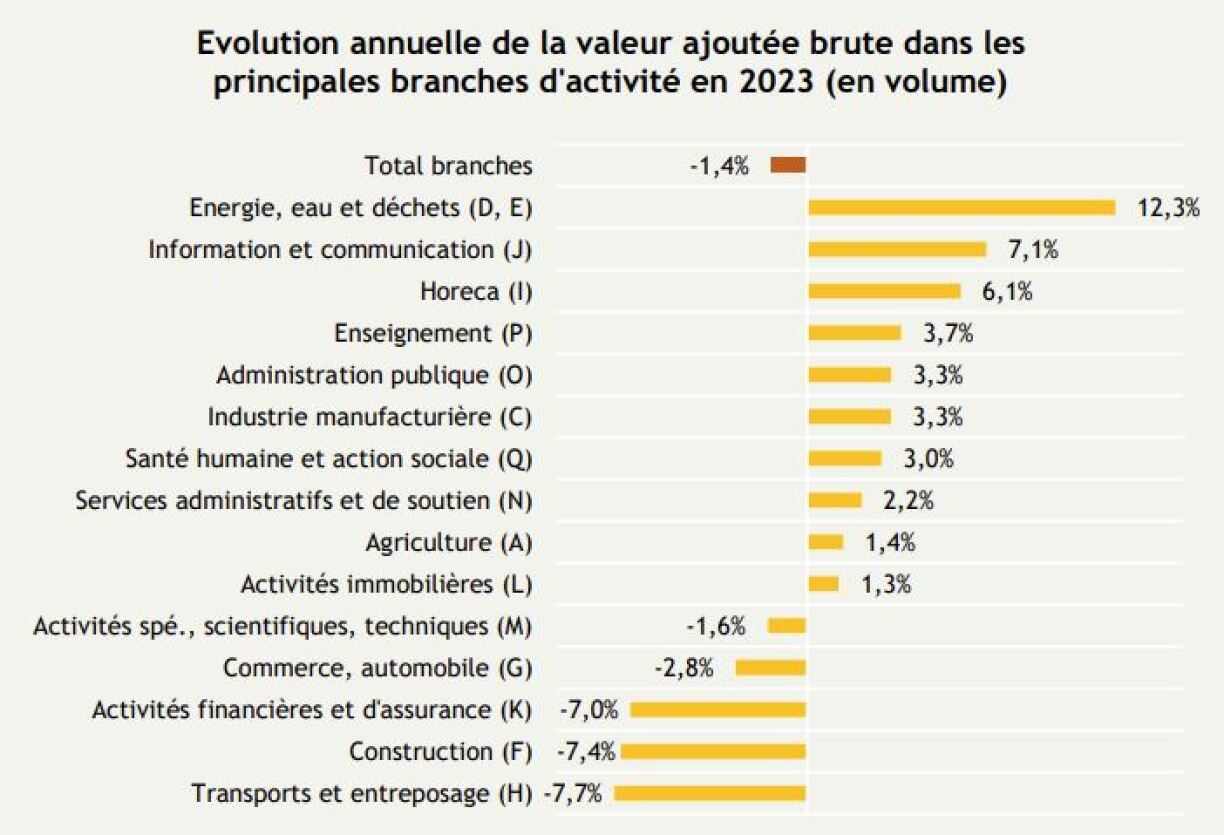
Despite facing significant job losses in the previous year, the hotel and catering sector also recorded significant growth in terms of gross added value, recording a 6.1% increase. However, the Idea Foundation points out that this growth remains below the pre-crisis level (15%), "most likely due to cost increases since 2022."
Finally, the industrial sector, after a challenging 2022, appears to have rebounded with a 3.3% growth. Some experts speculate that this sector could play a pivotal role in driving Luxembourg's economy forward in the years ahead. In the meantime, Luxembourg will have to find solutions to the major problems looming on the horizon.
Read also: Pension reform: Left Party calls for abolition of contribution cap
The financing of pensions will certainly be one of the major projects to be undertaken to ensure the long-term sustainability and attractiveness of the Luxembourg model. However, before that can happen, Luxembourg must tackle what some describe as "structural brakes," such as housing production. Overcoming these barriers is essential to fostering an environment conducive to attracting the "talents" of tomorrow to the Grand Duchy.





