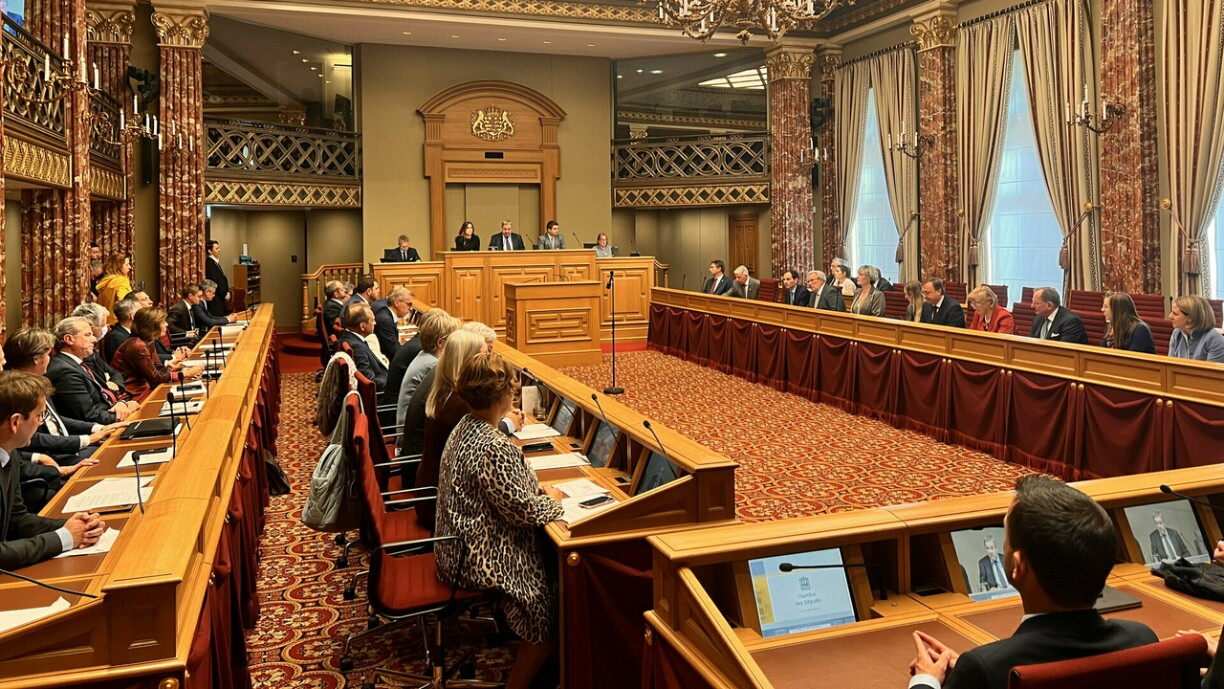
During this session, 46 MPs took their oath. Meanwhile, the 14 ministers who secured re-election will continue to lead the government until the swearing-in of a new coalition. At that point, they will also take their oaths provided that they are no longer part of the newly formed government, a possibility for the representatives of the Democratic Party (DP).
The new session welcomed several fresh faces to the Chamber of Deputies, each representing their respective parties:
The inaugural session, held on Tuesday, was presided over by the longest-serving MP, CSV Mayor-MP Michel Wolter, with the assistance of the two youngest members Braz and Emering.
In the near future, several current ministers will transition to their roles as deputies, provided they accept their mandates. At this point, no objections have been raised regarding this transition, although there has been speculation, particularly regarding the current Minister of Foreign Affairs, Jean Asselborn.
The LSAP will also see Georges Engel, lead candidate Paulette Lenert, Taina Bofferding, Franz Fayot, and Claude Haagen making the shift to the Chamber of Deputies. For the Green Party, Sam Tanson, François Bausch, and Joëlle Welfring, who replaced former minister Carole Dieschbourg, will move from the government bench to the opposition.
As the new Chamber of Deputies begins its legislative term, a period of transition is on the horizon. On the one hand, current ministers will soon be in parliament and, conversely, new MPs will soon be in government and non-elected candidates will move up.
In the event of a hypothetical 15-member CSV-DP coalition government, some MPs sworn in on Tuesday may soon vacate their parliamentary seats.
To illustrate, consider the case of Luc Frieden, the CSV's lead candidate, who took his oath as an MP during the recent session. Should the CSV-DP coalition indeed materialise, Frieden is expected to assume a governmental role, probably as the prime minister.
In such a scenario, the next person in line from the CSV's electoral list in the centre will ascend to Parliament. A look at the election results reveals that the next elected candidates from the CSV centre list include Maurice Bauer, Laurent Mosar, and Alex Donnersbach.
Similarly, in different constituencies, CSV candidates who narrowly missed election include Nathalie Morgenthaler and Françoise Kemp in the South, Jeff Boonen and Jean-Paul Schaaf in the North, and Stéphanie Weydert in the East.
For the DP, non-elected candidates such as Guy Arendt, Patrick Goldschmidt, and Claude Lamberty are waiting in the wings in the Centre. In the South constituency, Barbara Agostino and Mandy Minella were next in line after the elected MPs, while in the North, current Minister Marc Hansen and Eric Thill await their potential parliamentary roles. In the East, Gilles Baum and Ben Ries, both hailing from Junglinster, are the first non-elected candidates.
In the case of the DP, current government members could of course retain their positions for the upcoming five years. For instance, Xavier Bettel is expected to secure a ministerial post. In such a case, his swearing-in will occur not in the Chamber of Deputies but at a later date at the Grand Ducal Palace as a government member.
It is important to note that this is all purely speculative. The final makeup of the Chamber of Deputies will depend significantly on the number of ministries each party designates per constituency. This allocation could lead to instances where individuals voluntarily relinquish their positions to make way for others, possibly based on factors like age or experience. In addition, it is worth noting that a new government is not limited to using its elected candidates; they have the option to appoint external individuals as ministers. For these people, no one would need to ascend to parliament to replace them.
As a result, several unknowns persist regarding the ultimate composition of the Chamber of Deputies after the Frieden/Bettel government has taken its oath before Grand Duke Henri. The complete picture will only emerge once ministerial appointments are confirmed.
In any case, provided that the current coalition negotiations progress smoothly, the new government is expected to be sworn in by December. Subsequently, a second wave of MPs will take their oaths in a plenary session.





