According to the latest statistics, the wage picture is rather diverse across Luxembourg, with a clear concentration of high salaries around the capital city.
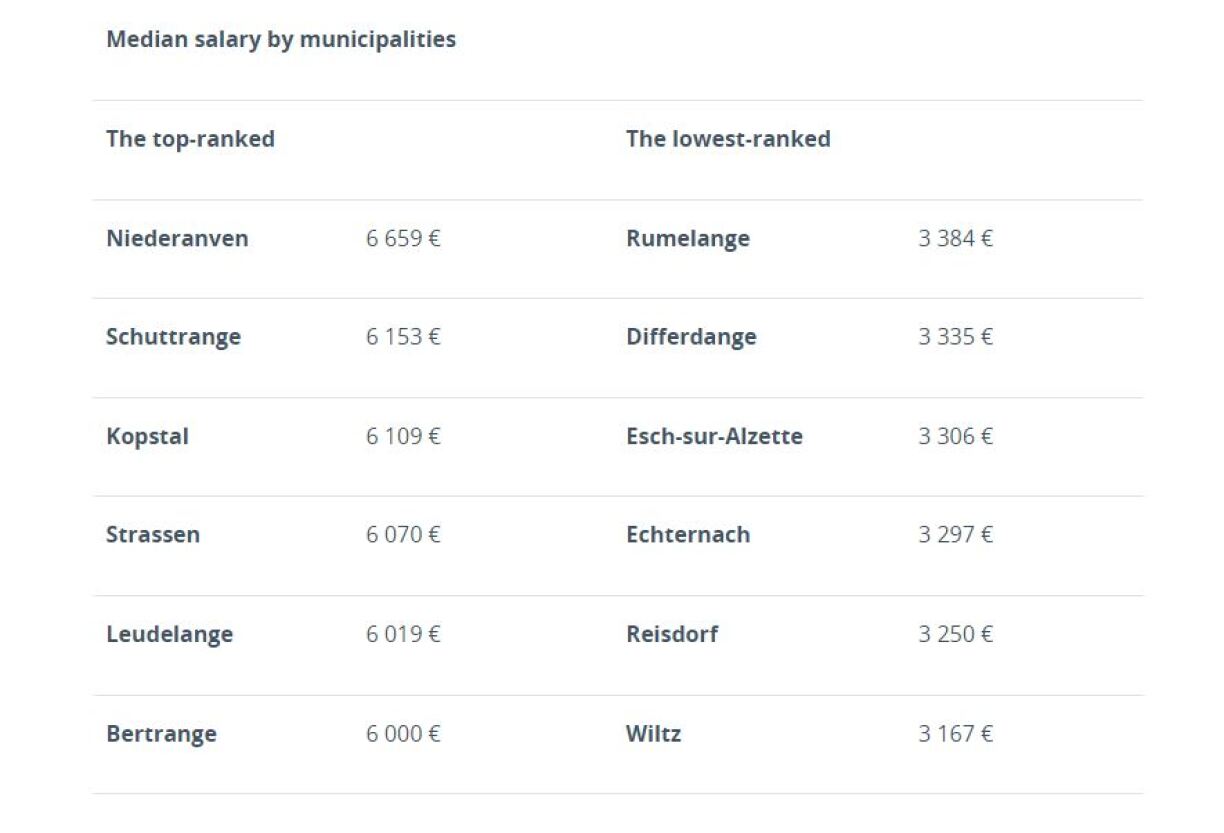
Notably, municipalities like Niederanven, Schuttrange, Kopstal, Strassen, Leudelange, and Bertrange all report median salary levels topping €6,000 monthly, while Luxembourg City itself lies at €5,139 per month.
On the other hand, municipalities to the north and south-west of the country show a contrasting situation with median salaries falling below €3,400.
Wiltz in northern Luxembourg is bottom of the pile with an average median salary of €3,167 per month, with Ettelbruck, Vianden and Troisvierges also performing poorly.
Municipalities bordering France to the south-west also lag behind the centre, with Rumelange, Differdange and Esch-sur-Alzette all lying in the range of €3,300-3,400.
This detailed breakdown allows for comprehensive analysis of income inequality. For instance, in Niederanven, the average salary stands at €12,644.86 while the median income is €6,659. The first and ninth deciles, which denote the salary level for the bottom 10% and the top 10% of earners, are at €2,234 and €21,875, respectively. These figures translate into a P90/10 ratio of 9.79, suggesting that the top earners receive nearly 10 times more than those at the lower end of the wage scale.
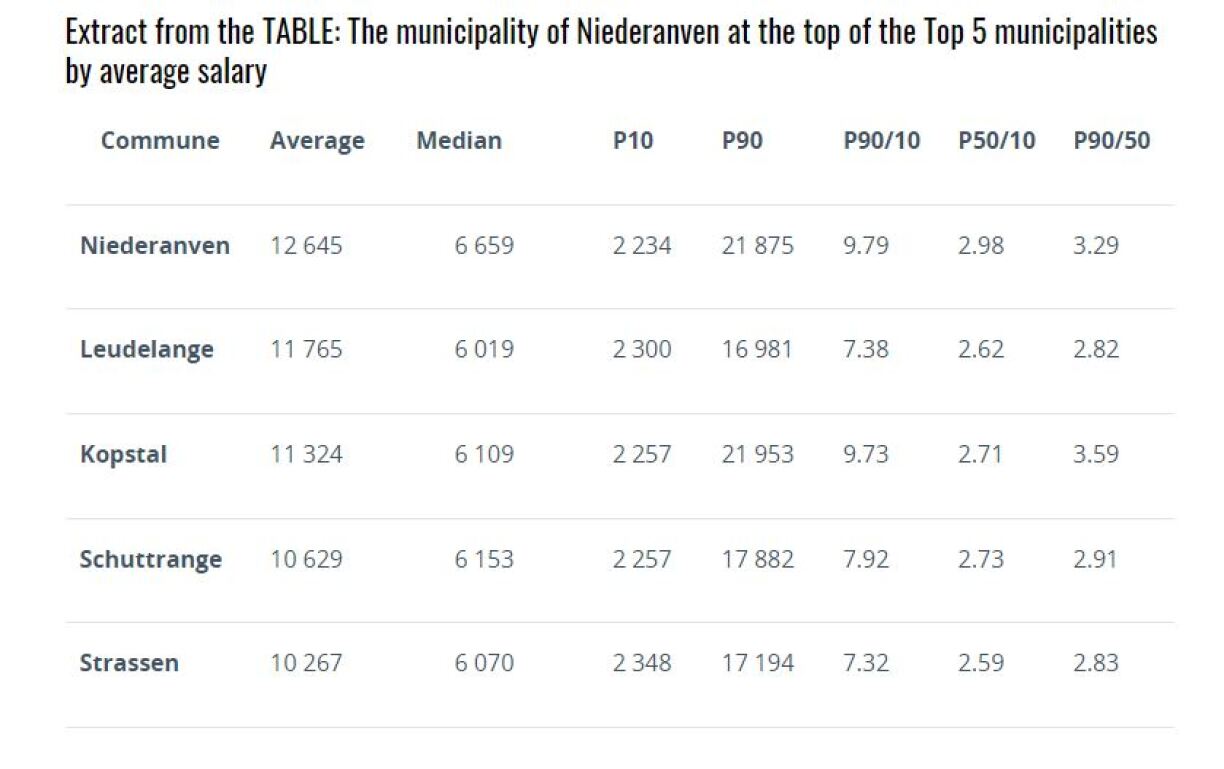
The complete table covers data spanning from 2013 to 2022 and is updated each year. The complete table can be found here courtesy of Lustat.
Luxembourg City, the country's principal economic and financial hub, generally sees higher salaries due to the presence of a significant number of financial institutions, international companies, and European organizations. These establishments offer an array of high-skilled, well-compensated job opportunities.
On the contrary, more rural areas in the north and municipalities located in the former coalfields in the southwest of Luxembourg present a different picture with relatively lower salaries. The reasons for this disparity include a limited range of job opportunities and a less diversified economy.