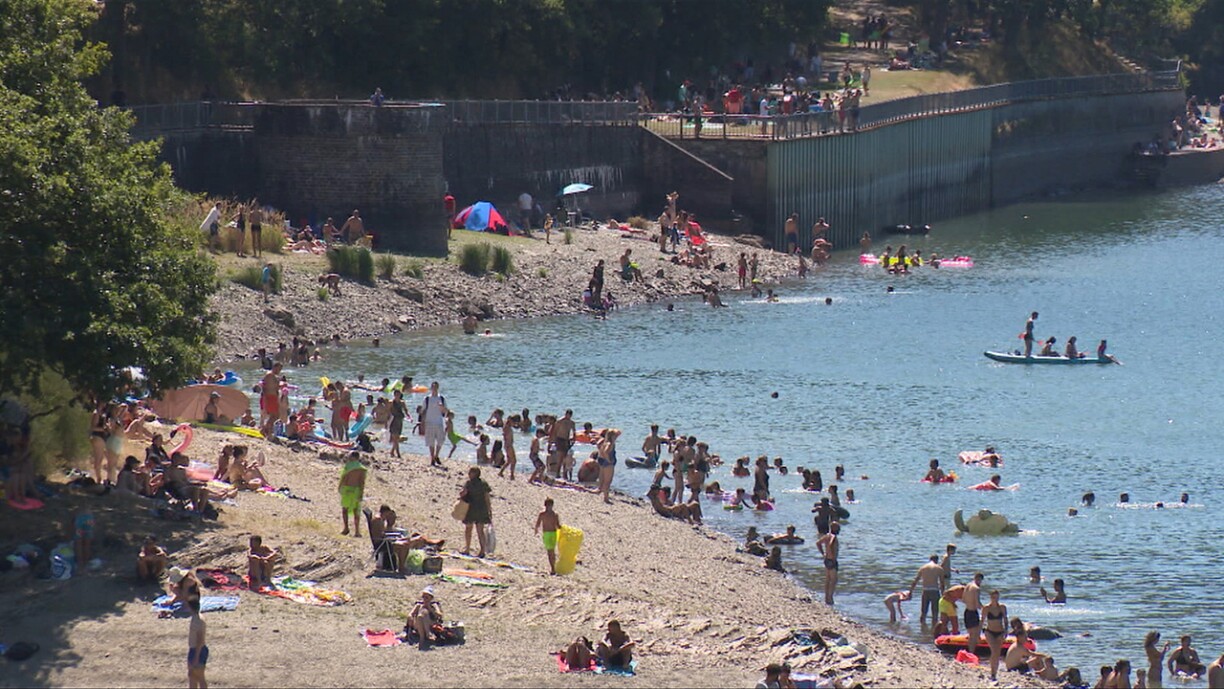
It might be an understatement to say that last weekend's situation at the Upper Sûre Lake was chaotic. There will be repercussions from what transpired, particularly given that some of the thousands of visitors acted in a less-than-civil manner. In order to be prepared for the next rush, the responsible local and national authorities have announced that they intend to take action. And all signs point to stricter rules at the Upper Sûre Lake in the future.
Especially on Saturday, the over 1,000 free parking spaces, as well as the 700 that are subject to fees, were all taken quite early in the day. Instead of turning back, however, numerous visitors just parked their cars wherever they pleased. This has happened in the past during busy weekends at the lake and was even tolerated to a certain degree.
But last weekend, red lines were crossed, says Marco Schank, the Mayor of Esch-sur-Sûre, who decided to take immediate action. In an interview with our colleagues from RTL Radio, Schank explained that there was a significant risk that rescue vehicles would be unable to access the area near the lake because of the large number of haphazardly parked cars. The village's mayor decided to close off access to the town but was shocked to see that some people blatantly disregarded the "no entry" signs.
This was the second time Schank had to make this choice; the first time was a weekend prior to the outbreak of the pandemic. Due to the pandemic, the municipality implemented a system in 2021 that required visitors to the Upper Sûre Lake to register their visit in advance.
But Schank admits that "this doesn't work around here; the lake is simply too big". He pointed out that Esch-sur-Sûre alone manages four beaches and that there are two more managed by neighbouring municipalities. "There are simply too many access points, we're unable to check them all," according to Schank.
Smaller areas, like the "Baggerweieren" in Remerschen, are easier to manage since they can simply be fenced off, according to Minister for Spatial Planning Claude Turmes. However, this is not feasible due to the Upper Sûre Lake's surface area. In the short-term, Turmes thinks that countable parking spaces could help the local authorities keep count of how many cars enter the area.
It is not the municipality's intent to "welcome an ever-increasing number of people at the Upper Sûre Lake," the mayor of Esch-sur-Sûre stressed. On the contrary, Schank pointed out that "the infrastructure is not designed for the number of people that were there". As a result, the police are unable to fulfil their duties properly.
Turmes agrees that one goal is to take pressure off of the police. He suggests creating a list of potential offences so that officers would not have to report each occurrence individually.
Another solution could be to allow municipalities to "borrow" municipal agents from larger neighbouring municipalities. Marco Schank, for one, does not exclude this option. However, the Mayor of Esch-sur-Sûre also considers hiring security personnel from private companies to prevent vandalism.
To discuss all of these proposals, an Upper Sûre Lake Committee – with representatives of the nature park, the police, the Grand Ducal Fire and Rescue Corps (CGDIS), the Bridges and Roads Authority, the municipalities, and the government – will be convened. The first meeting is slated to take place on July 6.





