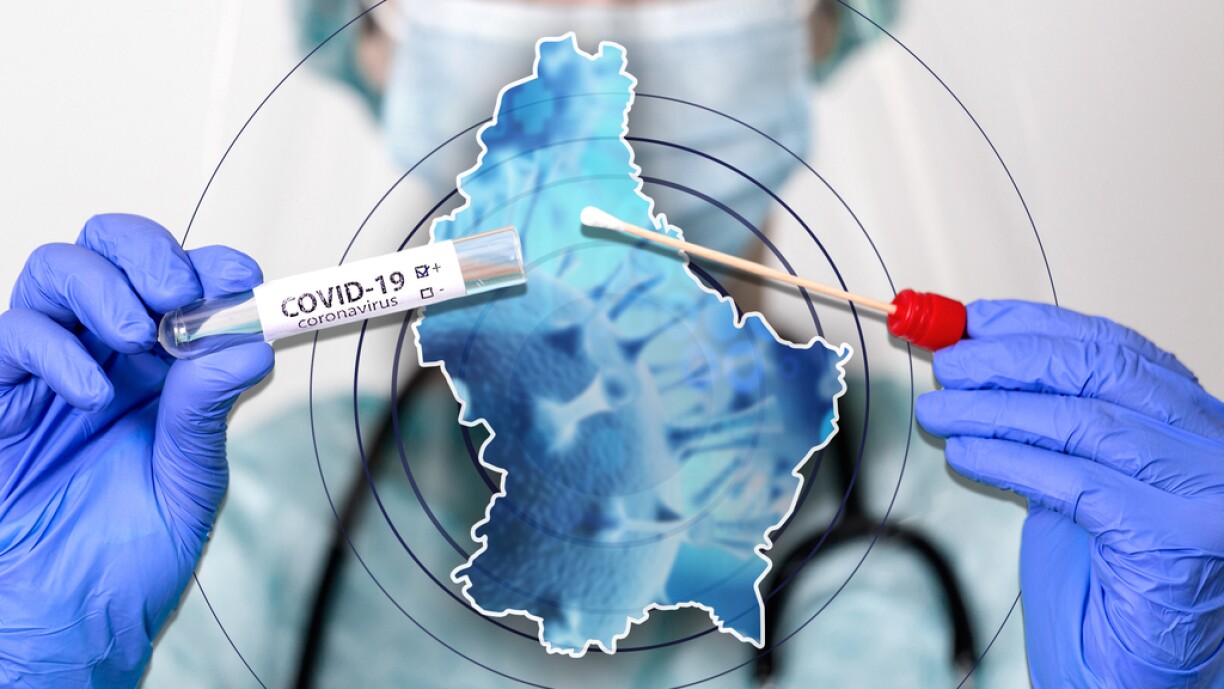
Between 31 May and 6 June, 324 new cases were reported in Luxembourg, i.e. a decrease of 8.5% compared to the week before, which saw 354 new cases. 217 people declared a positive result from a rapid test. The number of PCR tests also increased, from 44,490 to 47,272. 908 direct contact persons were identified, which comes down to an 18.5% increase compared to the week of 24 to 30 May.
Active infections are also on the decline in the Grand Duchy. As of 6 June, there were 675 active infections. On 30 May, there were 883. A positive trend can also be observed among cured individuals. 68,763 people recovered from an infection with the coronavirus. The average age of those diagnosed with coronavirus has slightly gone up from 32.6 to 33.9.
Deaths related to Covid-19 have decreased by 50% last week, with a total of two victims. However, the average age in this category has dropped significantly to 57 years.
The situation in the country's hospitals has also improved once again. Between 31 May and 6 June, Luxembourg's hospital treated 15 Covid-19 patients. A substantial decrease was observed in intensive care, where the number of occupied beds dropped from 13 to four. The average age among those hospitalised remained stable at 55. The effective reproduction rate has slightly increased from 0.82 to 0.89 over the same time period.
Another positive trend is that Luxembourg's seven-day incidence rate is at 51. In the week before, the Grand Duchy reported 56 new infections per 100,000 inhabitants. The German Robert Koch Institute considers countries with an incidence rate above 50 as "risk zones".
There is also good news regarding quarantine and isolation. From 31 May to 6 June, 28% fewer people were in isolation (836 people) and 30% fewer people were in quarantine (789 people). At 35.1%, one's own family remains the environment where people are most often infected with the virus, followed by recreational activities (5.1%) and holiday trips abroad (3.9%). It should be noted that in 50% of cases, the exact location or circumstances of infection could not be determined.
The trend for vaccinations is also positive. Last week, a total of 43,934 vaccine doses were administered, i.e. almost double the number administered the week before. Between 31 May and 6 June, 22,769 people received their first dose, while 21,165 residents received their second jab. As of 8 June, a total of 406,570 jabs have been administered in Luxembourg with 163,500 people being fully vaccinated.
One cause of concern, however, is the Delta variant, which was first discovered in India. This variant is currently responsible for 16.3% of all infections in Luxembourg. The most common variant in the Grand Duchy is the Alpha variant (first discovered in the UK) at 66%. They are followed by the Beta variant (first discovered in South Africa) at 2.8% and the Gamma variant (first discovered in Brazil) at 2.2%.





