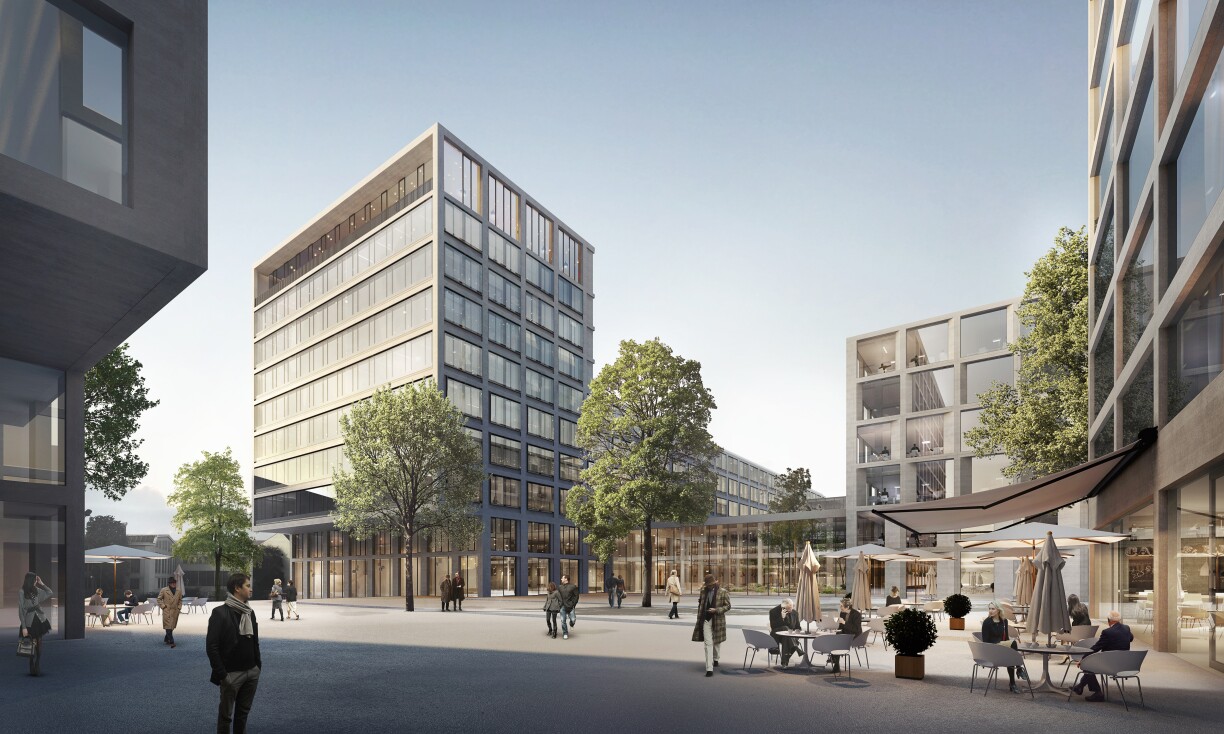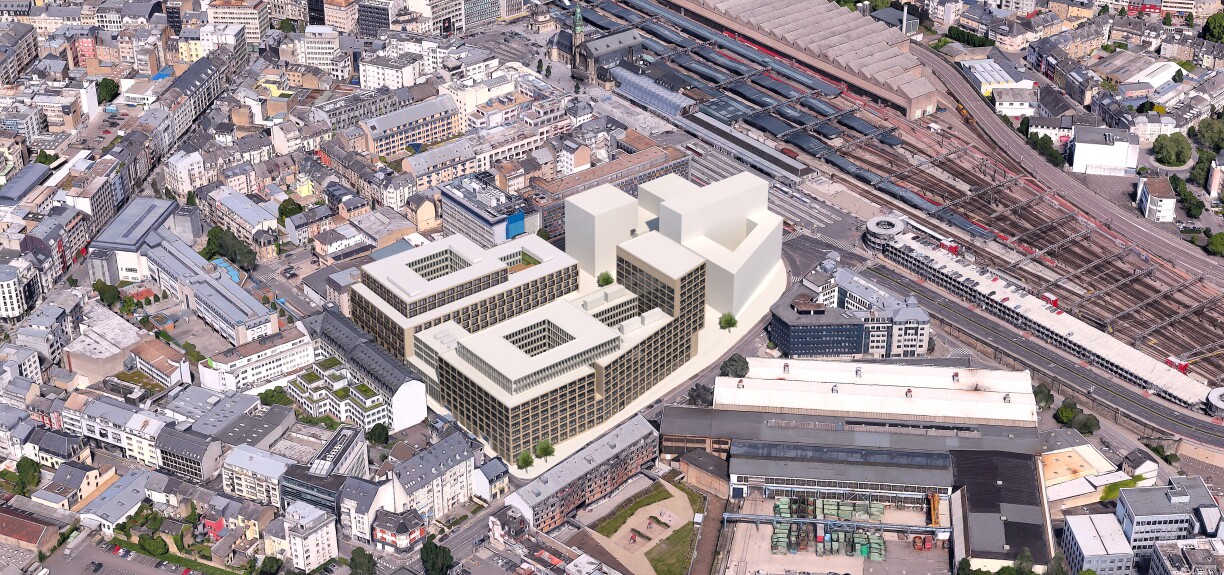
The first part of the massive Social Security City (Cité de la sécurité sociale) project was inaugurated in June 2023. Right beside it, a second building is now set to rise, officially launching Phase Two of the project.
The new building, spanning more than 35,000 square metres, is rising along Rue du Commerce and will mirror the first structure.
“It’s a similar administrative building, slightly smaller and without a tower. Where the two buildings meet, there will be the City’s garden, a large green space with trees, shrubs and flowers,” explains Romain Betz, head of the Real Estate Department at the Compensation Fund (FDC).
Betz adds one major detail that can’t yet be seen today: “What sets the future City apart is that, from above, all the rooftops will be green, just like the inner courtyards of both buildings.” He highlights the benefits of avoiding sealed surfaces, which allow rainwater to infiltrate more easily, and above all the improved quality of life awaiting the many employees already working on the site, as well as those who will join them by mid‑2029.
The entire complex will ultimately span more than 87,000 square meters of gross built surface. “It’s a major construction project for Luxembourg,” Betz explains. “That’s why we decided to build it in two phases.”
For now, stacks of construction containers occupy the spot where the central garden will eventually take shape. And where the historic building of the EU Publications Office once stood, there is now a vast, 18‑meter‑deep excavation. Nearly 40 workers are busy building the four underground levels. At the peak of the project, up to 300 workers will be on site at the same time.

At the outset, the team dug the pit deeper than its original level. “We’re building on Luxembourg sandstone, which is truly blue, meaning extremely hard,” Betz explains. To stabilise the excavation, reinforced concrete walls were poured, and anchors were driven into the ground, particularly along Rue du Commerce, to prevent any risk of collapse.
The structural work began in September 2025. While the first ground‑floor walls are already visible on the Rue du Fort Wedell side, the situation is very different at the opposite end of the site, near the station square, where only two basement levels have emerged so far. The reason: prestigious historical remains that sit almost flush against the future building’s underground structure.
Betz notes that Champagne lovers may be surprised to learn that the Mercier cellars once stood on this very site, hence the nearby Rue de Reims and Rue d’Épernay. Champagne was produced here using wine stored in those underground galleries.
“Most Luxembourgers don’t realise this anymore, but the cellars are still there, and we had to preserve them,” he says. With support from the National Institute for Archaeological Research (INRA), the entire network was mapped to protect as much as possible.
For context, Eugène Mercier established a Champagne production branch in Luxembourg City in 1895, taking advantage of lower customs duties on wine transported in barrels. By 1890, nearly 475,000 bottles were being exported from Luxembourg. The company returned to France after the First World War.

According to Christophe Dos Santos, project manager at Perrard, the site is progressing “well ahead of schedule”.
He also highlights a major innovation speeding up the work: the subcontractor responsible for reinforcement steel. “We’re working in a new way,” he says, noting it is “the first time in 15 years on construction sites” that he has seen this method used.
Normally, rebar arrives as individual steel bars. Here, the elements are delivered already welded into large frames. “All the assembly is done in the factory. Once the metal cages arrive, we simply position them and weld them together. And it works very well,” he adds. These custom‑made reinforcement cages, mesh panels and footings are produced at the CAAE facilities in Woippy, in the Moselle region.
The Social Security City will eventually bring together all of Luxembourg’s social security institutions on one site. The current building already hosts the National Health Fund (CNS), the Common Social Security Centre (CCSS), the Accident Insurance Association (AAA), the State Office for Assessment and Monitoring of the long-term care insurance (AEC), and the Medical Control of Social Security (CMSS). The second building will accommodate the National Pension Insurance Fund (CNAP), the Children’s Future Fund (CAE), and the Compensation Fund (FDC).
As landowner, the FDC is fully financing the project. Phase 1 required €176 million; Phase 2 will cost €141 million, plus €55 million for tenant fit‑outs, the wider Special Development Plan and the development of the entire site, including the main square and central garden.
In total, the project represents an investment of €372 million. Once completed, the FDC will lease the premises to the institutions moving into the new complex