In its fact-checking section, Agence France Presse (AFP) warns against the claims of this doctor from Luxembourg, a prominent local anti-vax figure.
In fact, this GP has been banned from practising for a year because of his controversial stance on Covid-19.
In a video shared several thousand times on social networks, he claims that people who have been vaccinated risk "micro thrombosis all over the body" and dying "next year".
He explains that he found D-Dimer levels - a possible marker of thrombosis - "above average" in one in five vaccinated patients. But "the increase in D-Dimer is not specific to thrombosis", as explained to AFP by the French Group of Studies on Haemostasis and Thrombosis (GFHT) and several experts. "Very high levels of D-Dimer in people who have been pricked," says the caption of this video, which has been shared more than 5,700 times on Facebook since 1 October. On the screen, Dr Benoît Ochs states that "one in five patients" would have D-Dimer levels "above the norms", before concluding that "there is a risk that these people will develop micro-thrombosis all over the body and by dint of this, all die next year." He also claims that many thromboses are found in the placentas of pregnant women. His claims are also being echoed on Twitter.

A reverse image search shows that the two-minute video is actually taken from an interview with Dr Ochs on the online programme 'Ondes de Choc' hosted by former public service journalist Richard Boutry, as shown in the screenshot below.
AFP has already fact checked false information disseminated by Boutry before.

Benoît Ochs also administered unauthorised treatments to his Covid-19 patients and described the vaccination of children as "infanticide". The doctor's lawyer has said he intends to appeal.
According to news website 'Marianne', Benoît Ochs draws inspiration from critical figures in the management of the pandemic in France, and praises Didier Raoult in particular: "I don't think Raoult is the best, but his results are the best in terms of mortality!". He also admires Louis Fouché.
This doctor, a prominent figure of the corona-sceptic movement in France, is known for his controversial positions on the health crisis, considering masks as "toxic", comparing lockdown to "camps", or speculating about the risk of sterility of the population due to vaccination. "Interesting and important scientific information", according to Benoît Ochs, who has joined the Reinfo Covid Collective, which was initiated by Louis Fouché.
In the video, Benoît Ochs states that high levels of D-Dimer are a consequence of the vaccine: "D-Dimer are products of the degradation of fibrin in clots," Marie-Antoinette Sevestre-Pietri, president of the French Society of Vascular Medicine, explained to AFP on 15 July.
"So, when you have a blood clot, you can have significant levels of circulating D-Dimer that can be measured," she said, adding that a specialist may prescribe a D-Dimer test when they suspect the presence of a blood clot.
However, "it's not because you have a high D-Dimer level that you have a thrombosis", Dr Nicolas Gendron, a doctor in the haematology department of the Georges-Pompidou hospital, told AFP on 20 July.
"If the D-Dimer level is below a significant threshold, it means that there is no trace of coagulation activation in the person, and we can exclude thrombosis from a diagnosis. But if the D-Dimer level is high, it does not mean that there is a thrombosis, it means that the suspicion is not lifted and that further tests, such as a CT scan, will be needed to confirm it," Dr Gendron continues.
In other words, a patient who has a thrombosis will most likely have an elevated D-Dimer level but a patient with an elevated D-Dimer level will not necessarily have a thrombosis.
This is because "the increase in D-Dimers is not specific to thrombosis", the French Haematology Society Group (GFHT) told AFP on 19 July. D-Dimers "increase with age, in pregnant women, and in many pathological situations such as bacterial or viral infections, even benign ones," the GFHT said.
Even if D-Dimer levels were elevated in vaccinated patients, this would not necessarily be a worrying signal. "When you are vaccinated, there is often an inflammation: you have a bit of fever, aches and pains, so it reflects a reaction of the body which is positive because it proves that the vaccine is working," says Marie-Antoinette Sevestre-Pietri.
However, while an inflammatory reaction will lead to a high level of D-Dimer, this does not automatically trigger a thrombosis. "To date, there is no scientific data to predict a deleterious effect of an isolated increase in D-Dimer levels," says the GFHT.
In the video that has gone viral, Benoît Ochs bases his claim that D-Dimer levels are rising as a result of the vaccine on what he has seen in his own patients. He claims that "one in five patients" would be affected. He does not detail any scientific protocol or provide any evidence.
He claims that "about 30 [of his vaccinated patients] have more than 3,000 D-Dimers" instead of 500 and that "at 3,000 D-Dimers you are thrombosing all your small arteries".
But as Marie-Antoinette Sevestre-Pietri explained to AFP on 7 October, "there is no normal level of D-Dimer." They can increase with age and setting a threshold of 500 as Dr Ochs does is misleading. "They are a useful biomarker in many circumstances. We use it in cases of suspected thrombosis, phlebitis, or pulmonary embolism, thinking that if it's below 500, there's no thrombosis, so we use the negative to rule out thrombosis, but if it's above 500, this tells us nothing."
Dr Gendron agrees: "The threshold of 500 ng/mL evolves, after 50 years, it's our age times ten. So, if you are 60, it's 600, if you are 70, it's 700, 80, it's 800 etc."
He adds that "in the case of a clinical suspicion of pulmonary embolism (with symptoms), if they are high, it doesn't mean you have a pulmonary embolism, it means that we can't exclude a pulmonary embolism, and we have to do a scan. It's a test actually to save on scans and to save time in the emergency room."
With Covid-19, D-Dimers were observed because "high levels can be a marker of unfavourable evolution but with lots of other things," adds Marie-Antoinette Sevestre-Pietri.
"The figures quoted do not shock me. Since Covid-19, we have found very high rates, we have seen rates of over 100,000. In this case, they may indicate the aggravation of a case of Covid-19, or if they are very high from the start, we deduce that it is a serious case of Covid-19," says Nicolas Gendron.
"Sometimes we get referrals for patients with high D-Dimer levels because of inflammation, cancer or for no apparent reason, and that's not why they're going to die within a year," he adds.
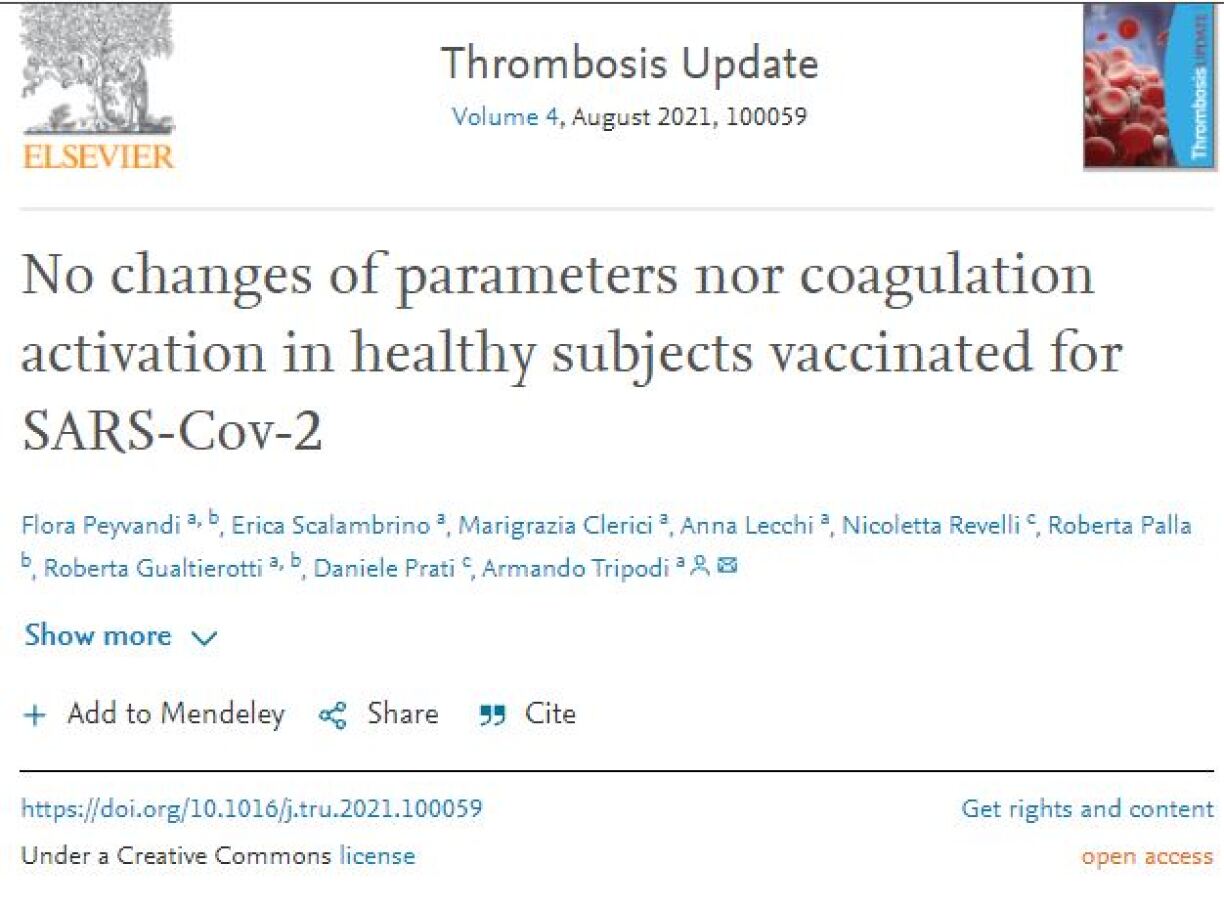
In contrast, a June 2021 peer-reviewed Italian study following 30 patients who received a first and then a second dose of Pfizer-BioNTech concludes that there is no increase in D-Dimer levels, nor any other sign of coagulation activation in those vaccinated, as seen in the screenshot below.
Dr Ochs also says that many thromboses are found in the placentas of pregnant women.
A study published on 11 May by Northwestern University in the US concluded that Covid-19 vaccines do not damage the placentas of pregnant women.
"The placenta is like the black box of a plane. If there's a problem during pregnancy, we usually see changes in the placenta that help us understand what happened," says one of the authors Dr Jeffrey Goldstein, assistant professor of pathology at Northwestern University School of Medicine.
"From what we see, the Covid-19 vaccines do not damage the placenta." The study included 84 vaccinated patients, with Moderna or Pfizer, and 116 unvaccinated patients who gave birth at Prentice Women's Hospital in Chicago.
"The study shows that there is no increase in thrombi, which means that there are still thrombi when you don't vaccinate," says Nicolas Gendron. According to Marie-Antoinette Sevestre-Pietri, "D-Dimers are higher during pregnancy in general, with the placenta, the presence of a living organism, the production of coagulation proteins is greater."
"Pregnancy is a phenomenon where you are at risk of thrombosis. This is a well-known fact. Some women respond to increased oestrogen by thrombosis. The physiological aim of pregnancy is to avoid post-partum haemorrhage, the D-Dimer levels increase because the body's aim is that on the day of delivery, the pregnant person is procoagulant and avoids a haemorrhage," explains Nicolas Gendron.
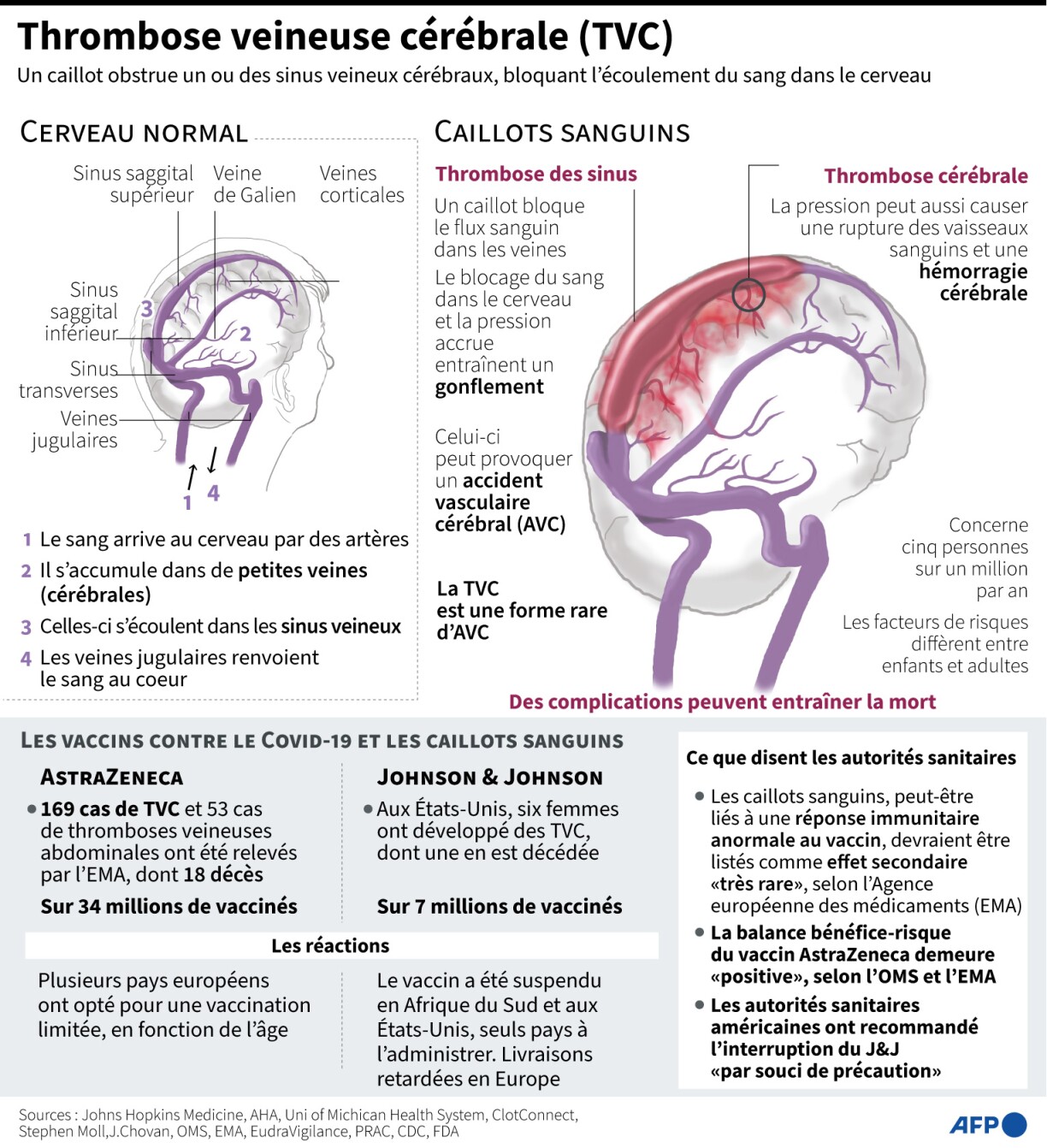
In April, the European Medicines Agency (EMA) said that blood clots should be listed as a "very rare" side effect of the two viral vector vaccines, AstraZeneca and Janssen, but this is not the case for Moderna and Pfizer/BioNTech's mRNA vaccines.
The EMA acknowledged "a possible link" between the AstraZeneca vaccine and Janssen as well as "very rare cases of unusual blood clots associated with low blood platelets", but said that in both cases the benefits outweighed the risks. For the AstraZeneca vaccine, the agency estimated in April that the risk of such clots was 1 in 100,000.
In addition, haematologists interviewed by AFP were keen to point out that Covid-19 increases the risk of cerebral venous thrombosis, an often overlooked consequence of the disease. A study published in April by Oxford University even concluded that the risk of developing a cerebral blood clot would be ten times higher after contracting the disease than after an anti-Covid injection.
The French National Agency for the Safety of Medicines (ANSM) notes, concerning all four authorised vaccines in its latest status report of 13 September 2021, updated on 5 October 2021, that "since the start of vaccination, 48,923 cases of adverse reactions have been analysed" out of "more than 71,206,000 injections carried out".
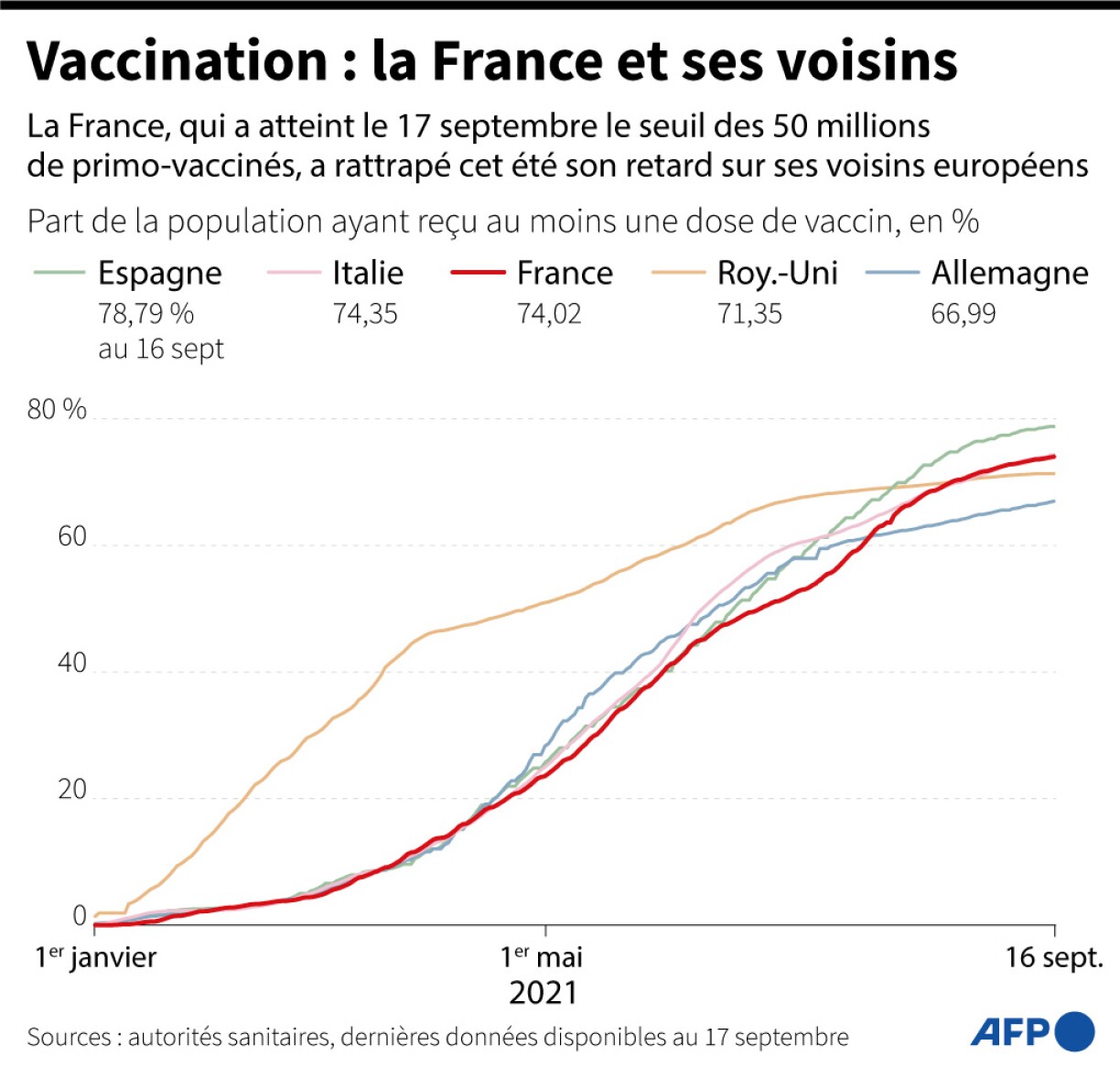
"The majority of adverse events are expected and not serious," the health agency reports. France reached the threshold of 50 million primary vaccinated on 17 September 2021, catching up with its European neighbours.