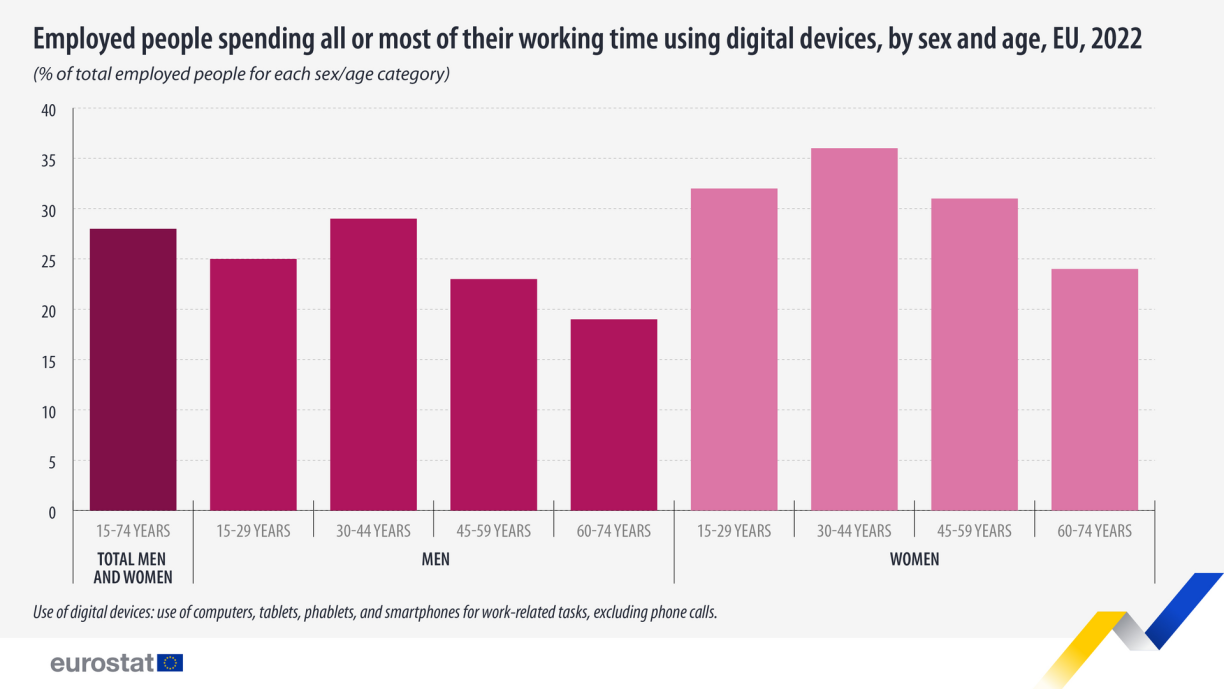
This trend demonstrated a gender imbalance, with a greater number of women making use of these devices than men.
For both sexes, the highest rates of digital device usage were noted in the age group of 30-44, with 36% of working women and 29% of working men engaging with digital tools either for most or all of their working hours.
The usage rate dipped in the subsequent age groups of 45-59 (31% women, 23% men), and 60-74 (24% women, 19% men).
However, this EU-wide trend was overshadowed by the usage figures in Luxembourg, where 47% of employed people aged 15-74 used digital devices for the majority or entirety of their working time. This was the highest rate among EU countries, followed by the Netherlands and Sweden at 41%. On the contrary, the lowest rates were registered in Romania, Bulgaria, and Greece, each at 12%.
Moreover, the EU data exhibited a positive correlation between the level of education and the usage of digital devices at work, irrespective of gender.
Women with a low or medium level of education used digital devices more frequently than their male counterparts, with 10% of women with low education and 28% with medium education using digital devices for most or all of their working time, as opposed to 8% and 16% of men respectively.
Interestingly, the situation reversed for people with a high level of education, with 47% of men and 44% of women spending most or all of their working time using digital devices.
Despite the shifts in gender disparity across different education levels, Luxembourg still remains a leader in digital device usage within the EU employment sector.





