If the walls of the Chamber of Deputies in Luxembourg could talk, they would have much to tell us.
Construction of Luxembourg's parliament, known as the Chamber of Deputies (Chambre des députés), dates back to 1858, while the adjoining Grand Ducal Palace, constitutionally reserved for the performance of duties by the Grand Duke, is almost 300 years older (1570s), as are the buildings across from the actual chamber which house administrative offices.
While historic photos and documentation help us paint a picture of these streets, now often busy and bustling with parliamentary deputies, administrative staff, residents of Luxembourg and tourist groups, many details of the past have been lost over the centuries.
To remedy this, historians and archivists have worked for years to research, understand, and present the building’s history and what it can tell us.
Diving into where it began, the changes it has seen and the stories it tells, head of the Parliamentary History Department Dr Fabio Spirinelli brought RTL Today into the various sites that make up today's Chamber.
The Chamber building itself was constructed between 1858 and 1860 by Antoine Hartmann, who despite such prominent work was lesser known than some of his peers.
The architecture presents a historicist style – a mix of different architectural styles from different periods.
"Before the Hôtel de la Chambre was constructed, you had another building standing here, which was called Maison Heynen", Spirinelli said. "It was used for administrative purposes, but it was in very bad shape, in ruins."
One of the reasons this particular location was chosen was for simple feasibility: there were not many other options that could meet those needs.
"At the time the building was constructed, Luxembourg was still a fortress", Spirinelli explained, "and this was probably one of the few spots [in the city centre] where it was possible to build a new building."
Next to where the Chamber was built was the Hôtel de Gouvernement – today, the Grand Ducal Palace. "At the time, it was still called Hôtel des États", Spirinelli added, "because the Chambres des députés did not exist. It was still Parliament, but it was called 'Assemblée des États' [Assembly of States] at the time."
The status of the Chamber in fact changed several times: As an institution, it became the Chamber of Deputies in 1848. Then in 1856, following a coup by then-Grand Duke William III, it was reverted to Assemblée des états.
And finally in 1868, Luxembourg's new constitution marked the end of the more authoritarian period – and it once again became the Chamber of Deputies.
The buildings have since borne witness to massive political and societal change: the Prussian garrison, the first world war, the second world war, de-fortification, the digital age, and the modern day today.
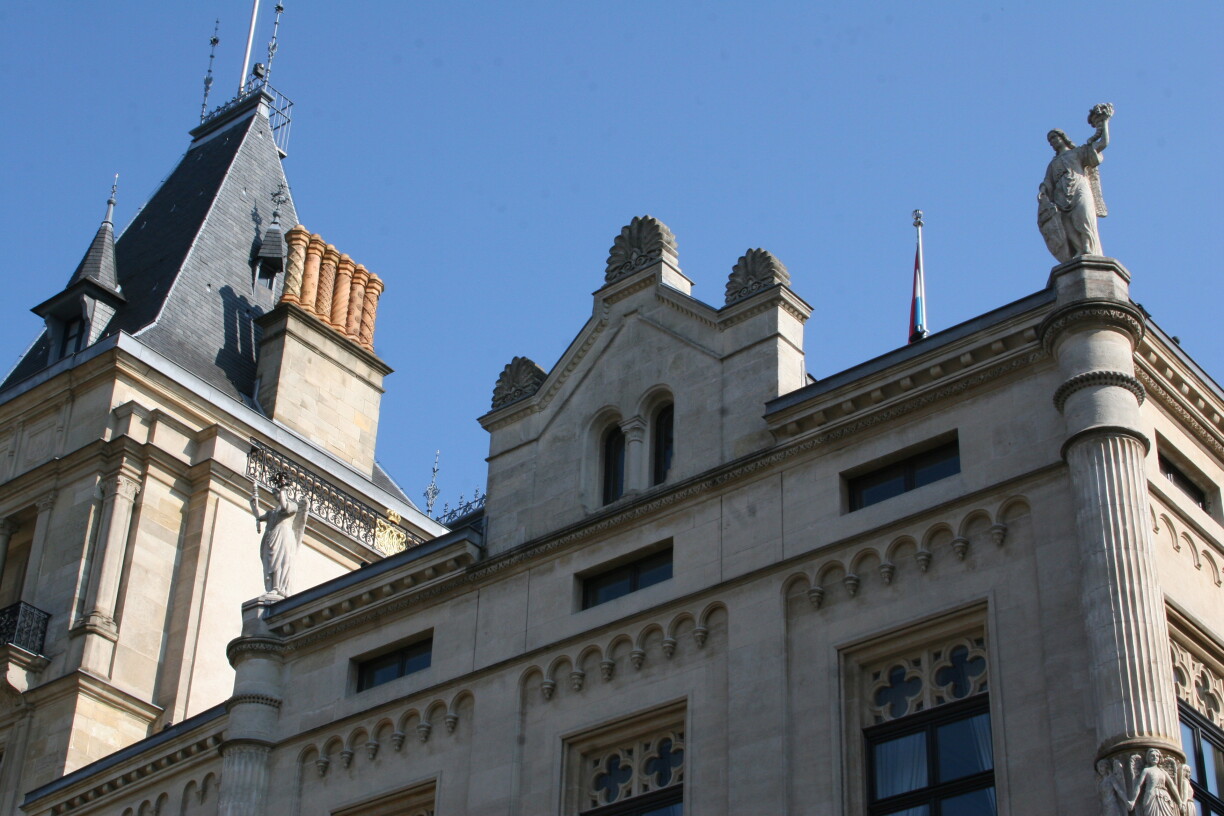
One thing that has remained stands atop both buildings.
"Since the building was constructed there have been statues of angels – but not these ones", Spirinelli noted. "During the Second World War, one of the angels holds a crown and this was removed by the Germans because, of course they didn't want to have any symbols of national independence to be shown."
Over the years, the hands of the angels disappeared too, due to erosion. In the 1970s, moulds based on the original statues were used to create new ones made of concrete, and in the 1990s, the statues were fully restored – crown and all.
As parliamentary staff grew there was a need to accommodate them.
Right across from the Chamber, you'll find what was then known as the Maison Richard, which became part of the Chamber in 1958, and the former Maison Printz, a hardware shop which was acquired in 1988.
The two buildings now form one block which houses offices of the administration and rooms for parliamentary commissions.
Nearby was Maison Wiltheim, a former bank that became parliamentary property in 2010.
"In 1945 there were four [administrative] people working at the Chamber of Deputies – and in the 1990s, we had around 40 people, so a tenfold increase over a bit less than half a century", Spirinelli said.
Since the 2000s and especially in the last decade, that expansion has continued to over 170.
And growth has been seen not just in size but also in scope, complexity, and quality. This includes the creation of new departments such as the Scientific Unit in 2021 and the Parliamentary History Department last year.
The chamber hall where parliamentary debates take place has changed significantly, too. In the 1880s, a bigger renovation plan was introduced to fight issues such as humidity, and to better connect the building with the technological advancements of the time.
"By the end of the 19th century, the building was also connected to the electrical network. [It] always went through changes that connected the larger technological developments to the needs of the Parliament, of the administration, of the deputies", Spirinelli elaborated.
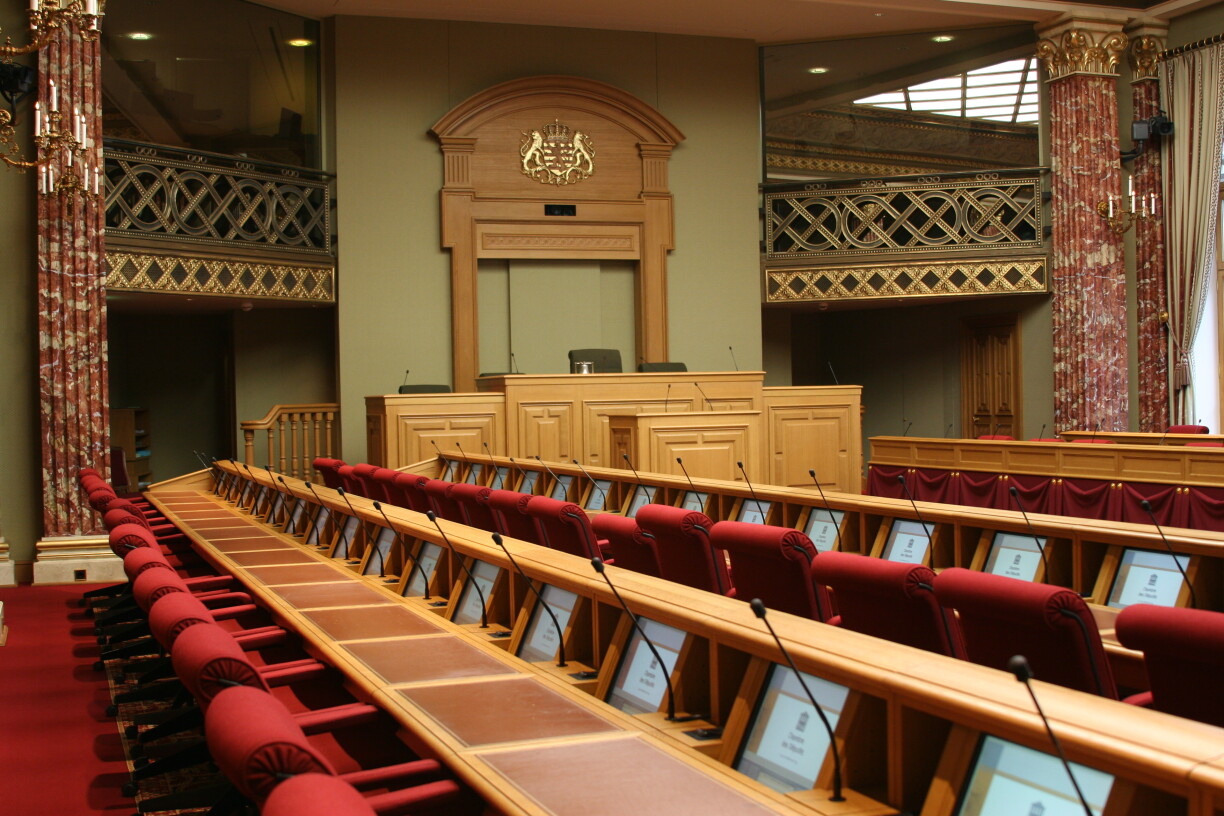
More than just practical or technical changes, these modifications pointed to changes in democracy and how it was practiced.
"They installed a podium at some point in the 20th century for the deputies then who wanted to go forward and [speak], which nowadays is very normal – but this was not the case in the 19th century", Spirinelli said.
Another major change: how parliamentary sessions were recorded. Historically, with stenographers in the middle of the room writing or typing. Since 1999, an extension overlooking the hall created a space for audio-visual recording equipment.
One thing most barely notice today is an interstice between the Grand Ducal Palace and the Chamber of Deputies.
"This was not there in the beginning", Spirinelli said, indicating a partition between the two buildings that connects them.
"[That] connection between both buildings was created in the 1880s, and I can imagine that one of the reasons at the time was […] for the Grand Duke to move easily from this building to the Chamber of Deputies.
"He was always supposed to open the parliamentary session so that's the reason also why they had a spot reserved for him – but of course this is also something that changed over the decades."
Another detail hiding in plain sight is what looks like a door from the outside, but one that does not open any longer.
"The former entrance on the side of the Chamber", Spirinelli pointed out. "When you look at it, you still see that there might have been an entrance at some point, and this is something a lot of people will pass by and don't really notice.
But this was an entrance until the 1880s, and you had a staircase behind that led to the tribunes and to the basement of the building."
During the German occupation, Spirinelli explained, the Nazi administration in Luxembourg also took air-raid measures for protection: "During the Second World War, in the basement of the Chamber of Deputies, the ceiling was reinforced and was used as a kind of shelter."
This was not something uncommon, and in fact occurred in numerous public administration buildings throughout Luxembourg.
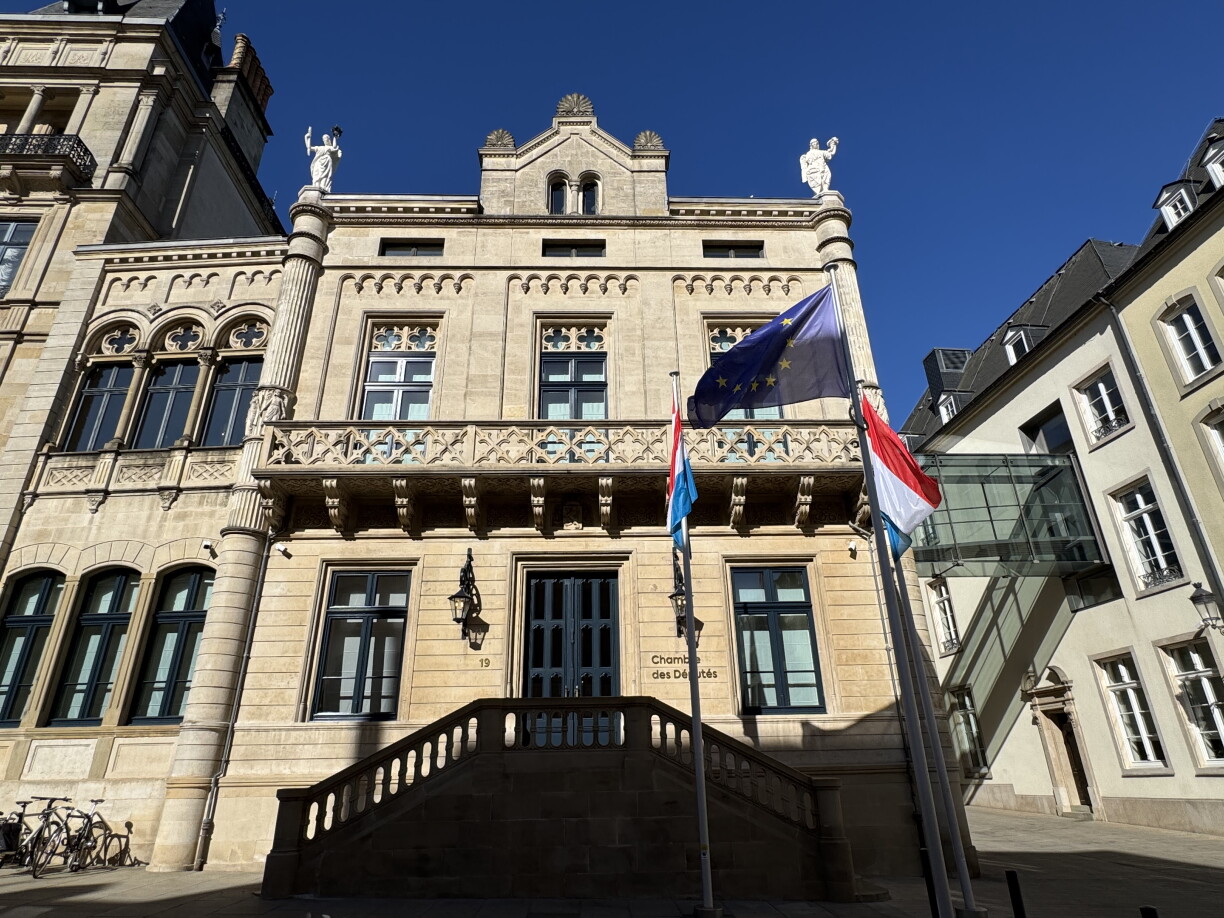
One thing that will stand out to any passer by (right above the oft-missed non-door) is the glass bridge.
"There were already plans in the 1930s to build a bridge", said Spirinelli, who explained that this was often the case – numerous plans were made and never realised.
"By the time a decision might have been taken, you had the war breaking out and the German invasion, and this is also one of the reasons why some projects didn't come through."
Had it been built in the 1930s, the bridge would have looked very different, and likely been made from stone.
Today, this modern bridge is meant to represent more than a sleek, modern structure: "The material of the glass bridge represents this transparency, [which is] important for parliamentary administration, and also the idea of connection."
Deep in the archives of these buildings are records of every discussion in parliament – from 1816 till the modern day. And in these details, both in the books and the buildings, the ideas and the institutions, history has a lot to tell us.
Work on this subject still continues today.
"There are so many aspects that still need research and I think this is something that also motivates [us] to do research on the issue of the Parliament", Spirinelli said.
"It's important to let people know the history of an institution where they send their representatives, to understand how at some point, political decisions were made – but also to understand the dangers that you might have for democracy to disappear."
On one hand, we know that the Chamber of Deputies was abolished after the German invasion in World War II. But with research, we also know that tensions on democracy were already present in the 1930s.
"[It is] also very important from a historical perspective to look at and to understand, how did this happen, and what were the reasons – if we can understand the reasons.
So, this is a really important part of our history, of our political history", Spirinelli concluded.





