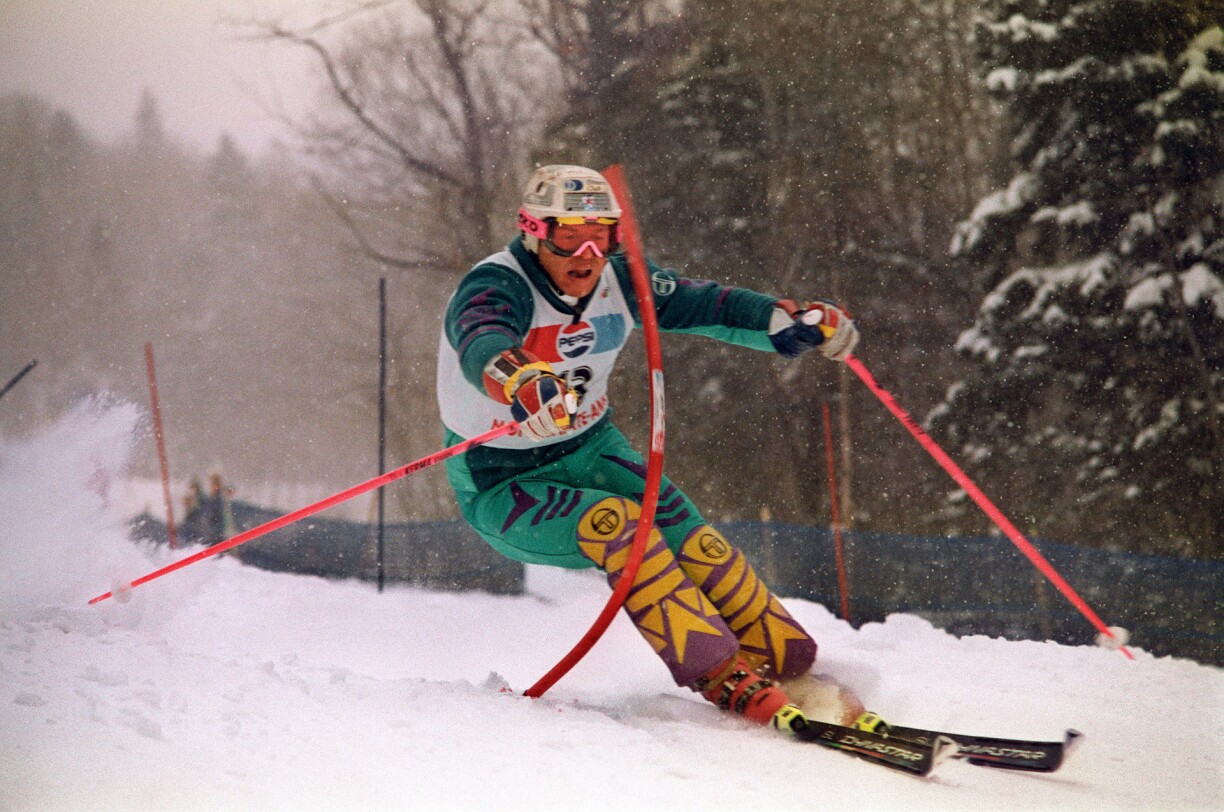
Marc Girardelli’s path to skiing greatness took an unexpected turn when he left Austria to compete for Luxembourg, a country with no alpine tradition. Despite this, he became one of the most decorated skiers in history, though Olympic gold remained just out of reach.
Listen to to episode right here or continue reading below!
Today, it’s the first episode of a double-header exploring the history of Luxembourg’s participation at the Olympic Games from 1900 to the modern day.
Marc Girardelli was born in Lustenau, Austria, in 1963 and took to skiing from an early age, excelling in multiple alpine disciplines, including slalom and ski jumping.
He was on track to compete for Austria on the world stage, but a dispute with the country’s skiing federation over his refusal to attend a boarding school derailed those plans. At just fourteen, he switched allegiances to Luxembourg – despite having no real ties to the country.
The move may have been partly strategic, as Luxembourg lacked a strong winter sports tradition and competition for places was minimal.
However, it came at a cost: due to existing regulations, Girardelli was barred from representing his new nation at the 1980 and 1984 Winter Olympics, as well as the 1982 World Championships.
Despite these setbacks, Girardelli was still able to compete in the FIS Alpine Ski World Cup, a prestigious circuit akin to today’s Diamond League in athletics.
He claimed his first World Cup victory in February 1983 in Sweden and finished third overall in the 1984 season after multiple wins. By 1985, at just 21, he secured his first overall World Cup title, triumphing in 11 individual events across slalom, giant slalom, and super-G.
His path to dominance was far from smooth. Prone to injury, he suffered a major crash in 1983 that tore cartilage, ligaments, and a tendon in his left knee. Yet, despite these setbacks, Girardelli remained a force in alpine skiing.
Girardelli made his World Championship debut for Luxembourg in 1985, claiming silver in the slalom and bronze in the giant slalom. He retained his World Cup overall title in 1986 before securing his first World Championship gold in the combined event at Crans-Montana in 1987.
He went on to win three more World Cups (1989, 1991, 1993) and three additional World Championship titles (1989, 1991, 1996). His five overall World Cup victories stood as a record until 2017, while his 11 World Championship medals place him second all-time.
A giant of the sport, Girardelli dominated at the highest levels – but Olympic gold remained elusive for both him and Luxembourg.
Girardelli made his Olympic debut at Calgary 1988, though it was far from his best season. Winless on the World Cup circuit that year, he struggled in Canada, managing only ninth-place finishes in the giant slalom and downhill.
Albertville 1992 offered his best shot at Olympic gold. In the super-G, he was edged out by Norway's Kjetil André Aamodt by 0.73 seconds; two days later, he fell just 0.32 seconds short of Italy’s Alberto Tomba in the giant slalom.
Two years later, with the Winter Olympics now offset from the Summer Games, Girardelli could not better his previous results, finishing fourth in the super-G and fifth in the downhill.
His Olympic tally remained at two silvers – a strong achievement, accounting for half of Luxembourg's all-time haul, yet a slight disappointment for a skier who had long been at the sport’s summit.
Thank you for tuning in! Now what are you waiting for – download and listen, on iTunes, Spotify, or wherever you get your podcasts.





