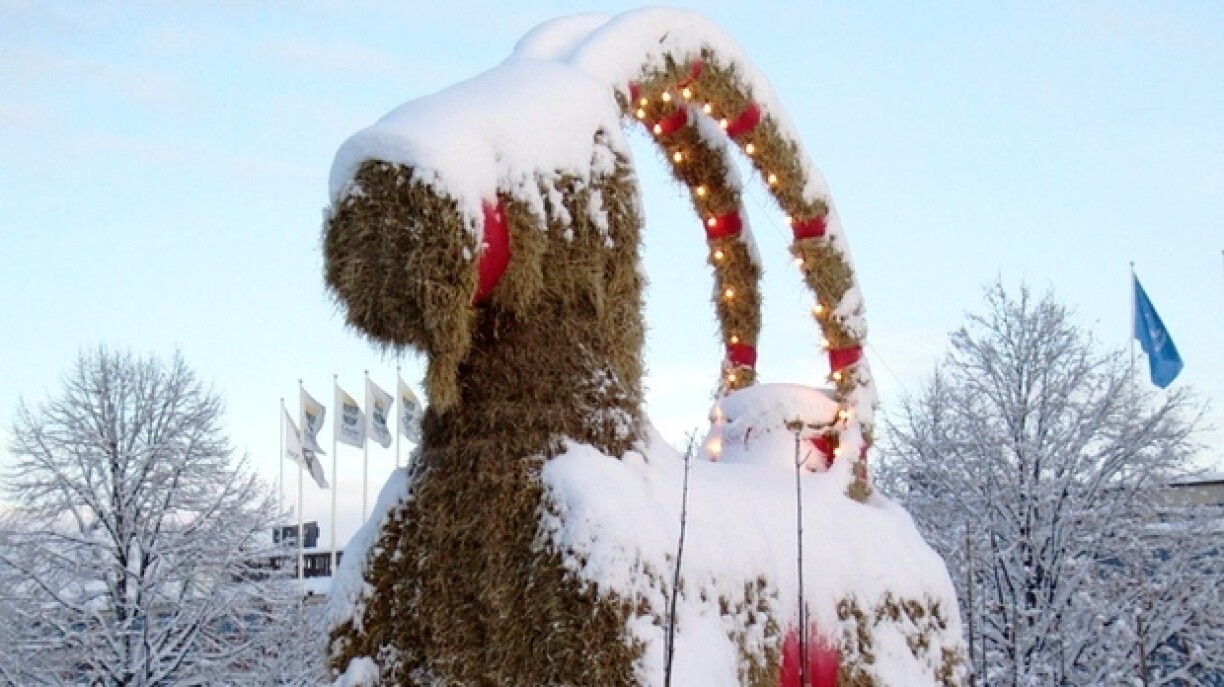
The actual tradition of erecting the goat, which usually measures well above 10 metres in height and weighs a couple of tonnes, began in 1966 - and since then, it has been demolished in one way or another an astounding 37 times, which means it's destroyed more often than not. Every year sees public speculation as to whether or not the goat will survive, and quite a few people watch the goat live on webcam to see if they can spot potential hooligans. Since 1988, some betting companies also take bets on whether it will survive.
It's not a cheap affair either - the cost of the 2006 goat reportedly landed at around 100,000 Swedish kronor, which is just shy of €10,000. If it's destroyed before 13 December, the goat is generally rebuilt.
A notable case of goat-burning vandalism occurred in 2001, when a visitor from Ohio burned it to the ground and was fined 100,000 SEK, served 18 days in jail, and had his lighter confiscated as 'he clearly was not able to handle it'. His defence was that he didn't know it was illegal, and thought he was taking part in a tradition.
The 'tradition' of vandalising the goat is understandably frowned upon by the group who finance its construction, and they have taken several steps over the years to keep it safe. In 1996, for instance, they introduced surveillance cameras to monitor it 24/7 - and that year, it did survive. It has however been burned down 14 times since, and only narrowly survived in 1997.
In 2003, the goat was protected by security guards. However, as temperatures dropped they decided to go warm themselves up in a nearby restaurant, at which point vandals sprung to action and, predictably, burned it down.
Attempts have also been made at fireproofing the goat since around 1979, though at times this has led to the goat looking 'soggy', and even with this protection vandals have managed to burn it.
Among the more dramatic attempts at burning or otherwise sabotaging the goat is the incident of 2005, when vandals dressed as Santa and a gingerbread man managed to burn it down by firing flaming arrows at it using bow and arrow.
In 2010, meanwhile, the goat actually survived - but not for lack of ambitious plans. On 2 December an unsuccessful attempt was made at burning it. Some two weeks later, on 17 December, it was reported that someone had attempted to bribe one of the guards to look the other way while the goat was to be airlifted by helicopter and flown to Stockholm.
While burning remains the most common method of destroying the goat, it has also been hit by a car, and been thrown into a river. The webcams aimed at the goat have also been hacked, for instance in 2009, just before vandals proceeded to burn the goat to the ground.
While attempts were made in 2018 and 2019, the goat has survived since 2017. Last year's security measures included a double fence, 24-hour CCTV, and two guards and a canine unit patrolling it 24/7.





