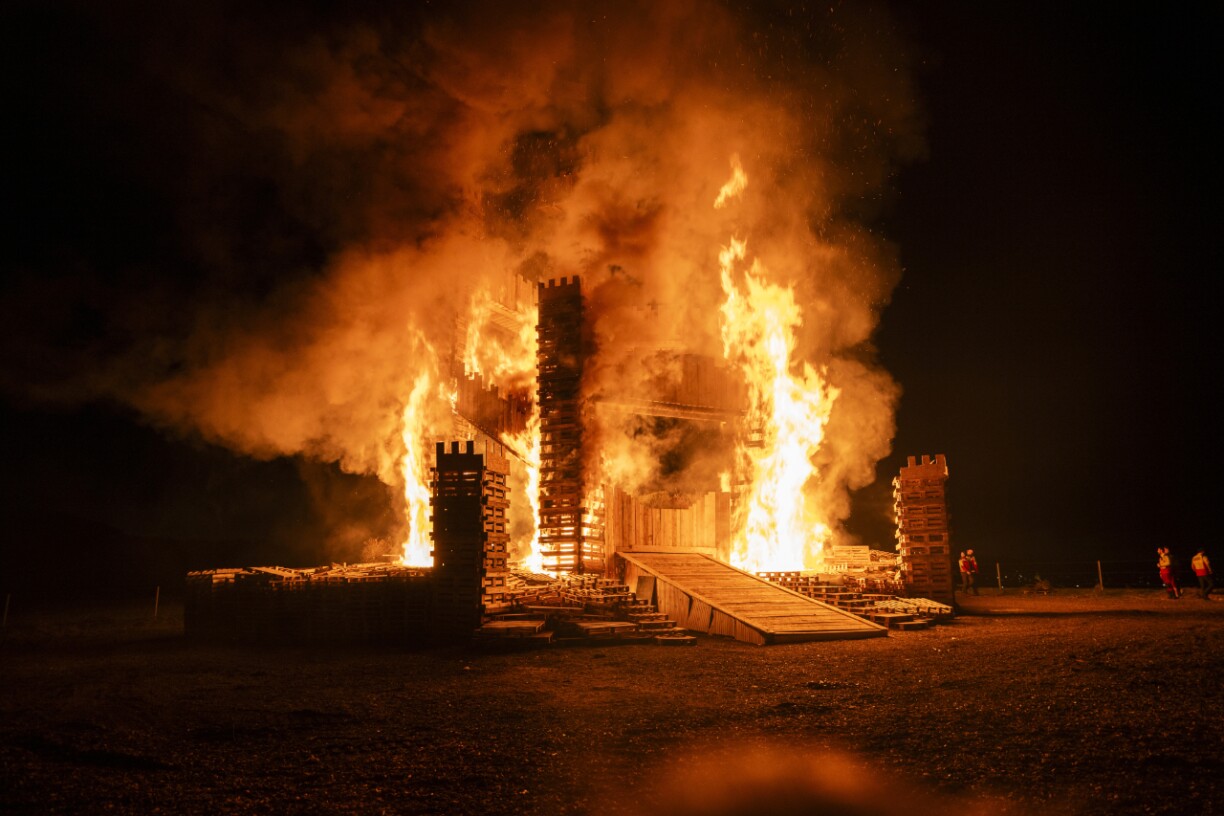
Across the country, winter is symbolically driven away with the lighting of bonfires. However, the weather forecast currently points to unstable conditions. What rules apply to the organisation of these events and what materials may be used for the traditional fires or crosses?
As Buergbrennen is a long-standing tradition, an exception applies – under normal circumstances, it is prohibited to burn waste outdoors, including garden waste. For Buergbrennen, only untreated wood that has been collected, straw, or hay may be used.
Sophie Capus, who is responsible for strategy and concept development at the Environment Agency, notes that moisture content is another important factor. While not a legal requirement, she explains that wood should not be too damp in order to minimise the release of pollutants.
Toxic substances are also produced when processed wood is burned – for example furniture or other bulky waste. Such materials must not be used, Capus stresses. Lieke Mevis, a biologist at Natur&Ëmwelt, also emphasises that inappropriate waste has no place on a Buergbrennen bonfire.
In the 1980s, tyres were sometimes burned, but this is no longer permitted. According to the Environment Agency, clubs are well informed and no complaints have been recorded in recent years.
Wind gusts of 40–50km/h are forecast, particularly in the evenings. MeteoLux generally issues an orange weather warning at around 65km/h, according to Luca Mathias from MeteoLux.
However, gusts of up to 50km/h can already pose risks, particularly in exposed locations. MeteoLux itself does not issue specific instructions relating directly to Buergbrennen fires.
The situation differs at the Grand Ducal Fire and Rescue Corps (CGDIS), which has more precise provisions. According to its guidelines, organising a bonfire is prohibited if wind speeds exceed 39km/h. However, RTL did not receive a response when asked what this entails exactly.
A 2019 document states: "Before lighting the bonfire, the organiser must ensure that the weather conditions allow for a safe fire. To this end, he can inquire with the air navigation administration or consult the MeteoLux website about the evolution of weather conditions during the hours when the public is present. In case of wind greater than 39km/h (Beaufort scale 6), lighting the bonfire is prohibited. A strong risk of thunderstorms must also lead to postponing or cancelling the event."
How conditions will develop over the weekend remains uncertain.
Natur&Ëmwelt also reminds organisers not to build bonfires too early, as animals may seek shelter beneath the wood or straw and risk being burned. According to the organisation, clubs are generally well informed about these environmental considerations.





