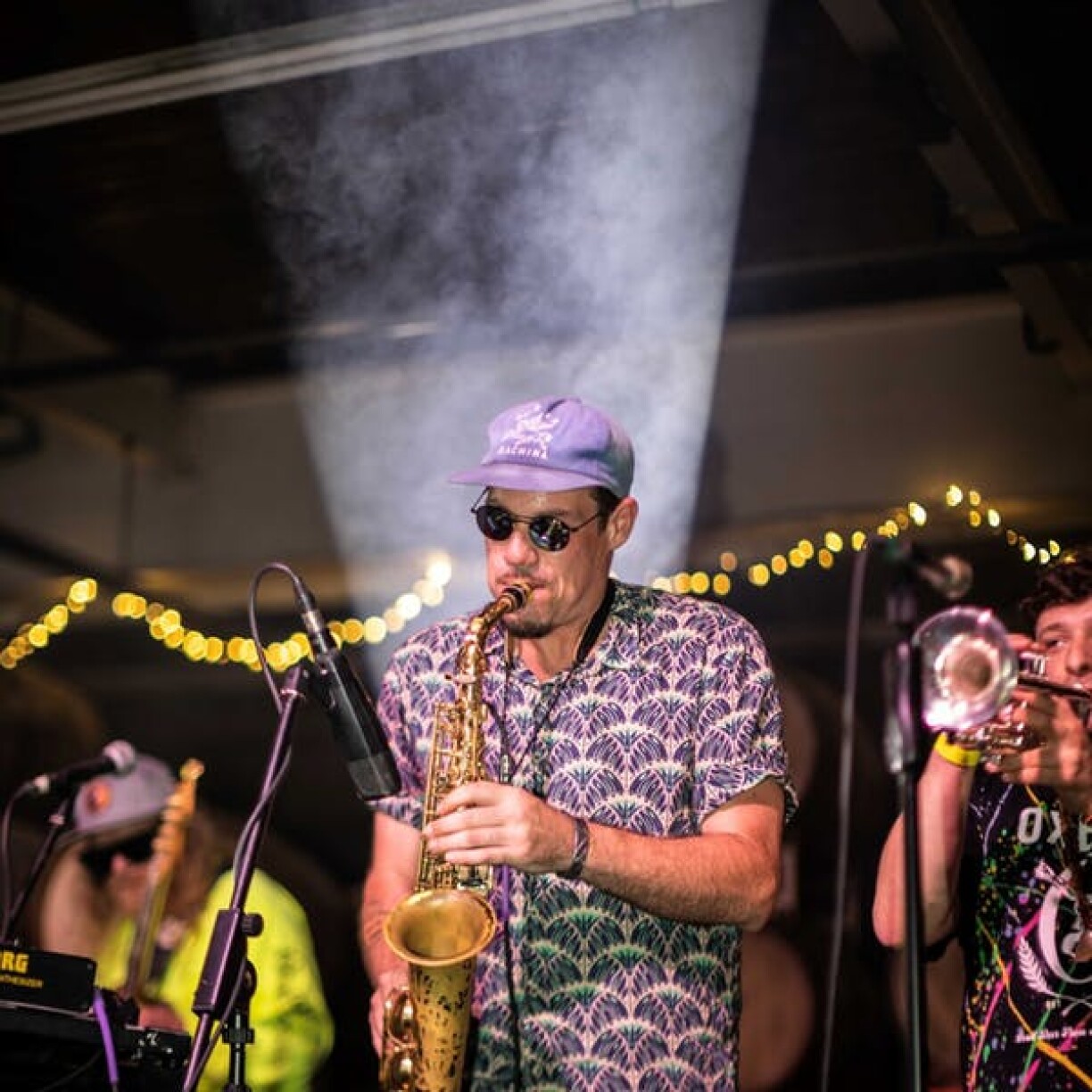
Lettuce is a six-piece funk band from the United States that combines a melting pot of soul, jazz, hip hop and experimental into an energetic and improvised performance. Despite years of live experience, the band's members drifted apart for about a decade, working in side projects with some of the biggest names in the music industry, including Clive Davis, David Bowie, Lady Gaga, Shakira, Eminem, Average White Band and Britney Spears. In the back of their minds was always one priority, however: to lift Lettuce back off the ground.
With its name derived from "Let us play", Lettuce has built a loyal following in the States and among jazz, soul and funk festival goers in Europe. That magic continues to grow with the band’s new album "Elevate", a democratic ensemble in which there is no leader, but a complete unit that functions as a single entity, with plenty of moving parts. Ryan Zoidis, sax player and one of the four founding members, chatted to RTL Today ahead of the gig about how he experienced the Grammys, the band's past and future, and life on the road as a family man with a young daughter.
Find out how to win tickets at the bottom of the article.
Hey Ryan! I must have called you out of bed this early in the morning.Sounds like a great way to celebrate the last day at home with the family. I really look forward to chatting about your music and your upcoming Luxembourg show, but first of all: congratulations on your Grammy nomination!
Thank you so much!
Were you at the event?
Yeah, I took my mom! It was great, it was beautiful. It was actually a bit of a somber day because right when we showed up we found out about the helicopter crash that Kobe Bryant and his daughter were in. But other than that it was really exciting and just felt...it just felt great to be included in that ceremony on that level. Sometimes it's hard to tell where we are with the rest of world musically. We're so embedded in what we do, so it was a really nice validation and a real good moment for the band and everybody involved.
How did you feel at the ceremony? Did you think you had entered some sort of bubble, felt out of place, or maybe even sensed an atmosphere of inclusion by your peers?
Honestly I felt like we belonged there. We've been playing music and making records for...jeez, so long! Over 20 years. We've been recording music for over 20 to 30 years, so I really felt like we belonged there. I had written it off years ago as something we would never participate in because our music was hard to classify, but it felt great to be around all our peers that were there. Peers that we have shared and exchanged things with, played gigs and recorded with. It was really cool to be in a room with all these people that we really respect.
Do you think that the Grammy's still have a big say in the music business? Maybe it's big flaw is that artists that have been making music for so many years aren't always included.
I don't know, man. It's an award ceremony for art, so if you break it down it definitely and will always have some flaws. There are a lot of amazing people that never got nominated for a Grammy, such as John Coltrane. That seems like a pretty glaring flaw to me. For me, music and competition both never really vibed, they don't go together for me. Art and "Who is better?", all that stuff doesn't make sense to me.
But at the same time it was nice to be nominated. Sometimes we get bubbled and isolated into the jam band scene here in the States, so this is something that helps validate us to the rest of the music listening world that doesn't pay attention to that stuff.
So in a way you're glad the award ceremony exists but it's also healthy to distance yourself from it?
I don't know about distance, but just not really think about it. We wanna continue making and doing what we do best, which is trying to make great music. If we get a Grammy along the way, awesome! A nomination has definitely helped us as a band and entity, I think, simply because it opens up people's ears to us that normally wouldn't check us out.
Were you a student at Berklee as well, just like the rest of the band?
Yeah. We all met at a summer programme there when we were 15. We then met again a year later and even lived in the same dorm. There was an ensemble in the basement of the dorm and that's where we did most of our early improvisations. That's where we figured out that we had something special.
So did you all plan the fact that you would be in the same dorm?
We did, we definitely did what we could to be in the same dorm. That summer together we realised that there was something special there. At that time I lived off campus while everyone else was on campus, but I had gone to that programme the year prior and stayed with my dad, who lived in Boston. So I didn't really need anybody while I was there. Then in the second year I got put in an ensemble, and that introduced me to drummer Adam Deitch, guitarist Adam "Shmeeans" Smirnoff and bassist Erick "Jesus" Coomes. They were all on the same floor, if I remember correctly. So we played together then in the five-week programme and ended up hooking back up for college, and that's where it all ended up.
You must have very fond memories of that college time.
Yeah, I do, definitely. For example, being around a drummer that amazing like Deitch, who was on a completely different level than any other drummer any of us had ever played with up to that point. I think I can speak for all of us. He really pushed us to believe in ourselves more because he wanted to play with us. He liked where we were coming from stylistically - we all have this vague funk background and foundation that was our common thread. His parents are music educators so he definitely picked that up along the way, he just has that energy. He knows how to lift people up with positive encouragement and positive reinforcement. That's one of the things that really fuelled the early stages of the band. We were just kids! It helped us hold in on who we wanted to be stylistically. It was a very special time.
As is so often the case, many students going through music education at higher levels often end up with a degree but limited practical experience, and so they just get thrown into the real world and onto the stage. But you guys seem to have been gigging tremendous amounts and getting out there as much as you could.
Yeah. In our first year of college we were trying to find the college party that had a band already. We would then go, stand by the stage, ask the band if we could all sit in at the same time. So we would take over! We would go from party to party and do that, carrying all our gear. All the colleges are really close over there. MIT is down the street, North Eastern as well. Sometimes there would be a party at North Eastern, we would go and sit in, and the later head to an MIT party that was on a little later. That's really how we got a ton of people initially.
You're currently six guys in the band. Do you think it's a format and set-up that's proving to be difficult for financial and practical reasons?
Yeah, for sure. We're currently two horns, guitar, keys, bass and drums. It's definitely not practical and we definitely had our doubts about this years ago. That was one of the big reasons why Lettuce didn't gig for a long time. It was because Soullive (Editor's note: other band of former members Krasno and Evans) was touring extensively at that time, and they were primarily a three-piece, so we figured out that touring with a three-piece was much easier than touring with a six, seven or eight-piece. At one time we had eight of us. So what happened was that for 10 years we didn't really pursue the idea of Lettuce because we thought it wasn't financially possible. We left Berkeley thinking we were getting pop gigs as instrumentalists, which we did.
We all have great stories about that period when we weren't playing together. We were learning a bunch of stuff about situations. I was in a band here in Maine that ended up being signed to Arista Records by Clive Davis, and David Bowie sang on two songs on the record, recorded with Toni Visconti. Adam Deitch was out playing for Shakira, Average White Band, Scofield, Lauryn Hill, really big stuff. Then Adam Smirnoff, our guitar player, was gigging with Lady Gaga when she blew up, he also did Robert Randolph. Everybody was working, thinking we were doing the right thing. Our bass player was playing on every hip hop record, including Britney Spears and Eminem, the early Kanye stuff and a bunch of Drake records.
We all thought we were on the right path. But then we were all wondering about Lettuce and how we could eventually bring it back together. We all continued to believe in it and regrouped ten years later, with a few gigs in between. That's basically the story.
Those are big names. But so the decision remained to be a six-piece instead of eight?
Yeah, we are more agile, especially with only two people in the brass section. We are a little bit lighter on our feet when it comes to improvising sessions and coming up with horn parts on the spot. The rhythm section is constantly coming up with new stuff.
Do you feel like you constantly have to be on your toes with the rhythm section because they're so free in where they go during the gig?
Yeah, we always have to be on our toes, anticipating what and where they are going. But the beauty of it all is that we can read each other. We can almost telepathically communicate and know what's about the happen without any huge gestures. We also have certain technology now where we can talk through little mics in our in-ears, but we've never used it very much.
Do you think mid-show in-ear communication can have a negative influence on the band's performance?
I have mixed feelings about it, I go back and forth. Sometimes it's really helpful for something new. If we're doing something new and our drummer wants to cue the sections it's great, or if it's something drastic or we need to change something in the set list, or we're going into something just because someone feels like they want to go into it rather than what is on the set list. I appreciate those moments on stage.
We've gotten better at not using it as much anymore because we realise that it can really affect the morale, and can really become a distraction. People talking in your ear when you're playing...we only use it when we need it.
So what are your future plans? I read there is lots of new music in the making. Are you composing and recording constantly?
Well, our drummer Adam is one of the most prolific musicians ever, he just can't help himself. He's constantly writing and recording music no matter where he is or what he is doing. He's always thinking about the next tune, and he has a library of tunes ready to go. During our last recording session, which was supposed to be only for our current album Elevate, we ended up recording 30 songs. We have 20 songs that we plan to release over the next year. Our next record will be coming out in April or May, we're gonna start promoting that pretty soon.
Then we're gonna start work on our third album, which again is all from the same recording session. We'll probably cut two or three more songs to add to that final session. These three will go together as a package. Three full-length albums with the right artwork and vibe. There will be continuity in the sound and artwork.
I personally really want to do an improvised record, and we've been exploring the idea a little bit more, because so much magic happens live and we want to record a Hi-Fi version of that, on analog, mixed live to a WAV file. I've talked to a couple of guys about it, but we just have so much music to put out.

I'm curious to hear if there are any differences between touring in the US and Europe? Have you been here before?
We've been to Europe before but only done London, Paris, North Sea Jazz Festival and such. Most places where we are going we haven't been, so we're excited.
How's the touring routine for your daughter?
We talk every day and she's even coming to London to meet us. So that will be her first time in Europe, and she'll spend five days in London even though I only get to see her for one day. But that's okay. It's cool, when I'm gone I'm working but when I'm home I'm free. It's quality time, focused and present. It's balanced, a beautiful thing.
I was really nervous about it when we started touring hard, and she was a little bit younger, it was a lot harder. But now I know my schedule a year in advance and it makes things much easier. She loves it, she's exposed to all of this great music and I think there is a lot of positives. People think that musician parents are gone all the time, but it's just not really true. Every situation is different.
Lettuce are playing the Rockhal Club on Monday 24 February. Head over to our Facebook page, find the post of this interview and win tickets to the gig! Alternatively, get your tickets here.




