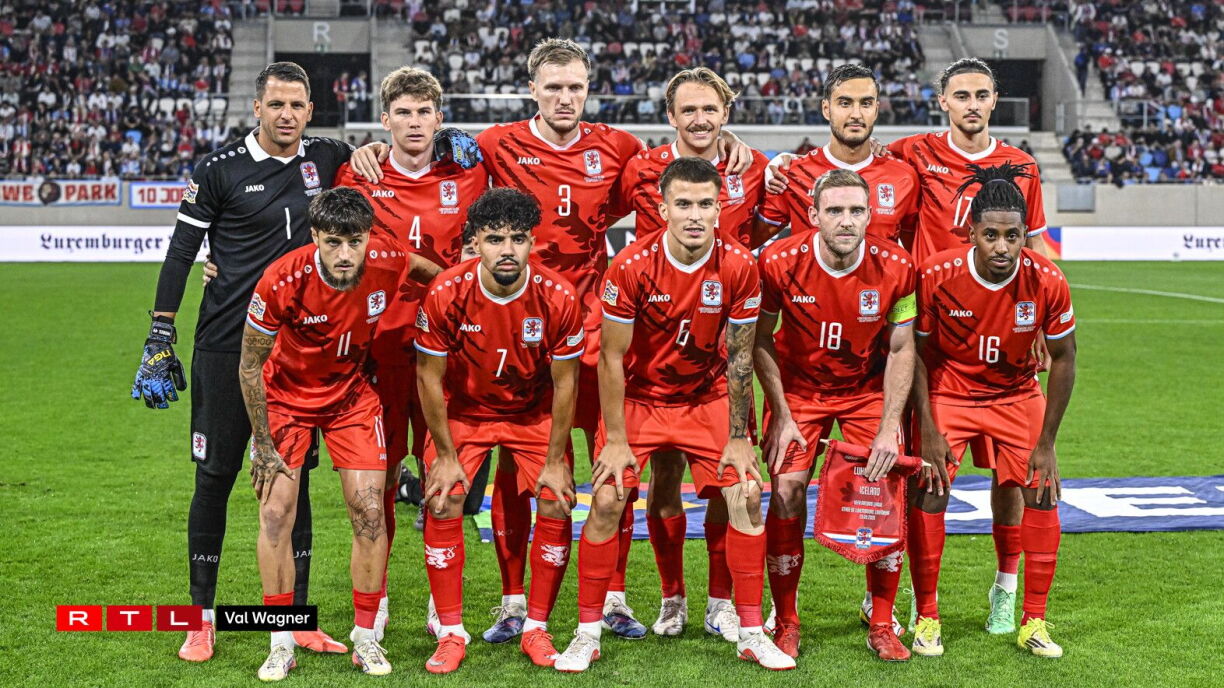
The first international window of the 2026-27 season was lauded as a historic one months before it went underway. After the previous years’ stop-start schedule that interrupted club football every month throughout the autumn, FIFA is now experimenting with a congested three-week, four-game period instead.
This has resulted in games every three to four days, an unprecedented workload even without taking into account the continuous travelling. Over the last 11 days, Luxembourg’s players have flown to Bulgaria, returned to their Mondercange base, went all the way to Estonia merely days later, only to come back again for a final showdown before everyone leaves for their clubs.
The biggest question surrounding the new format was the extent of the physical toll it will take on the most important players. Rotating between fixtures is a wise thing, but every squad has undroppable star players and unquestionable starters who cannot be rested for a crucial game unless absolutely necessary.
Luxembourg, already missing Seid Korać and Christopher Martins through injuries, brought all guns out for the first two matches, trying to gain enough of a foothold against Bulgaria and Iceland to then change up the lineup for the easiest-looking Estonia fixture.
However, a flurry of fitness issues and injuries put a dent in Strasser’s plans from the very first days of the camp. Olivier Thill and Enzo dos Santos, it turned out, were not fully fit and were nursing light injuries. Fellow midfielder Mathias Olesen has only just returned to action following over a month out, and is still recovering.
Later, as the window progressed, every game brought further selection headaches. Danel Sinani lasted only one half against Bulgaria before suffering a serious injury that will see him sidelined for the remainder of the calendar year.
Laurent Jans was taken off against Iceland and, although he stayed in the camp to provide leadership and know-how, is unlikely to feature this month. Deputy centre-back Enes Mahmutović got suspended. And last, but not least, in a grotesque turn of events, the talismanic Leandro Barreiro will also miss the last match after a yellow-card mix-up.
In the space of just over a week, three new faces have been called up as an emergency measure to contend with the flurry of absentees. Eldin Džogović, Sofiane Ikene and Arnold Qevani have not started a game since being summoned, but the first has seen seven minutes of action as a late substitute.
Naturally, longer and more exhausting international windows favour teams with immense depth in every position. Others, like Luxembourg, might not be able to afford having to draft three replacements to fill in for the heavy hitters. As a consequence, a window that offered plenty of encouragement and promise in the first game was derailed quickly and ruthlessly.
Despite the assertive display against Bulgaria and the all-round dominance that night, the Red Lions have still looked toothless in front of goal ever since. Hamza Kadamani, Aiman Dardari, and Jayson Videira (the three attackers tested so far) all have the qualities to add to the national team, but none are a born scorer or have the same creative guile as Sinani.
When Videira started alongside Omar Natami in Estonia, the approach was telling. Both of them celebrated their first start for their country, with Natami making his international debut. While he offered drive and attacking impetus, his overall ability still lags behind those of Yvandro or Gerson Rodrigues, from recent years.
Qevani is the newest name in the fold, another potential debutant. The 18-year-old was called up to the camp straight from the youth team, where he is touted as one of the country’s brightest talents up front. Currently playing for RFC Liège in Belgium, he has both the goalscoring knack and physical dominance Luxembourg have been missing. Whether Strasser throws him into the fire remains to be seen, but his inclusion is a sign that the technician is willing to explore all avenues to the opponents’ goal.
What can Luxembourg gain from this window?
First and foremost, the primary concern is to put out the fires caused by injuries and absences all across the squad.
In lieu of Mahmutović, Vahid Selimović and Dirk Carlson can almost certainly expect a spot in the XI on Tuesday. Tomás Cruz will become the engine of the midfield, and Olesen has the best chance to be the anchor that Martins usually is. Dos Santos is set to receive his second consecutive start.
It would be little surprise to see Vincent Thill and Dardari remain in the XI, while Qevani will likely have to beat Kadamani for a spot. Natami had a solid debut overall, but can still lose his starting place if Thill is favoured on the right.
Confidence should not be an issue. While two losses and no goals scored is hardly morale-boosting, the injuries are a caveat that cannot be overlooked. Bulgaria can be beaten – this set of players has just gone and done it away from home. Support from a sold-out Stade de Luxembourg will only serve as extra fuel for the group.
For November, the challenge is trickier. In order to achieve top spot and direct promotion, Luxembourg will likely have to topple Iceland, which is a long shot considering the three-goal deficit in the head-to-head rankings. A play-off spot awaits second-placed teams, which seems more doable given the performances of both Bulgaria and Estonia.
A team likely strengthened by the returns of Martins, Jans and Olivier Thill at the very least will give the Red Lions a realistic chance to end on a positive note





