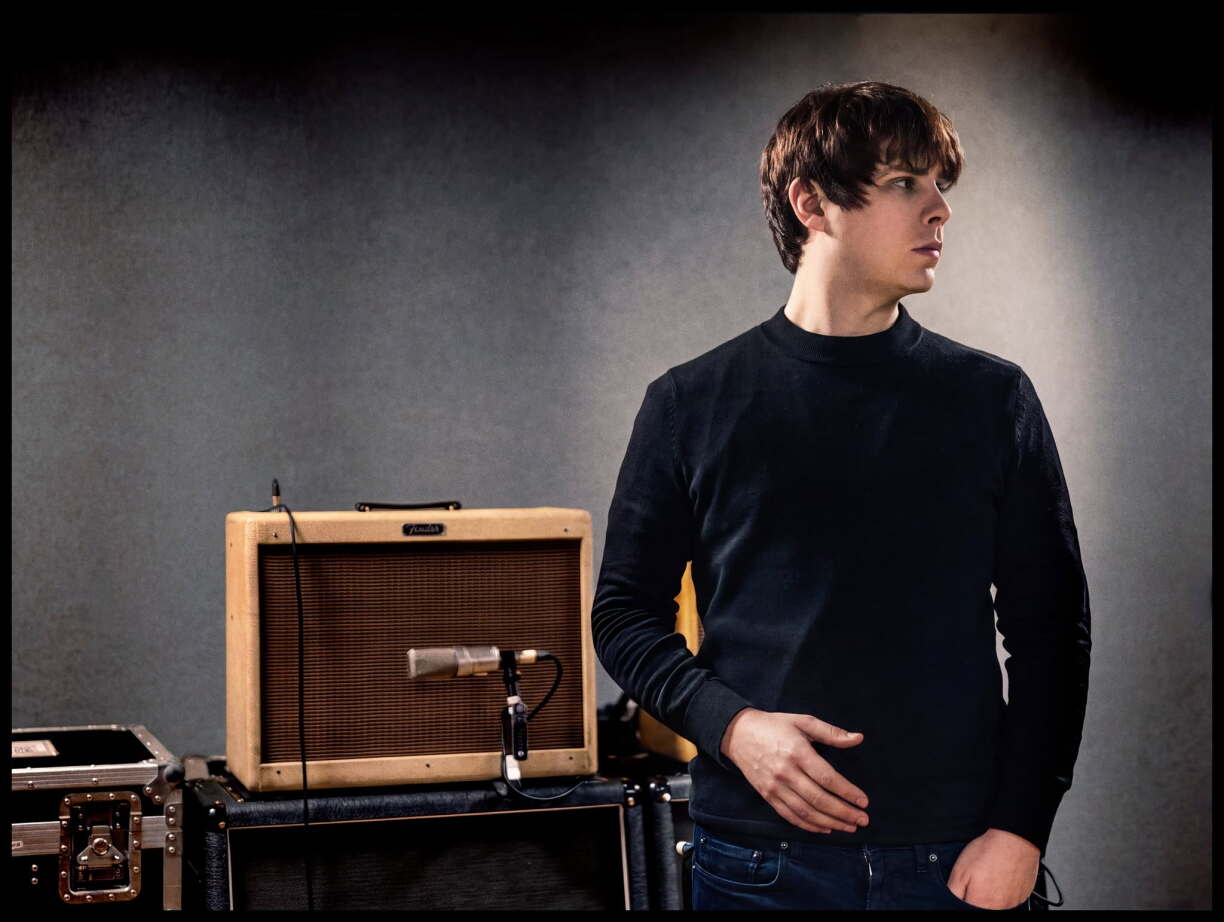
Jake Bugg has a very specific fear when it comes to performing live. It's not a broken guitar pedal, a dodgy monitor or even forgetting the words to a song.
It's hiccups.
“My worst personal fear, though, is having hiccups,” he tells Stephen 'Steps' Lowe on RTL Today Radio. “That would be just a disaster.”
It's why he doesn't drink beer on stage. Fizzy drinks are apparently best left until after the show, too.
It's a wonderfully ordinary concern for somebody who was thrust into the music industry's spotlight at just 18, when Lightning Bolt turned a young songwriter from Nottingham into one of Britain's most talked-about new artists.
Nearly 15 years later, Bugg has accumulated an impressive catalogue, travelled the world and experienced the highs and pressures that come with an unusually early introduction to fame.
But with his latest album, Alamo, he's doing something that hasn't always come naturally: opening up about himself.
Looking back at his teenage breakthrough, Bugg recognises the musician he was, even if the person feels rather more distant.
“I think in the music, I definitely recognise it,” he explains. “I think on reflection as a human, maybe not so much.”
The intervening years have brought considerable changes, and he hopes those changes are reflected in the records he's made.
There was pressure from the beginning, and not simply from record companies or the people working around him.
Success also changed the way people in his personal life responded to him. Family relationships, expectations and responsibilities all became part of an experience that few teenagers are equipped to navigate.
Bugg acknowledges that some situations could have been handled differently, but he's reluctant to complain about the opportunities that came his way.
He wanted to travel, make records and build a life around music. If pressure was part of the deal, it was something he was prepared to accept.
What matters now is what he's learned from those experiences.
His new album, Alamo, finds Bugg looking inward.
The artwork shows him walking alone through a barren landscape, an image he feels captures the record's themes of isolation, uncertainty and finding a way through life's difficulties.
It's a striking contrast to the exuberance of Lightning Bolt, although the musical foundations remain recognisably his own.
Bugg admits that articulating personal experiences has never been particularly easy.
He's drawn on his life before, of course, but this time he wanted to explore emotions and experiences he'd struggled to explain, including things reaching back into childhood.

His previous album had approached its subject matter more from the outside, examining society and the world around him. This time, the perspective shifted.
“Maybe it was time to go the other way and to maybe look inside a little more and be reflective of that.”
It wasn't an elaborate artistic plan. The direction emerged naturally as the first songs took shape.
And while writing about personal experiences can be uncomfortable, Bugg believes music gives him a way to express things that ordinary conversation sometimes cannot.
“Music's allowed me that freedom to express that in a way that I feel comfortable with. And sometimes it's not comfortable at all.”
There's a distinction, he suggests, between being honest and being able to explain exactly how you feel. Emotions are rarely straightforward, and turning them into songs means finding a balance between personal truth and leaving listeners room for their own interpretations.
Musically, Alamo draws Bugg back towards the folk, country, blues and Americana sounds that shaped his earliest work.
He enjoys experimenting, and his collaboration with electronic duo CamelPhat introduced him to a very different musical world. Performing dance music without a guitar felt strange at first, but he found the experience exhilarating.
It also made him eager to explore further collaborations.
Nevertheless, the music that feels most natural to him remains relatively simple: somebody with an instrument, singing about their life.
That simplicity became an important part of the new album's production.
Working with longtime friend and producer Jimmy Hogarth (Anohni, Amy Winehouse, Paolo Nutini), Bugg concentrated on making the songs sound more like himself rather than dressing them up unnecessarily.
Some tracks feature very little percussion. Others were deliberately stripped back to preserve their emotional character.
One song even had an entire orchestral string arrangement recorded before the decision was made to remove it.
For a musician who loves strings, it wasn't an easy choice.
Bugg admits he was gutted, particularly because the arrangement sounded beautiful. But its grandeur was working against the loneliness the song was supposed to convey.
Sometimes the most effective musical decision is knowing what to leave out.
For all the changes in his career, Bugg hasn't lost his enthusiasm for writing songs.
The excitement is still there, but the greatest satisfaction now comes from developing an initial idea into something complete.
He compares songwriting to solving a puzzle. There are frustrating moments when the pieces refuse to fit, followed by the enormous relief of finally finding the answer.
That attachment to the creative process also explains his lack of enthusiasm for artificial intelligence in music.
“I have no interest in using it myself whatsoever,” he says.
Bugg sees the act of creating as the most rewarding part of being a musician. Using AI to generate material, he argues, risks removing the very experience that makes the work worthwhile.
He acknowledges that the technology may have valuable applications elsewhere, including science and medicine, but has little interest in allowing it to take over his songwriting.
His alternative suggestion for musicians seeking inspiration is refreshingly uncomplicated: listen to more records.
Of course, it's impossible to discuss Jake Bugg without returning to Lightning Bolt.
The song helped launch his career, but after so many years, does he still feel it belongs to him?
Bugg believes that once music is released into the world, it begins to take on a life of its own.
Sometimes a song becomes more recognisable than the person who created it.
He remembers performing Lightning Bolt at a radio industry event in America. Afterwards, a young security guard approached him with a compliment.
The performance had been brilliant, the man explained, and Bugg had sounded exactly like the bloke who sang the original.
There was just one problem.
“I am the guy. It's my song,” Bugg recalls telling him.
The security guard knew the music perfectly well. He simply had no idea who Jake Bugg was.
It's an amusing reminder that a successful song can travel considerably further than its creator's face.
Bugg also recalls discovering that author Stephen King had praised Lightning Bolt online, while interest from Mötley Crüe's Nikki Sixx particularly delighted his uncle, a huge fan of the band.
Despite those extraordinary endorsements, Bugg remains remarkably modest about his audience.
He's still amazed that people connect with his songs at all.
And while the initial excitement of signing a record deal is something every aspiring musician dreams about, he's come to appreciate something more valuable: a lasting career.
That, he says, is only possible because people continue to buy records, attend concerts and support the music.
Bugg has experienced difficult periods, personally and professionally, but he's never seriously considered walking away from making records.
Touring can be exhausting. The business surrounding music isn't always enjoyable. But going into a studio and creating something new remains an essential part of his life.
“I don't think I could ever turn my back on it really, because it's never turned its back on me.”
It's perhaps the most revealing sentiment of the conversation.
Music has given him the chance to travel, meet extraordinary people and experience a world that would otherwise have been unimaginable.
He feels a genuine sense of gratitude for that.
And with Alamo, he hopes some of the experiences he's struggled to put into words might offer comfort to others navigating difficulties of their own.
The next chapter will also bring a different kind of challenge.
Bugg is planning an acoustic tour, stripping away the safety net of a full band and revisiting songs from across his catalogue.
He admits that performing alone brings more pressure, but also greater freedom.
And Luxembourg could well be part of those plans.
Having played here several times, he remembers the audiences fondly and says he'd welcome the opportunity to return. There's even the prospect of a backstage drink, although given his fear of hiccups, it might be wise to leave the fizzy stuff until the performance is safely over.
Nearly fifteen years after Lightning Bolt, Jake Bugg is no longer the teenager everybody wanted to label as the next big thing.
He's a musician who has grown into his craft, learned to appreciate the audience that stayed with him and discovered that some of the most difficult things to say can become the most meaningful songs.
And while the music may be more personal than ever, the motivation behind it remains wonderfully simple.
He still loves making it.
Listen to both parts of Stephen 'Steps' Lowe's conversation with Jake Bugg on RTL Today Radio and RTL Play.
Alamo arrives on 13 November and is Bugg's first release on Thirty Tigers.


