Private gatherings: Five people from a maximum of two households are allowed to meet up. Some states go a little further: In Saxony-Anhalt, one household can meet with an additional five people from a second household. Children and youth under 14 years old are not counted.
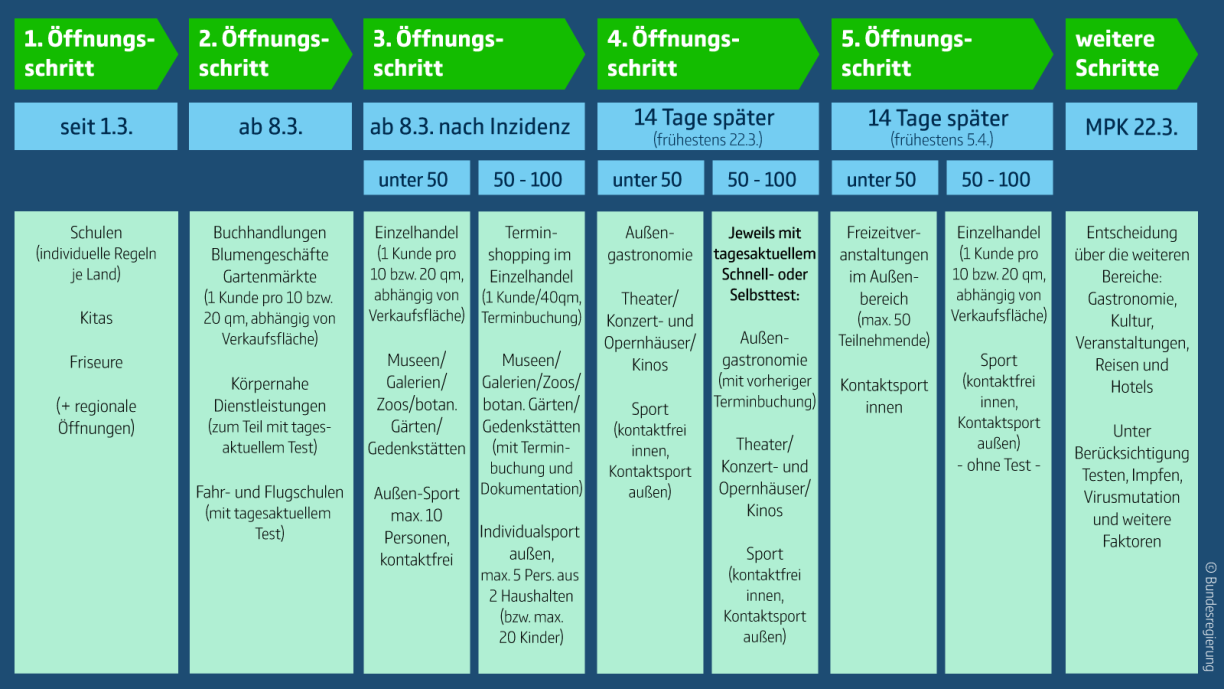
Shopping: If the incidence rate drops below 100 cases per 100,000 inhabitants, retail stores may hand out booked time slots to customers. If the incidence rate drops below 50 cases per 100,000 inhabitants, stores can reopen fully but have to limit their number of customers based on area. Individual states will adapt according to incidence rates.
Culture: Museums and galleries may open depending on incidence rate. In Saxony the date has been set for 15 March; in Thuringia there is no talk of reopening as of yet.
Services: Massage salons can reopen for business on Monday, as well as tattoo studios, and hand and nail care. Hairdressers had already opened on 1 March.
Sport: 10 people can exercise out in the open with sufficient distance, but only if the incidence rate drops below 50. If the rate is below 100, five people from two households can exercise together. Children below 14 years old can do exercise in groups of 20. In Hesse, bookings can be made for fitness studios and gyms. Berlin, meanwhile, has lowered the children's age to 12.
Education: In schools, face-to-face teaching is slowly being ramped up, but again there are regional differences. Depending on incidence rates, primary schools will be back in alternating classes. In Hamburg, for example, the attendance requirement for schoolchildren has been lifted so that parents can decide to keep their children at home.
The German government has released a roadmap of its national exit strategy over the coming weeks. The next steps will include opening the hospitality sector (on 22.03 at the earliest), opening concert venues, theatres and cinemas.





