The war in Ukraine has now been fought for six months, beginning with a Russian invasion on 24 February 2022, as the country marks 31 years since it declared independence from the Soviet Union.
Countries around the world have been contributing to the defence of Ukraine through financial and military aid, as well as humanitarian aid.
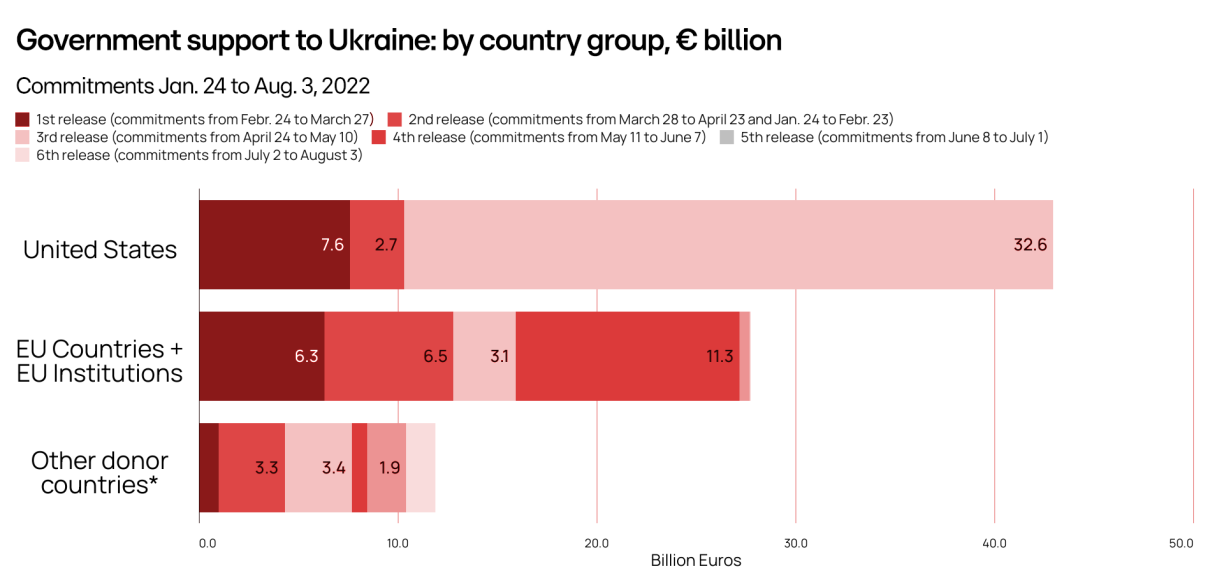
In absolute terms, the largest supporter, as of earlier this month, was the United States, with a total of € 44.5 billion in contributions.
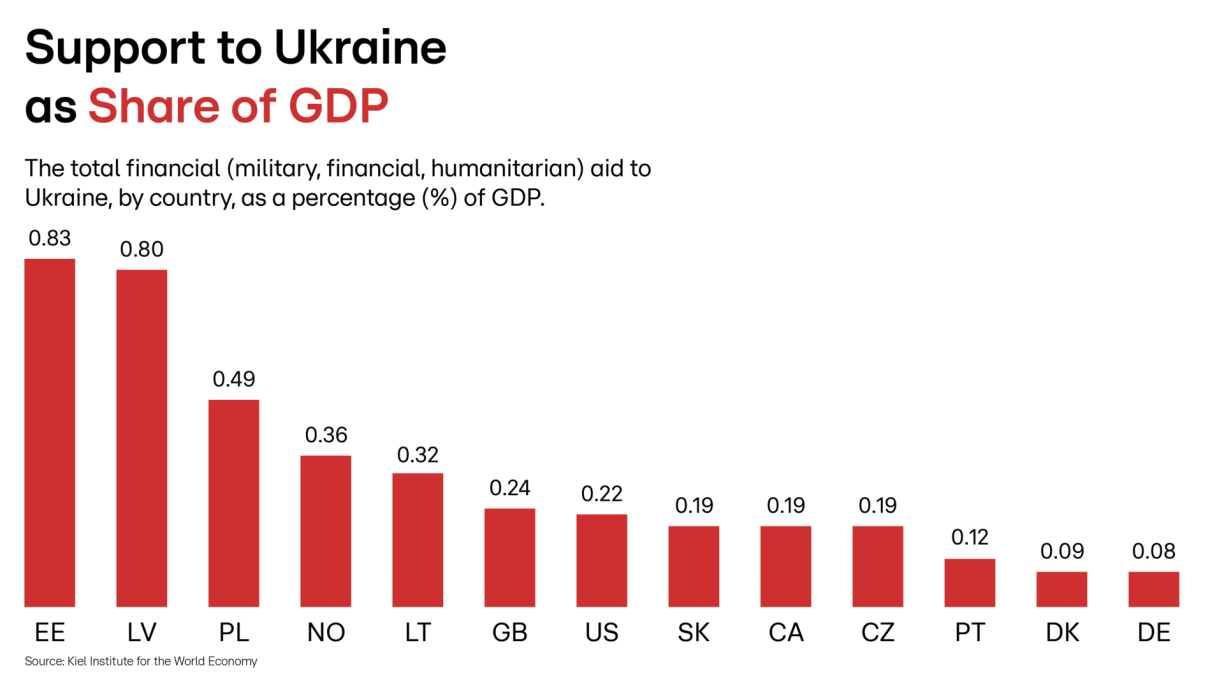
A very different image is drawn when contributions are compared as a percentage of each country's GDP.
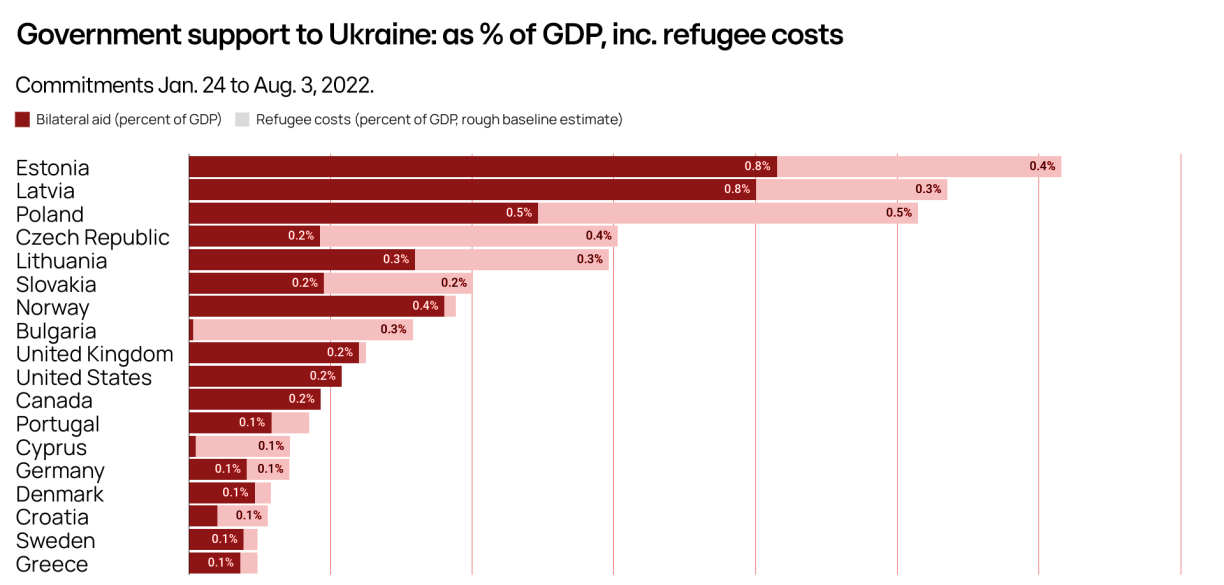
The Kiel Institute for the World Economy tracks and quantifies military, financial and humanitarian aid promised by governments to Ukraine and their data suggests it is Estonia and Latvia who have contributed more than any other country as a percentage of their own economic outputs, and with a significant difference.
Latvia and Estonia both border Russia, with the former having recently labelled the invasion of Ukraine a 'targeted genocide against the Ukrainian people' as its Parliament voted to designate Russia as a “state sponsor of terrorism” over the war in Ukraine.
Estonia has led the calls for increased sanctions against Russia, pushing for a ban on Russian gas inside the EU and Russian tourists in Europe. The EU Member-state has its own intricate history with Russia's predecessor, the Soviet Union, and wants to ensure Russia is stopped in its tracks.
You can see that in relevant terms, the U.S. has not come close to Estonia’s contributions in the first six months of the war - its contribution of €250 million equates to 0.83 percent of the country's GDP. Additionally, it has spent 0.4% of its GDP accommodating (for) Ukrainian refugees.
Poland has also spent significantly, contributing 1% of its GDP in war-related efforts; 0.5% to support Ukraine directly, and 0.5% to host refugees.
Luxembourg has spent 0.07% of its GDP to support Ukraine, and another 0.02% to accommodate refugees. In comparison, our neighbours, France and Belgium have spent 0.04% on aid and 0.01% and 0.03% on refugees, respectively while Germany has spent 0.08% on aid 0.06% on managing refugees.
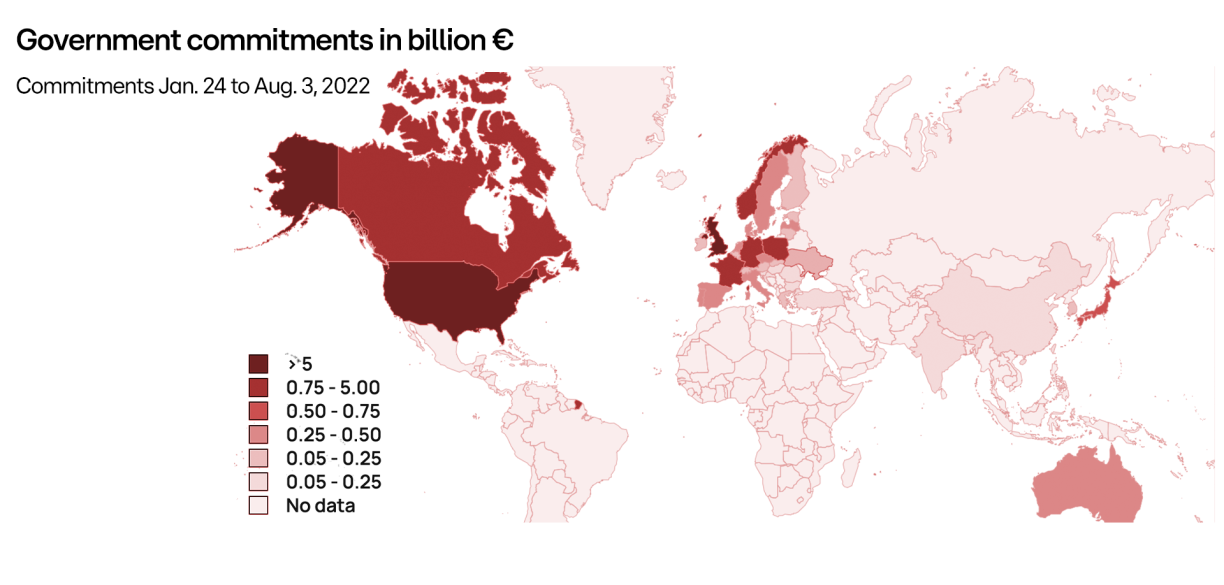
Looking at a map of contributors, a clear map of NATO allies is painted with a block spanning from Canada to the US, and from Norway to Greece and Turkey.
The European Union, through its institutions, is the biggest contributor of Financial aid to Ukraine, having committed over € 12 billion.
The United States' financial input up to this point has been equivalent to 0.22% of its gross domestic product.
Billions have been committed to support Ukraine, however not all aid has already been delivered or transferred to Ukraine.
The Institute's team tracking support to Ukraine has also noticed that the flow of new international support dried up in July. No large EU country like Germany, France or Italy made significant new pledges last month, however, the gap between committed and disbursed aid narrowed.
“In July, donor countries initiated almost no new aid, but they did deliver some of the already committed support such as weapon systems," said Christoph Trebesch, head of the team that compiles the Ukraine Support Tracker. Germany, for example, has not announced any further military support, although it did send considerable military aid committed earlier.

Christos Floros covers News and Politics for RTL Today @christosfloros





