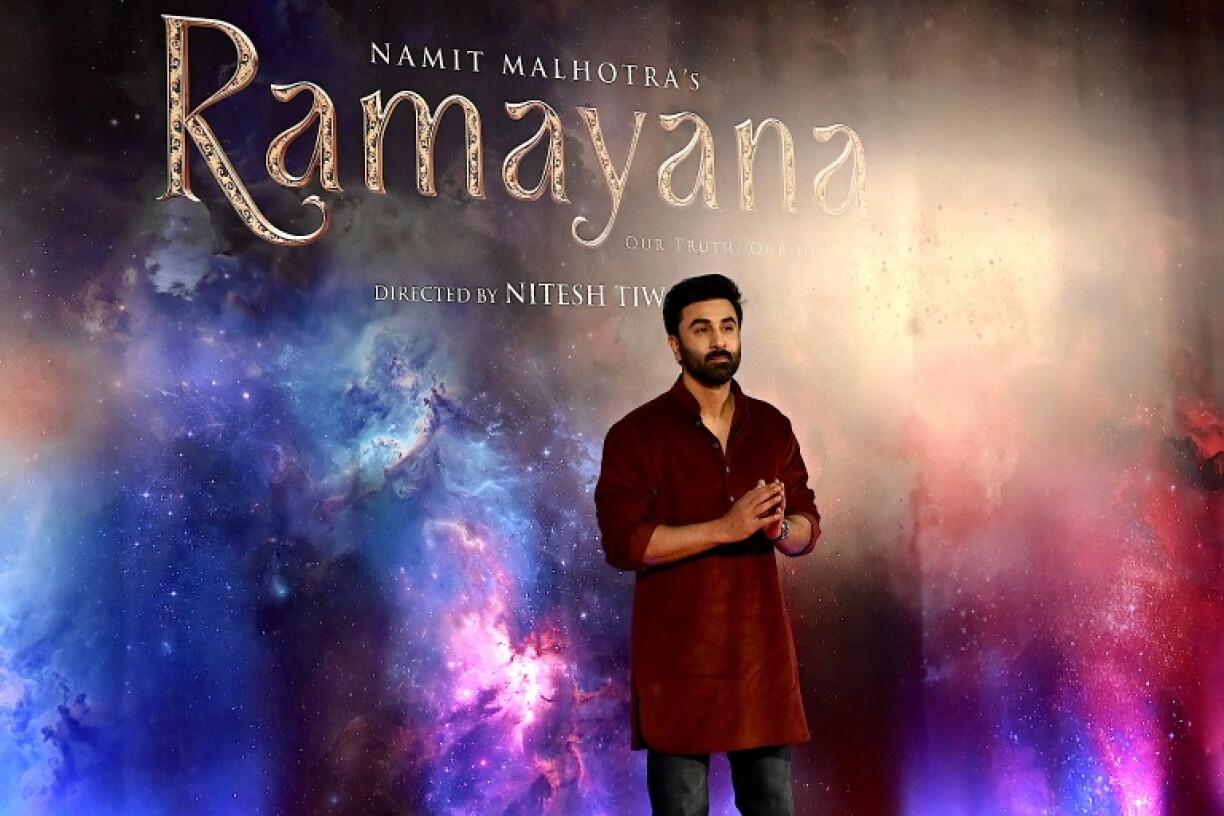
A big-budget film adaptation of the Ramayana, one of Hinduism's most revered epics, has renewed attention on the ancient tale that continues to shape India's culture, identity and politics.
"Ramayana: Rise of a Legend", featuring Bollywood star Ranbir Kapoor, is set for release in India on Thursday, two days before the country's biggest festival of Diwali.
Conceived as the first in a two-part series, the movie has had a budget of $420 million, making it the most expensive project in Indian cinema history, according to industry experts.
It premiered in Los Angeles last week and has been dubbed into nearly 40 languages, according to Indian media.
Director Nitesh Tiwari has said artificial intelligence was used to synchronise characters' lip movements with the translated scripts.
With its vast scale, visual spectacle and mythical characters, "Ramayana" has drawn comparisons with Christopher Nolan's "The Odyssey", a global smash hit based on Homer's classic poem.
Here is a look at why the Ramayana holds such a central place in Indian politics and society.
Traditionally attributed to Valmiki, an ancient poet who wrote in Sanskrit, the Ramayana recounts the story of Prince Ram, who is exiled for 14 years and embarks on a quest to rescue his wife Sita after she is abducted by the demon king Ravana.
Ram is aided in his journey by his brother Lakshman and the monkey god Hanuman.
The epic has been retold and reinterpreted for centuries across South and Southeast Asia in numerous languages and traditions.
Hindus widely revere Ram as an incarnation of the god Vishnu.
In modern India, the Ramayana became closely linked to a Hindu nationalist movement to build a temple to Ram in Ayodhya, a city in the northern state of Uttar Pradesh that believers regard as his birthplace.
But on the proposed temple site stood a 16th-century mosque built by Mughal emperor Babur. Hindu nationalists believe the mosque was built over Ram's birthplace.
The dispute emerged as a major flashpoint in the late 1980s and early 1990s, helping propel Hindu nationalism into the political mainstream.
A Hindu mob demolished the mosque in 1992, triggering nationwide religious riots that killed about 2,000 people, most of them Muslims.
The Supreme Court awarded the disputed site for the construction of a Hindu temple in 2019.
Prime Minister Narendra Modi inaugurated a grand temple there in 2024.
Of the many screen adaptations of the Ramayana, the most influential was a television series broadcast by state-run Doordarshan in the late 1980s.
At a time when visual depictions of Ram were relatively rare, millions of Indians tuned in each week, with viewing often taking on a devotional character.
Some scholars argue the hugely popular series strengthened the then-nascent Hindu nationalist movement.
Modi's Bharatiya Janata Party, which championed the Ayodhya campaign, won just two parliamentary seats in 1984.
But its tally rose to 120 in 1991 as the dispute became a national issue.
The Ramayana has spread far beyond India, inspiring countless retellings across South and Southeast Asia in several languages including Tamil, Bengali, Thai, Khmer and Indonesian.
Its stories and characters feature in traditional dance, theatre and shadow-puppet performances in countries such as Thailand, Cambodia and Indonesia.
The epic also plays a key role in Hindu festivals, particularly during Dussehra, which marks Ram's victory over Ravana, and Diwali, which is widely associated with his return to Ayodhya after exile.
sai/abh/mjw/abs


