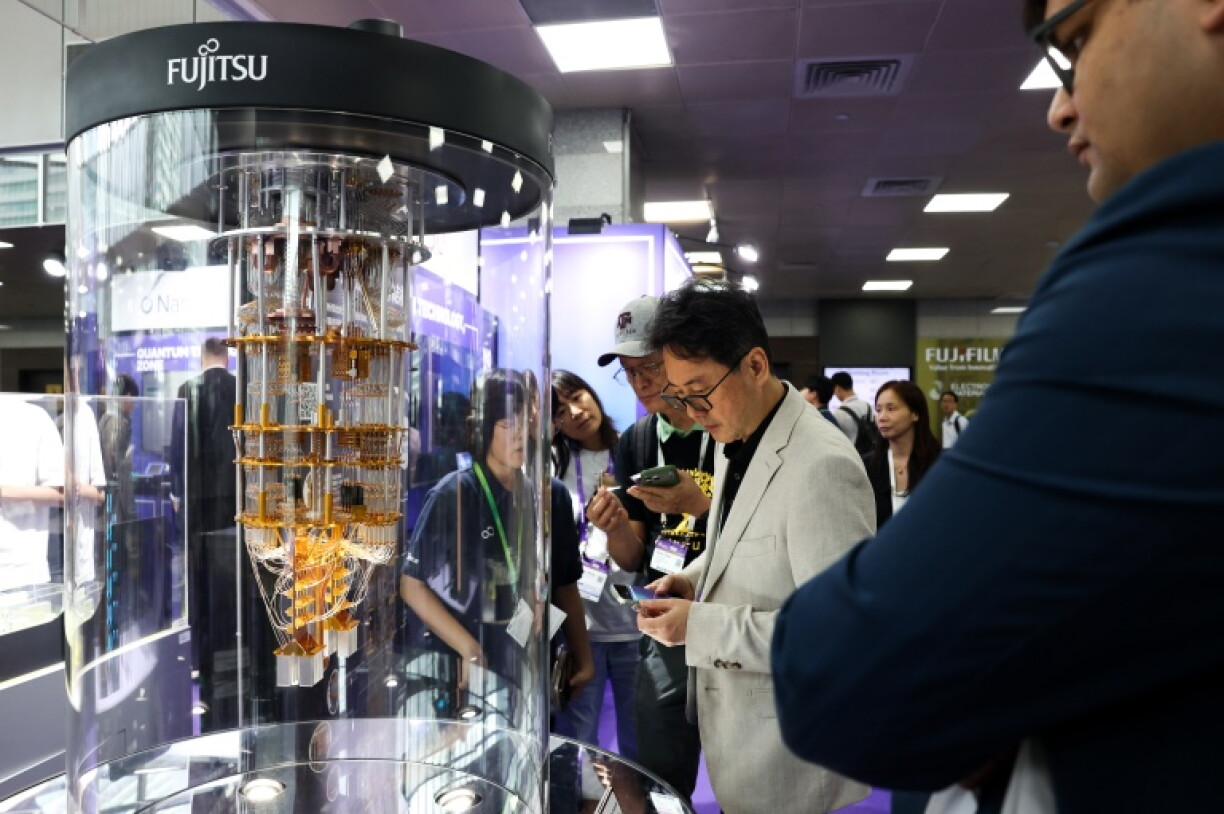
After several dashed predictions, quantum computing is accelerating rapidly with actual use cases and scientific breakthroughs now expected within years, not decades.
US technology giants and start-ups, as well as banks and pharmaceutical companies, are pouring investments into the revolutionary technology.
And Europe is moving to catch up, with the European Commission announcing plans Wednesday to earmark up to 50 billion euros ($55 billion) to boost both quantum computing and AI as it seeks to avoid losing ground to the United States and China.
Here is what to know about quantum technologies that can be hard to decipher.
While classical computing relies on bits with just two states (0 or 1), quantum computing harnesses "qubits" with infinite possible states.
Each added qubit theoretically doubles computing capacity, allowing quantum computers to analyze countless possibilities simultaneously, solving in minutes what might take millions of years classically.
"Classical computers are speaking the wrong language. In quantum we're almost speaking the language of nature," said John Levy, chief executive of the hybrid chip developer SEEQC. "This unlocks previously unsolvable problems."
Microsoft meanwhile has unveiled quantum technology based on an entirely new state of matter -- neither solid, gas, nor liquid.
Levy's verdict: "They should win a Nobel Prize."
Six major competing quantum computing technologies are currently being developed -- involving superconducting circuits, silicon qubits, ions and neutral atoms -- but "they all currently have problems", as Michel Devoret, winner of the 2025 Nobel Prize in physics for his work on the subject, pointed out in December.
It is impossible to predict at this stage which one will ultimately prevail.
Given its exponential computing power, Levy believes quantum's potential exceeds our "limited imagination", especially when paired with AI.
Some even view quantum computing as the only path to "superintelligent" AI with superior cognitive abilities.
Practically speaking, quantum technology will drastically accelerate discovery of new molecules –- extending the periodic table.
This would mean new materials, breakthrough medications, advanced fabrics, complex financial models and super-efficient batteries.
Philosopher and investor Anders Indset foresees an "efficiency race" transforming everything from agriculture to transportation: "We'll have hyper-efficient, lighter cars and cheaper, cleaner air travel methods."
Leading US players IBM, Microsoft and Google are each aiming to develop a commercial quantum computer by 2029. IBM said in May that it would be investing $10 billion in the technology to achieve this goal.
Europe hosts start-ups in the field, however, such as French companies Pasqal (listed on the New York Stock Exchange) and Quandela, and Finland's IQM Quantum Computers.
And quantum computers already operate today.
IBM claims its quantum services have generated sales of $1 billion, though current applications remain limited mainly to research.
The market will initially expand through servers equipped with specialized chips and systems.
"We are now switching from quantum theory to the quantum economy," Indset said. "The drive is to be leader in trillion dollar industries."
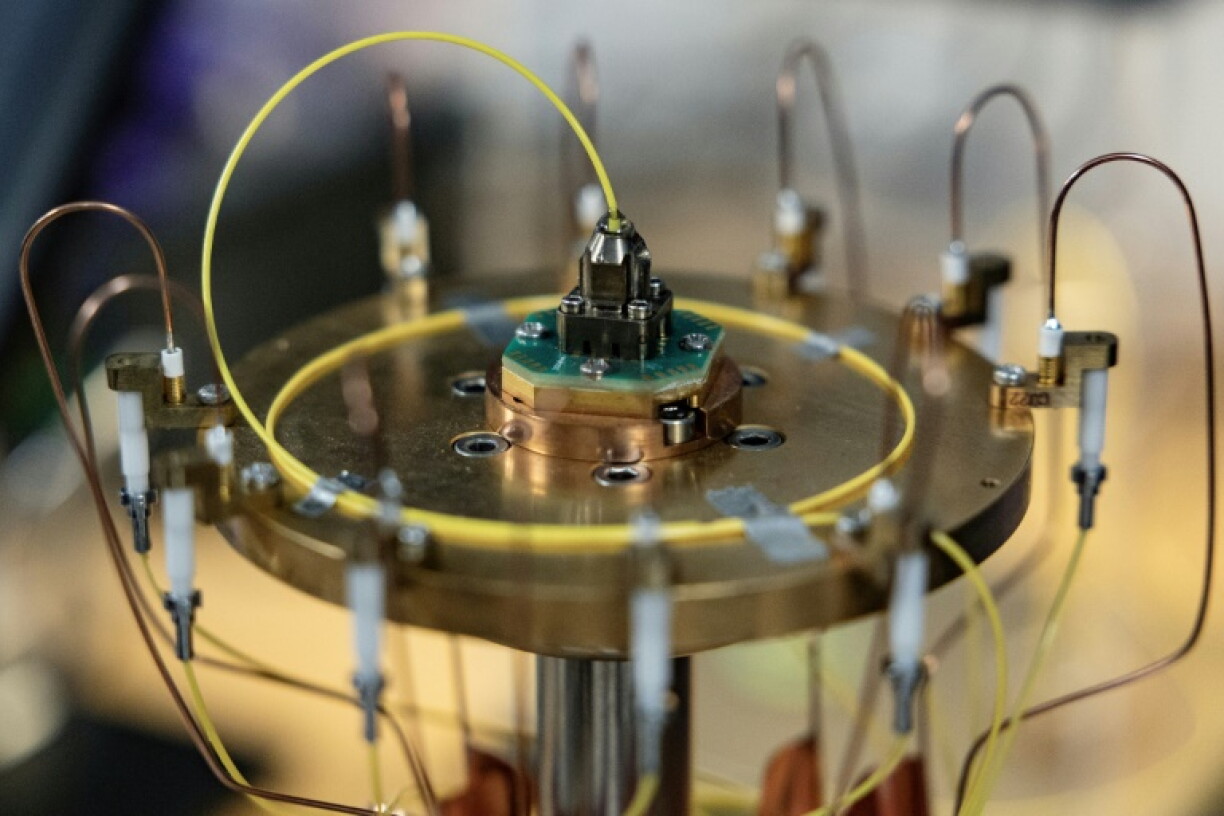
According to the consulting firm McKinsey, quantum computing could generate up to $2.700 trillion in economic value by 2035.
The giants, already in a furious race to lead on AI, are heavily investing to solve quantum's biggest challenge: calculation errors.
Qubits require sub-freezing temperatures and are extremely sensitive to environmental "noise" such as vibrations, heat, electromagnetic interference that cause computational errors.
Google's new Willow quantum chip and Amazon's Ocelot semiconductor prototype aim to sharply reduce these errors and costs.
"We're witnessing the creation of an ecosystem," said Levy, noting that the pharmaceutical giant Merck is investing in his company to secure access to future quantum tools.
The United States and China are racing ahead in quantum development, with Washington imposing export restrictions on the technology.
But beyond competition, quantum computing poses serious cybersecurity concerns.
Since qubits can test countless combinations simultaneously, they could potentially break conventional encryption methods.
US government agencies and tech companies like Apple are already developing "post-quantum" encryption to prepare for this new reality.
In October, an IBM executive told AFP he was worried that "less than 10 per cent" of organisations were prepared for cyberattacks.
Current quantum computers are not powerful enough to carry out such attacks.
Even so, some US government agencies and companies are already developing new encryption methods, and Britain is advising organisations to transition to quantum-resistant cryptographic systems by 2035.
juj-kj/vg/cw/js