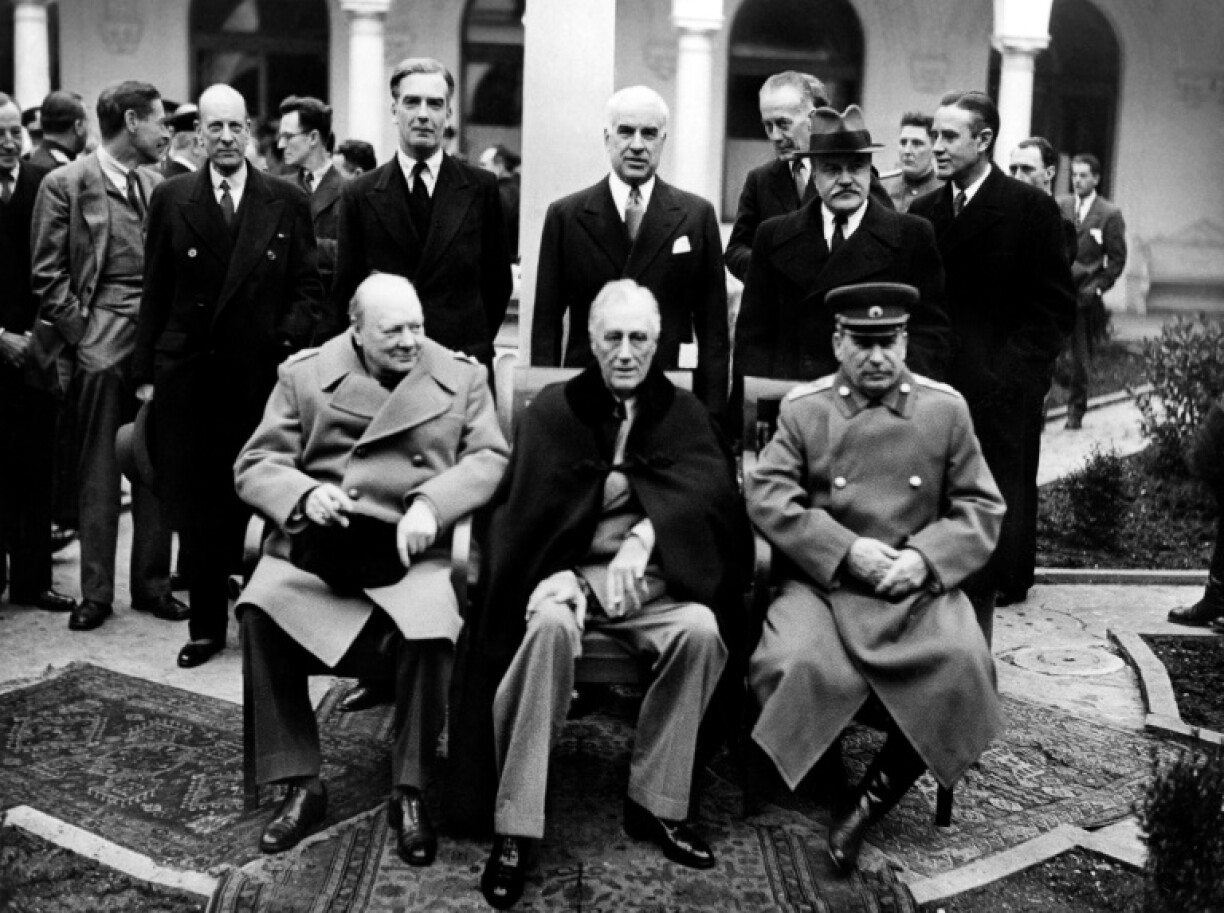
In February 1945, three men came together in Yalta to discuss the future of the world: Winston Churchill, Franklin D Roosevelt, and Joseph Stalin.
81 years later, three other men came together in Shenzhen: Donald Trump, Xi Jinping, and Vladimir Putin.
Both meetings represent great-power politics. But while the first sought to institutionalise the exercise of power, the second may symbolise the dismantling of those very institutional constraints.
Two world wars within three decades had exposed the dangers of the unhindered exercise of power. The political architecture that emerged from the Second World War sought to address that problem.
Institutions such as the United Nations, the International Monetary Fund, and the World Bank were established to govern international relations across political and economic spheres.
However, the great powers did not relinquish their dominance. The five permanent members of the UN Security Council were granted veto powers, while voting rights within the Bretton Woods institutions were weighted.
The objective was not to dismantle the hierarchy of power but to institutionalise its exercise.
This institutional framework placed certain constraints on the exercise of power while recognising certain sovereign rights of smaller nations.
Great powers retained their privileges. They continued to interfere in the domestic politics of other countries. Coups, regime changes, and both direct and indirect interventions continued. But their power was not meant to be completely unhindered.
That was the compromise of 1945.
On 19 November, the leaders of the United States, China, and Russia met in Shenzhen against the backdrop of conflicts in Ukraine and Iran, trade tensions, and nuclear risks.
Among the areas of common ground were proposals to reform the United Nations and restrict the reach of the International Criminal Court. The very powers entrusted with safeguarding these institutions are now seeking to restrict its reach.
What makes this meeting significant is not necessarily what the three leaders achieved, but the model of international relations it represents.
Xi Jinping remarked that history shows how peace among major countries brings stability to the world.
But there is a fundamental difference between establishing peace among nations and establishing peace among great powers.
The former requires respecting the sovereignty of all countries. The latter primarily requires great powers to accommodate each other's strategic interests.
Under the second model, American pressure on Venezuela, Russia's invasion of Ukraine, and military confrontation between Israel and Iran can coexist with diplomatic accommodation between Washington, Moscow, and Beijing.
Peace among great powers does not necessarily translate into peace for the rest of the world.
What we may be witnessing, therefore, is not the abandonment of the pursuit of peace, but a redefinition of whose peace matters.
For great powers to coexist without confronting one another, they must establish boundaries within which each can exercise its influence without provoking the others.
This is not a new model.
Following Napoleon's defeat in 1815, the Concert of Europe sought to preserve peace through a balance of power among Europe's major powers.
A similar logic appears to be emerging today.
Washington's revival of the Monroe Doctrine, now popularly referred to as the Donroe Doctrine, reflects its determination to reassert predominance in the Western Hemisphere. Venezuela has already felt its consequences. Cuba could be next.
Moscow seeks to restore its influence across the former Soviet neighbourhood, while Beijing seeks to establish its predominance in East Asia.
Although no formal agreement dividing the world into spheres of influence exists, the direction of travel is increasingly apparent.
The problem is that what a great power considers its sphere of influence is inhabited by countries that consider themselves sovereign.
What Washington calls its neighbourhood, Venezuela calls its homeland. What Moscow considers its strategic depth, Ukraine considers its sovereign territory.
The accommodation of great powers can therefore come at the expense of the countries within their respective spheres of influence.
The comparison between Yalta and Shenzhen also reveals a changing hierarchy of power.
Britain, which occupied one of the three chairs in Yalta, no longer occupies one in Shenzhen. Its relative decline was compounded by Brexit, a largely self-inflicted reduction in its collective geopolitical leverage.
But more significant than Britain's absence was that of the European Union.
On the very same day, the European-led Coalition of the Willing gathered in Berlin to discuss Ukraine. The contrast between the two meetings was telling.
In Berlin, countries came together to discuss a specific international crisis. In Shenzhen, three countries came together to discuss multiple international crises and the institutions governing international relations.
One was an agenda-based meeting; the other had the character of a world-order meeting.
It is quite telling when German Chancellor Friedrich Merz warns that a return to a Yalta-style arrangement would not bring peace.
A world governed by spheres of influence contains an inherent contradiction. Such a system can maintain peace only as long as great powers agree on where their respective spheres begin and end.
But power is not static. Some countries gain power over time while others lose it. As power expands, so do ambitions. Eventually, spheres of influence overlap and accommodation gives way to confrontation.
The Concert of Europe helped maintain relative stability for decades. But competing ambitions, nationalism, and rival alliances gradually undermined that equilibrium.
By 1914, it took a single flashpoint in Sarajevo to plunge the great powers into a world war.
During the Cold War, competing spheres of influence brought the United States and the Soviet Union dangerously close to nuclear confrontation over Cuba.
Today, Iran, Ukraine, and Taiwan represent potential flashpoints in a similarly contested geopolitical landscape.
The mechanism intended to preserve peace among great powers can eventually become the very mechanism that destroys it.
For Luxembourg, this transition from institutionally constrained power towards unhindered power has profound implications. With an army of around a thousand soldiers, Luxembourg cannot guarantee its sovereignty through military strength alone.
Its security rests on collective defence, European integration, and international institutions that recognise sovereignty irrespective of military capability.
In a world governed by great-power politics, smaller countries face two distinct risks. When great powers agree, their sovereignty can become a bargaining chip.
When great powers disagree, their territories can become battlegrounds.
Luxembourg's monuments commemorating the Battle of the Bulge stand as reminders of what happens when great powers turn smaller countries into battlegrounds.
The postwar institutional order was far from perfect. Its principles were selectively applied, and disputes over Palestine, Kashmir, Cyprus, and Western Sahara remain unresolved. But it offered smaller countries something a world governed by unhindered power cannot reliably guarantee: rights protected by international institutions.
For great powers, international institutions are often a constraint on their power. For smaller countries, those same institutions are a source of power.
When the United Nations is bypassed by the Board of Peace, when the Security Council is bypassed by the Coalition of the Willing, and when institutional diplomacy gives way to a meeting of three great powers in Shenzhen, the institutional world order, albeit a flawed one, appears to be slowly dying.
The dismantling of the institutional world order therefore means fundamentally different things for Washington and Luxembourg.
For one, it means greater freedom to exercise power. For the other, it means greater exposure to the exercise of power.
About the Author: Waqas M Awan is a Luxembourg-based corporate professional and the author of Power of Sage: An Anti-thesis to Machiavellian Prince. He holds an MBA and an LLM and has held senior finance roles at S&P 500 companies and Big4. He writes on economics, geopolitics, and power systems.