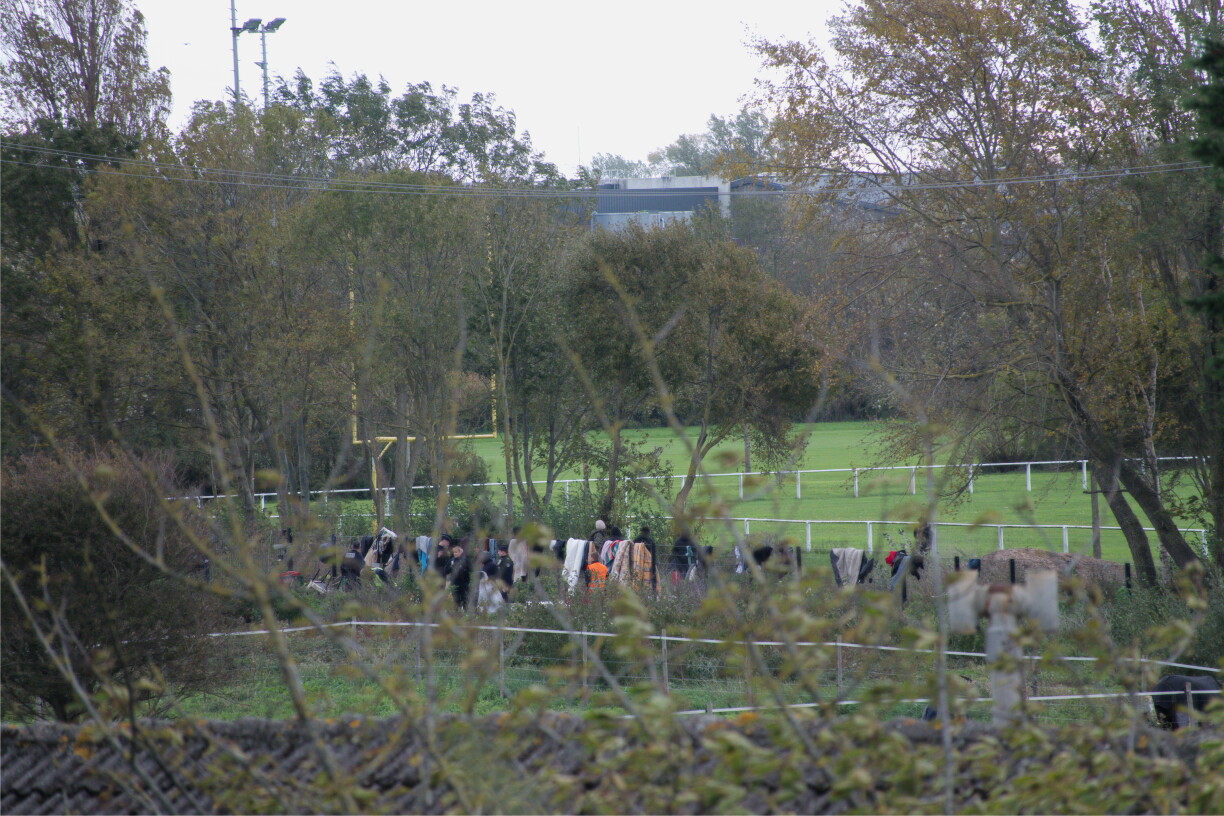
The 'jungle' was a settlement of asylum-seeking people on the outskirts of the northern French city Calais. Thousands had set temporary roots in a close-by forest to prepare crossings to the United Kingdom.
10 years after the French government dismantled the informal camps, little has changed. Living sites are now scattered further outside of the city, beyond the public eye. NGOs claim the dismantlement set the precedent for increased state violence.
The doors of my cramped train carriage finally opened in early September. We had reached the terminus in the northern French coastal town of Calais. Passengers quickly migrated and congested the space of the previously deserted tracks.
Before my head even poked out of the door, I heard the assertive voices of the security staff. Their shouts pierced through the air above the chatter of the crowd.
A woman at the back of the crowd was handling her bike. The security staff had noticed her and harshly commanded the crowd to form a corridor for her alone to move from one end of the track to the exit on the other.
Her whiteness stood out in the crowd of mostly Black and Brown people who were demanded to make way for her.
As I would learn quite quickly, this first impression of Calais was a telling one.
Security staff and police are much present at the train station and the near-by bus stops. Many people on the move, including asylum-seeking people, pass through these locations while trying to navigate the French coast.
Later, a fellow volunteer told me that she saw how security staff had organised a line for white passengers and one for non-white passengers while checking boarding passes. Her testimony starkly reminds of stories of apartheid South Africa or Jim-Crow United States.
Other volunteers speak of asylum-seeking people being pushed, refused entry, and insulted by security staff and police when accessing public transport, as also documented by the local NGO Human Rights Observers (HRO).
This is what is allowed to happen in the city centre of Calais. Outside of the public eye, state and police violence take even more overt forms.
For the past two months, I have been a volunteer at an organisation responding to the needs of asylum-seeking people in Calais. The coastal town, which is only a four-hour car drive away from Luxembourg, is the closest point in France to the British shore.
Geographically speaking, only 33km of English Channel lie between the European mainland and the British island. This distance translates into a four- to eight-hour journey on a small dinghy boat on sea, or an indefinite time hidden in shipping containers or lorries crossing the Eurotunnel.
Both are highly dangerous attempts but often the sole option to reach the United Kingdom without visa or similar documents.
As Doctors Without Borders confirm, safe legal passageways are at the moment nearly nonexistent. Many people set camp near Calais and close-by Dunkerque to organise such journeys and await favourable weather conditions for a crossing.
Reasons for these attempts are manifold – people might want to reunite with loved ones who are already on the British island, but are facing the UK's highly restricted family reunifications procedures (further limited last year); or they had received a refused asylum application in an EU country, so the UK became the last option outside the EU's internally synchronised asylum procedures; or they might simply have a personal preference for the UK due to language or community.
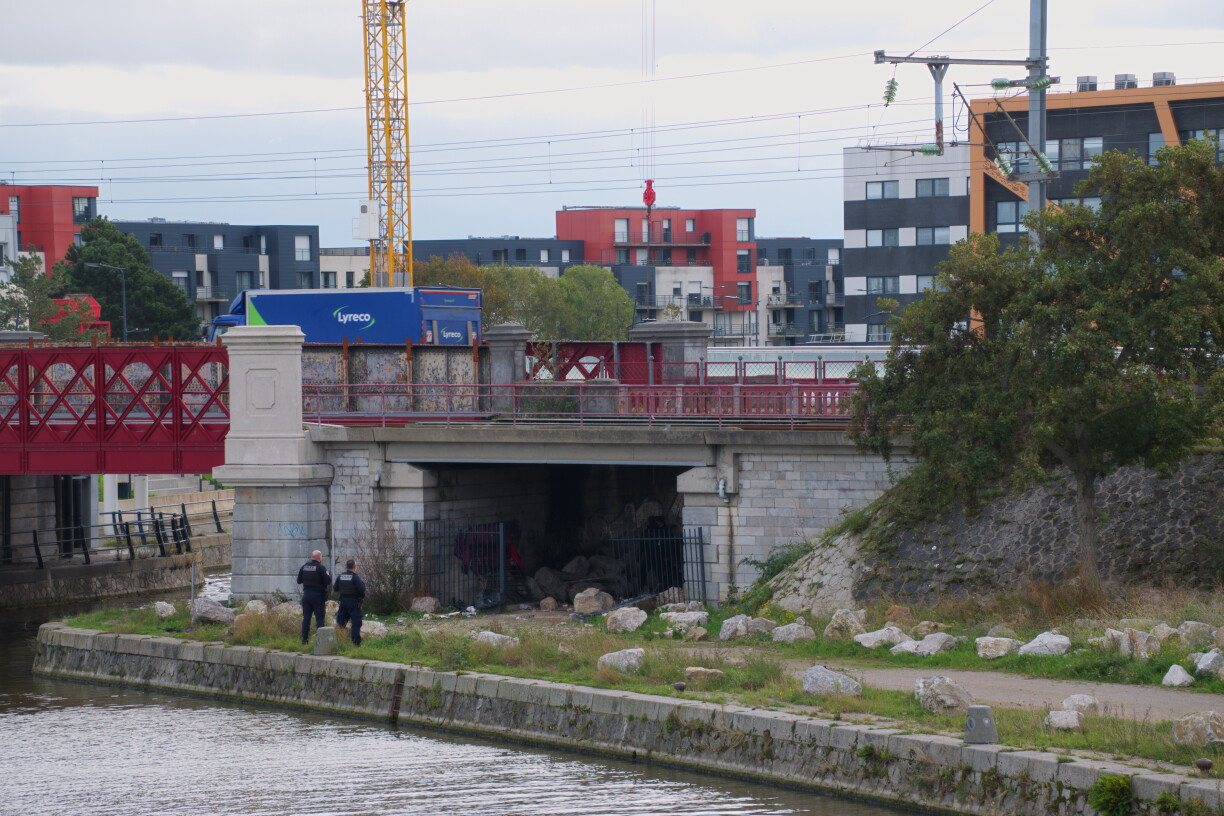
According to the British government, last year, around 49,074 people arrived in the UK by dinghy boat, lorry, or shipping container to request asylum. On average at any given time, around 3,000 people live on the street, in parks, or in the forest close to Calais and Dunkerque.
Each of these people has their own reflections, dreams, and fears.
In 2026, at least 24 people died so far on the border.
During volunteer shifts, I have met people who told me in fluent German about having lived and worked in Germany for several years, just to have their papers refused and being left without any alternatives. I have met Palestinians who described in fluent English their desire to finally settle and rest somewhere in safety.
I have met individuals who told me about the people they saw losing their lives on sea, while telling me of having no other choice than to attempt crossing themselves.
But the question of the whys remains secondary for many volunteers working on the ground. The reality is that people are in Calais and their living conditions have been highly precarious for the past decades.
Their precarity is understood by many NGOs as a political decision – a decision also defined by 2016, the dismantlement of the 'jungle'.
The 'jungle' was often described as a proper village. In the months leading up to the dismantlement of this living site close to Calais, around 10,000 people had settled down in the area.
Volunteers who had worked in the jungle speak of restaurants, religious spaces, and even bars set up by people on the move.
In a report by InfoMigrant, the mayor at the time, Natacha Bouchart, describes the "jungle" as total anarchy – a self-ruled space where the municipality did not have the means to intervene. A volunteer who was providing humanitarian aid in the jungle adds nuance as she remembers the "living conditions were inhumane – but at the same time, in the jungle, the migrants were protected because they were in their own space".
24 October 2016 marks the start of the dismantlement of the jungle, ordered by the French Interior Affairs Ministry.
Around 6,400 people were moved to shelters all over France and nearly 500 unaccompanied children were reunited with family members in the United Kingdom. These children were allowed to cross the channel without needing to risk their lives.
What followed the jungle was a political shift.
HRO describes the government's proceeding political approach as "zero-fixation" politics.
Zero-fixation politics refers to policies which do not allow people to set roots somewhere – people are pushed to keep moving. One tool for such politics are weekly evictions and "daily harassment", as HRO describes it.
I accompanied HRO during their shifts on 27 October 2026. We saw two living sites in Calais being evicted. Several tents of people were confiscated and people were left without shelter onsite. Two were arrested.
As Pablo, a volunteer at HRO who accompanied me during the shift, notes, "these arrests are always arbitrary for us".
Usually, everyone in the living site is in the same legal situation, and the police arbitrarily pick some to "maintain a state of fear among people on the move". Most often, people are arrested for two to three days, just to be set free thereafter.
The consequences of such evictions can be manifold.
HRO recently encountered a teenager whose phone was taken by the police after an eviction: "He had suicidal thoughts. He was like, 'Everything is on my phone. I have no clue how to get my phone back, how to get in touch with people, no contact with my family'."
In September, HRO documented at least 152 people being evicted with 24 tents being confiscated. HRO knows their numbers only cover a fraction of all executed evictions and confiscations.
The waiting period to get a new tent by a non-governmental organisation is currently around 10 to 15 days.
Land modifications are another tool used in Calais, according to HRO.
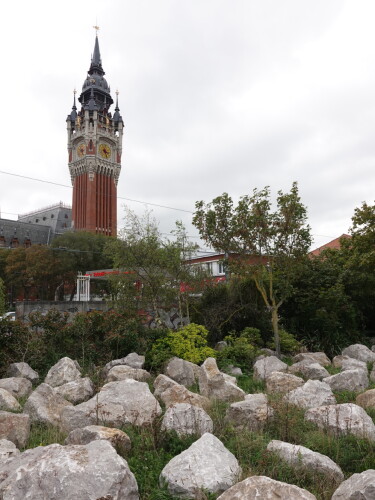
In meadows close to the city centre, the government placed large stones to make it impossible to pitch a tent. More stones are in the process of being installed.
Fences with barbed wire and even walls have also been set up to limit movement by foot in the wider region. Trees that might provide cover have been cut.
HRO explains that, close to an area where many non-governmental organisations provide free services in Calais, the municipality even had ploughed the ground. In the rainy coastal town, this causes intense mud to form, another reason keeping people from pitching tents in the area.
These policies are presented as to protect the French people from "migrants" and to dissuade asylum-seeking people from coming to Calais, as noted by HRO, "but there are very few tools to protect people on the move".
A clear example are the lacking capacities in emergency shelters close to Calais for both minors as well as adults who consider applying for asylum.
"People are still dying – not only while trying to cross, but also in the living sites. Nothing is changing because they are not considered as real human beings", HRO underlines. "The only answer has been repression, even though we see that it doesn't work. Despite these politics, people are still coming to Calais and Dunkerque."
In many ways, the French coast is showing me what it can mean to be European.
HRO concludes: "If no one cares about the situation, the state can do whatever they want."