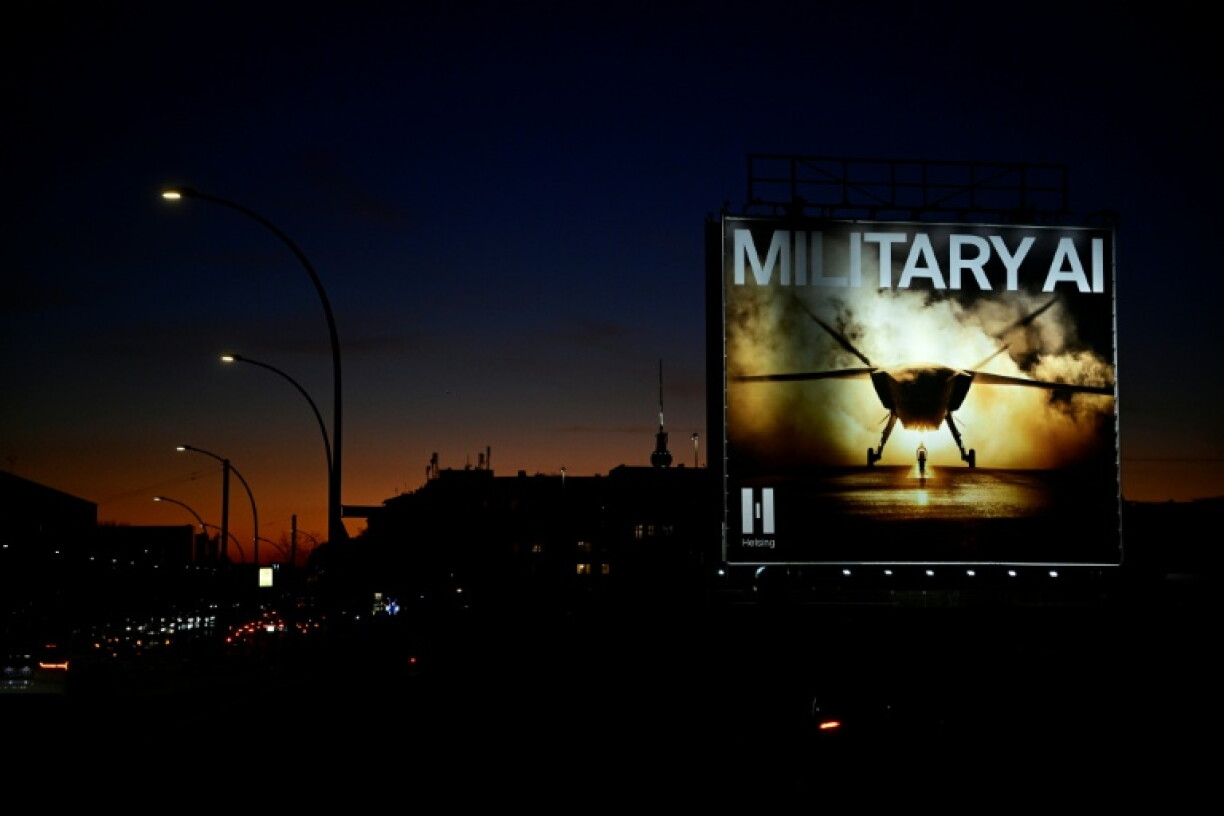
With growing concern, NATO militaries and defence giants are watching how artificial intelligence on the battlefield is forcing them into an ever-more urgent race against time.
Since Tuesday, military chiefs, officials and defence experts from the transatlantic alliance's 32 member states and Ukraine have gathered in the Turkish city of Izmir for NATO Edge, a three-day conference on critical technologies and digital warfare.
And the key message is this: success no longer depends on having information your enemy lacks, but on connecting the dots faster.
For Admiral Pierre Vandier, NATO's Supreme Allied Commander Transformation (SACT), the challenge is no longer about the available technology but "the speed at which we can integrate it, adapt it and scale it".
"Decisive change is from data to understanding, from understanding to decision, from decision to effect," he told delegates.
"AI accelerates every link in that chain. Terabytes float in from the field every day," Vandier said.
"Today, time is not our friend anymore. Speed of geotechnical chaos, speed of technology, speed of enemy adaptation ... Our environment is a race."
For the past two days, military and political leaders have been locked in debate with hi-tech firms about how to speed up their interactions.
But while dealing with an alliance like NATO offers strength in numbers and capabilities, it is much slower than working with a single state.
"NATO is a little more challenging to deal with than a member nation," admitted Mitch Free, vice president of Vantor, which provides satellite imagery for defence and intelligence agencies.
"Now ... they're really starting to accelerate how they interact with industry much earlier."
Today's battlefields are about swarms of drones, jamming technologies, cyber ops, electromagnetic attacks, the use of space and the real-time mapping of both enemy and allied troop movements.

"Within seconds, the question is: what's coming at me? Where will it hit, how do I respond?" said a European industrialist, speaking on condition of anonymity.
On the frontline, that means "a team has one minute between the moment something triggers a sensor and the moment the enemy strikes."
For defence companies, there is no room for error: it is one thing to successfully demonstrate a product in an air-conditioned office but quite another to prove its effectiveness under fire.
"A drone that doesn't adapt to new electronic warfare within a month or two becomes obsolete," warned Oksana Ferchuk, Ukraine's minister for digital transformation.
In the ongoing war with Russia, "when a front-line unit reports a problem, a successful solution must be delivered within weeks", and it must be continuously improved, she said.
"So, we stopped thinking of capability as a finished product and started treating it as a continuous cycle. You must build, test in the field, receive feedback, update and repeat," she said.
To do that, "we need to bring businesses closer to the battlefield," insisted Major General Rainer Beeck, one of NATO's top cyberspace commanders.
Although the newest products are all AI-designed from the outset, they must be able to incorporate modifications and upgrades, while older systems must be adapted to operate with AI without disrupting the functioning of the overall system.
Jurgen Eckel, head of strategy and innovation at Airbus Defence and Space, put it bluntly.
"AI is changing faster than military doctrine."
dla/hmw/jhb


