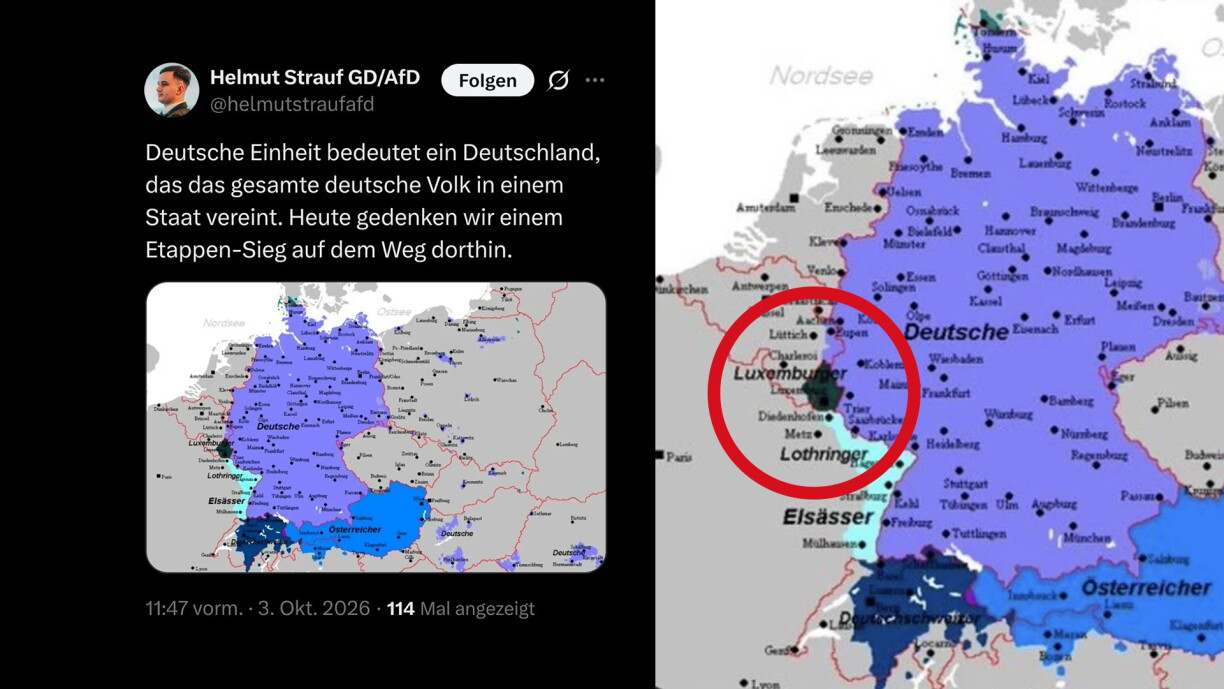
Could Luxembourg, Alsace-Moselle, Austria, parts of Italy, Switzerland, and elsewhere actually be German territories? That is what a map posted on X by a member of the far-right AfD party suggests.
History is repeating itself. Some ideas we thought had been dead and buried since the last century are returning from the grave.
On 3 October, a map posted on X resurrected the idea of "Greater Germany".
The map was posted by Helmut Strauf, then a member of Generation Deutschland, the youth movement of the far-right Alternative for Germany (AfD) party. It shows a Germany extending well beyond its present-day borders, incorporating parts of neighbouring countries including Austria, Switzerland, Italy, Denmark, and Belgium, as well as Luxembourg, Alsace and Moselle.
The map came with the following caption (in German): "German unity means a Germany that brings together the entire German people in a single state. Today, we commemorate a milestone on the road towards that goal." The date chosen, 3 October, was no coincidence: it is Tag der Deutschen Einheit, German Unity Day (the country's national holiday since 1990).
Unsurprisingly, the post – which its author quickly deleted – caused an uproar. Our colleagues from RTL Infos contacted Ulrich Pfeil, a professor of German civilisation at the University of Lorraine in Metz. The German historian pointed out a rather amusing detail: "This young man from Saarland goes by the name Helmut Strauf [...], when in fact his name is Luca-Maurice Strauf." Perhaps his first name wasn't Germanic enough?
Another detail worth noting: Strauf's nostalgia is rather selective. Pfeil noted that, looking at the map, there are territorial claims only to the west, north and south – but virtually nothing to the east. Strauf seemingly is not laying claim to East Prussia, the Königsberg region, now known as Kaliningrad, which is part of Russia. The historian wonders whether Strauf wants to avoid upsetting Moscow,"because, as we all know, the AfD's ties to Putin are very close".
But what exactly is this idea of 'Greater Germany'?
The roots of 'Greater Germany' run deep. For decades, the German far right has never abandoned its fantasy of Germany regaining its pre-war borders.
There is a word for this political and ideological movement: 'Pan-Germanism'. The doctrine aims to bring together all people of Germanic origin or who speak German within a 'Greater Germany' ('Großdeutschland'). "At the beginning of the 19th century, after the Napoleonic Wars and the Congress of Vienna in 1815, there was already a desire, particularly among young Germans, to create a nation-state", Pfeil recalls.
But at first, the historian adds, the main idea was to provide a common home for all Germans, or for everyone in Europe who spoke German. "It wasn't yet about a Germany that dominated everyone else", according to Pfeil.
By the end of the 19th century, however, Pan-Germanism had changed in nature, the historian continues: "Under the two emperors Wilhelm [Editor's note: Wilhelm I, followed by his grandson Wilhelm II], this nationalism began to incorporate racial theories" and expansionist ideas, promoted in particular by the Pan-German League. This radicalisation intensified up to the Second World War, with the consequences that are well known.
It was also towards the end of the 19th century, from 1871 onwards, that the German Empire expanded across Europe. It formed a vast territory "stretching from Metz to practically Lithuania", covering nearly 540,000km².
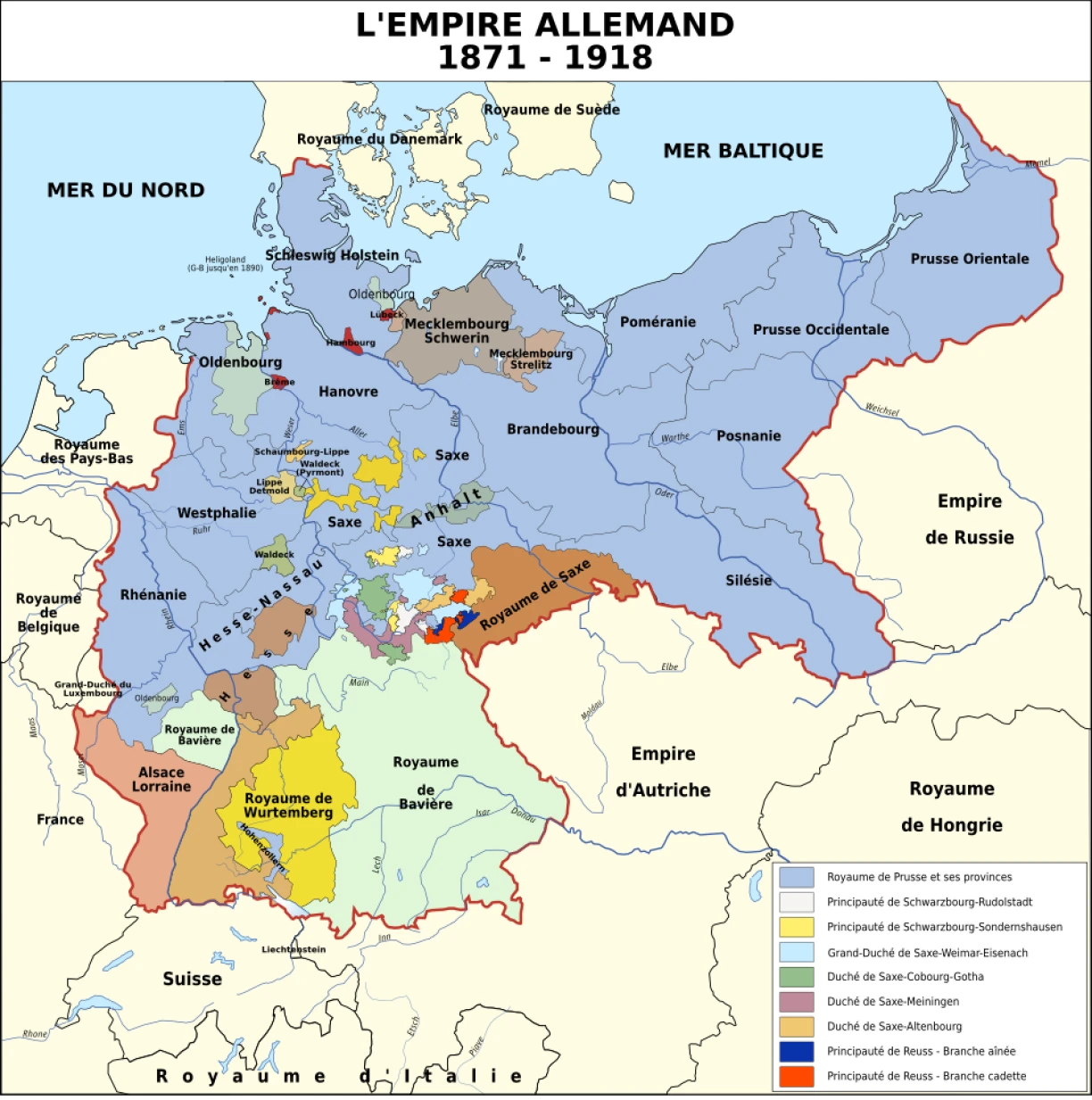
Strauf's map draws on this nostalgia for a Greater Germany, adding other countries considered Germanic because their populations speak German. Luxembourg is among them. It "was part of the German Confederation between 1815 and 1866", the historian points out. "So, this young Mr Strauf from the AfD has this idea that there needs to be a Greater Germany, because Germany lost a lot of territory after the First and Second World Wars", Pfeil summarises.
In 1945, Germany did indeed lose the territories it had annexed after 1937, amounting to 25% of its land area. These included the province of East Prussia, which was taken over by Poland and the Soviet Union. The German population of these territories – nearly 14 million people – was forcibly expelled. "Many Germans had to leave these eastern territories and ended up in West Germany and East Germany", Pfeil explained. The Federal Republic of Germany and the German Democratic Republic were both established in 1949.
The exodus left its mark. In the decades that followed, "among all those who had been forced to leave these eastern territories, the idea persisted that one day they should become German again".
"For a long time, there was virtually no far right in Germany", and this fantasy of a Greater Germany remained the preserve of small groups on the fringes of the CDU, Germany's main conservative Christian Democratic party.
But at the start of the 21st century, the far right is no longer hiding. "Over the past year or two, when you hear some of the speeches, when you look at what's happening in Saxony-Anhalt after the elections, we are witnessing a lightning-fast radicalisation", of which Strauf's map is a symptom.
The publication of the map provoked a strong reaction in France, of course, but also in Germany, the historian notes: "It was in all the newspapers, including Der Spiegel again this morning, often with people saying: 'There you have it, that's the AfD's true face, that's what they want.' They don't yet say it openly in the media, but there is still this revanchist idea within the AfD."
It took several days after the controversial post for Generation Deutschland to announce that Strauf was stepping down from his position on the organisation's executive committee. His departure was officially attributed to "personal reasons" but was nonetheless welcomed by the organisation's president, who thanked the activist for his work with Generation Deutschland.
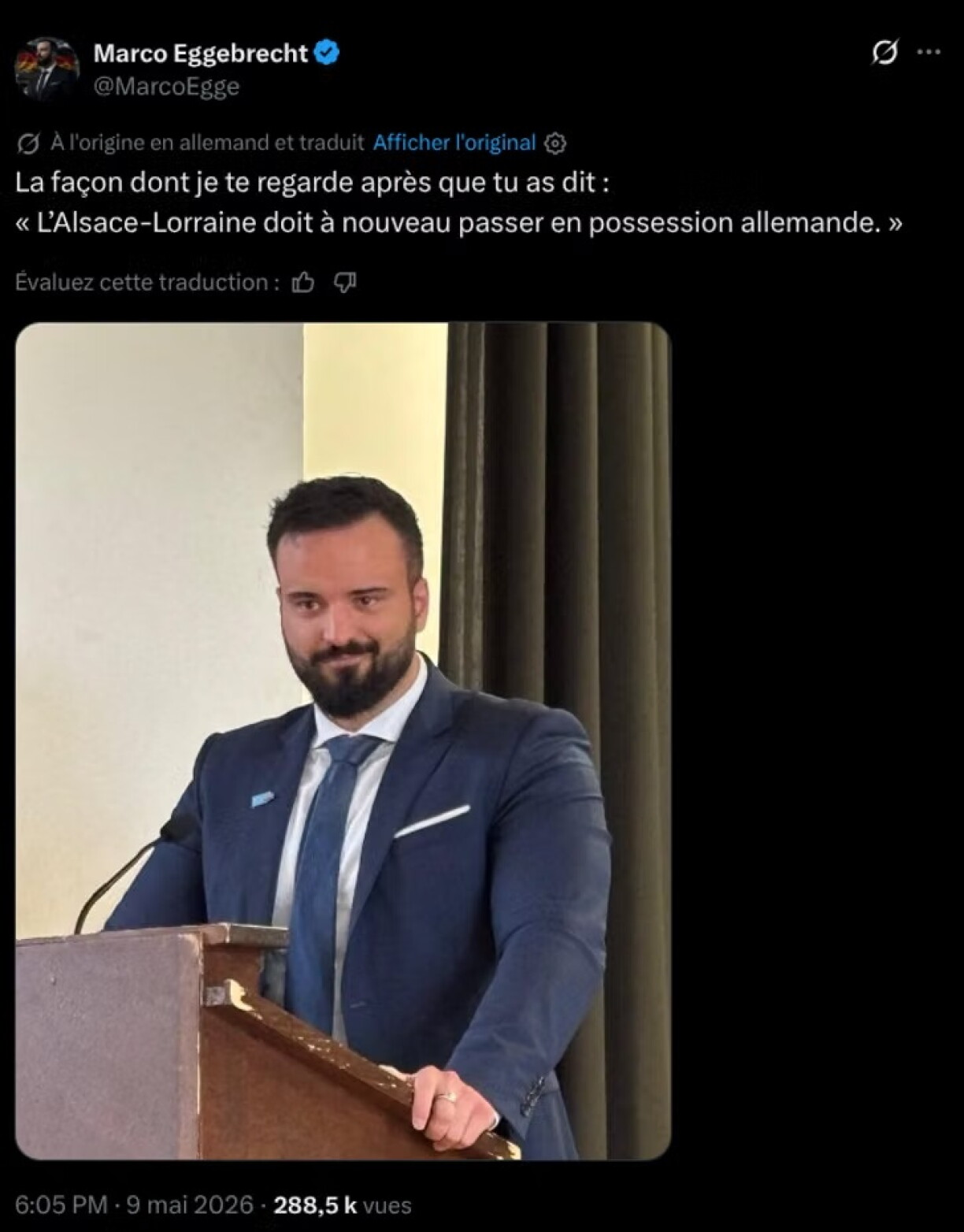
But Strauf is not an isolated case. There are precedents. Last May, for example, the French satire magazine Charlie Hebdo spotted a similar post by another AfD youth activist, Marco Eggebrecht. On X, he posed with a knowing look and the caption: "The look I give you when I hear: Alsace-Lorraine must return to German hands."
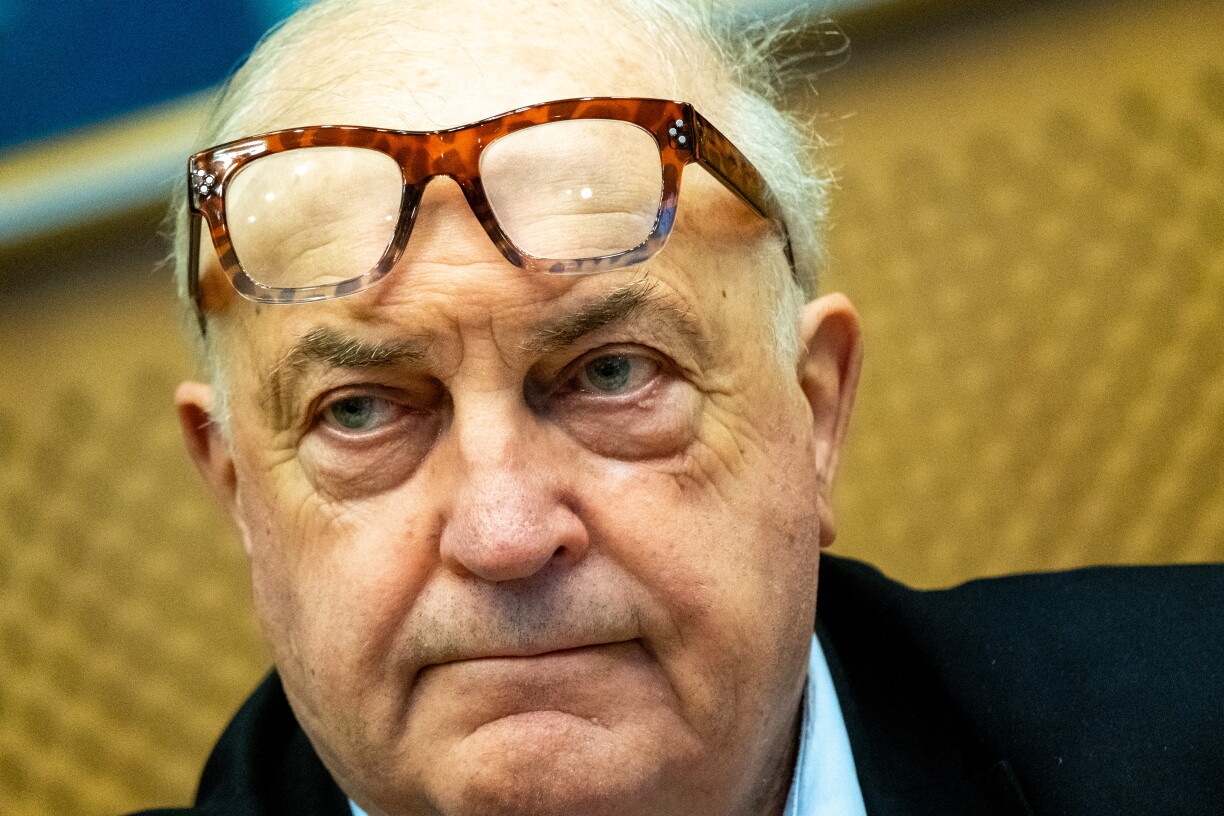
Luxembourg MEP Charles Goerens believes that these AfD politicians are being deliberately provocative. "They're trying to test the limits. They want to see how much the public is prepared to swallow", Goerens said. "But there's what they say, and then there's what they imply. And what they imply is clear. They are fascists, they are Nazis", the Luxembourg MEP told RTL Infos.
Goerens, a leading figure in the Democratic Party (DP), does not use the term "Nazi" lightly. He cites the case of AfD politician Björn Höcke: "You can call him a Nazi without the slightest risk of being taken to court, because the courts have already ruled on it." Höcke, one of the AfD's most radical figures, was indeed convicted in 2024 for using the Nazi slogan "Everything for Germany", which is banned under German law.
What's more, Goerens argues that even former leaders, such as Jörg Meuthen or Frauke Petry, who have left the AfD, say "very clearly" that the AfD's inner circle is dominated by Nazis who are in control. "That's the situation today," he insists.
The AfD frightens even members of France's far-right National Rally (RN). Jean-Philippe Tanguy, now responsible for economic affairs within the RN, said in 2019 that he had left a meeting with AfD members "terrified". He recently reiterated his concerns following the AfD's victory in Saxony-Anhalt: "It shocks me because they voted for people who play down Germany's Nazi past, who say you could be in the SS without being a bad person. It's scandalous", the MP said.
It is no coincidence, Goerens agrees, "that the RN has distanced itself from the AfD, given that the RN wants to project the image of a moderate party".
Returning to the AfD's victory in Saxony-Anhalt, Goerens said: "It's a tsunami. A tsunami we saw coming but played down by saying, 'So far, so good.' I don't think we collectively realise the danger facing us. Just look at the disintegration of the CDU. Today, it's barely at 20% in the polls, while the AfD is above 26%."
Is this extremism also taking root in Luxembourg? "Until now, Luxembourg has always managed to bury its problems under piles of money. If we had even a hint of the problems France faces, I think we'd be in the same situation, with the same political divisions," Goerens stated.
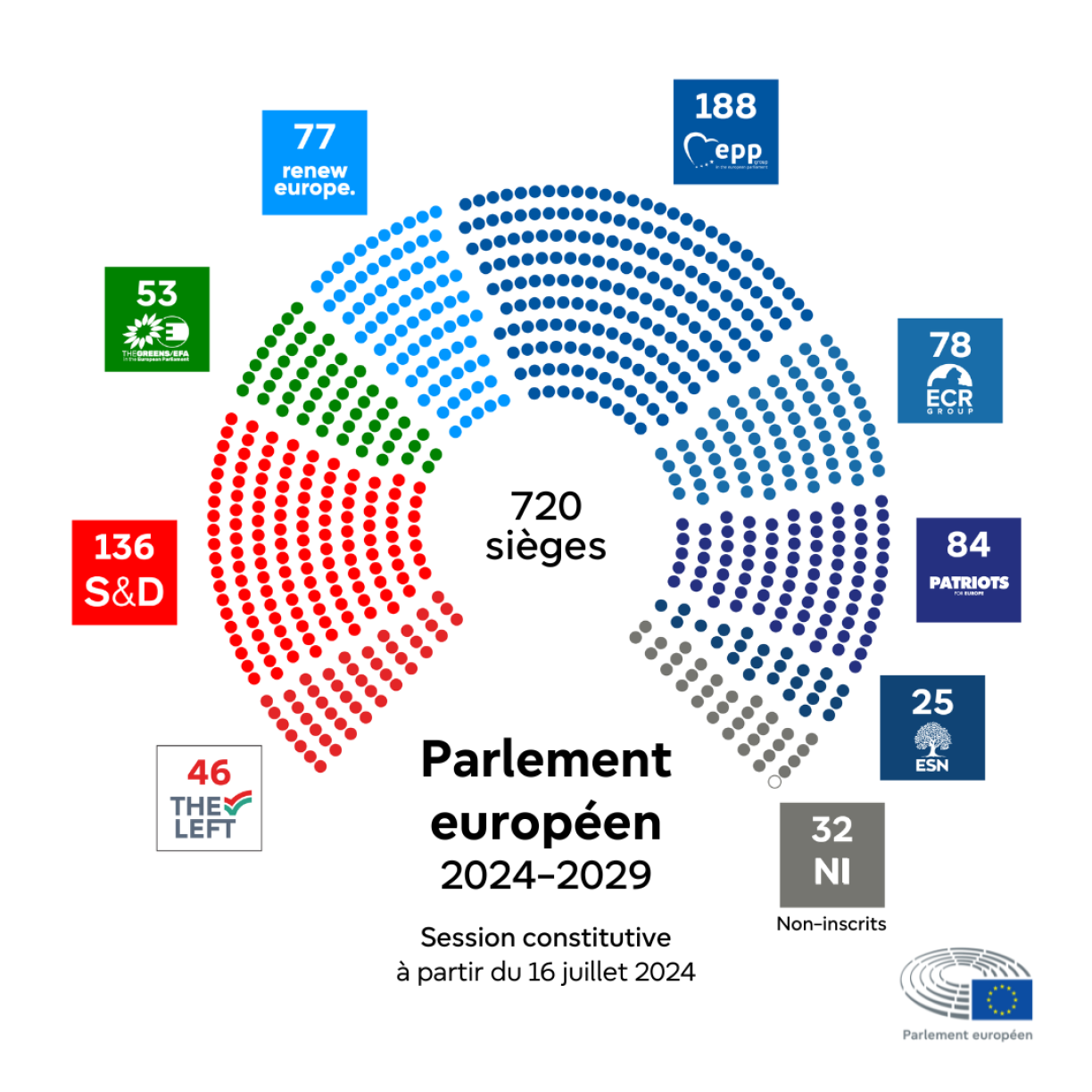
The far right is gaining more and more weight in the European Parliament. The Patriots for Europe group (PfE, chaired by the RN's Jordan Bardella) holds nearly 12% of the seats. The Europe of Sovereign Nations group (ESN, founded by the AfD) has just under 4%.
"What's happening in the European Parliament gives us a glimpse of what we may face in the future. As Mitterrand put it so well in 1995: nationalism means war. And here we are! Nationalism, imperialism – they've made their choice. And they have propaganda tools to promote their point of view. We, the moderate parties, the parties of the centre, have found nothing capable of stopping them", laments the MEP, a member of the Renew Europe group.
As a result, "within two years, we could have a far-right party in power in Spain, France, Germany, and Poland... In Slovakia and Czechia, they're already there. In Belgium, there's a Flemish extremist party, Vlaams Belang, which is extremely strong and has deep roots among the population."
There is, of course, the Hungarian exception "that proves the rule", the MEP adds by way of qualification (the latest parliamentary elections ended 16 years of rule by Viktor Orbán and his party, which is labelled far-right). "But everything points to there being a substantial blocking minority in the European Council. So what should we do in these times? This is a stress test for our European institutions", Goerens acknowledged.
Those institutions are all the more vulnerable because the geopolitical situation around the EU is growing darker, with Russia's invasion of Ukraine, a US President who "wants to make us economically and technologically dependent on him," and China on the trade front.
"That doesn't mean we've done nothing; we've made efforts in the defence sector, for example. But a common army that isn't part of a solid political union won't work", Goerens argues. However, there is one question that haunts the Luxembourg MEP: What happens if Europe disintegrates to a significant degree?
"What happens if Germany is rearmed to the teeth, with territorial ambitions of the sort we caught a glimpse of in that AfD member's map", Goerens wonders. In his view, political union means a shared analysis of the situation and joint action. "But at the institutional level, we don't even have a sufficiently substantial minority to get the debate started", he lamented.
He acknowledges a certain pessimism: "People often accuse me of being too pessimistic. But I always reply that the pessimistic German Jews survived in New York. The optimists perished in the gas chambers. Sometimes pessimism can be a good thing."
And yet, Goerens fears the worst. "Every day, we get used to an ever stronger dose," he warns, and in the medium and long term, that's not good for democracy. "I'm not saying things will necessarily take the same course as they did in 1933–1945, but it's starting as it did in the late 1920s and early 1930s," he said.
In life, there are passing events, and there are major currents, Goerens concludes: "I see a major current whose ambition is to crush everything else: the AfD movement, strongly backed by J. D. Vance, Trump and the Heritage Foundation.
This isn't just a passing event. It's a major movement that is taking shape. I spoke to a German expert who told me that in Saxony-Anhalt, they are advising the AfD on how to govern and how to put its programme into practice. They see themselves as being there for the long haul. I don't think this movement will stop any time soon."





