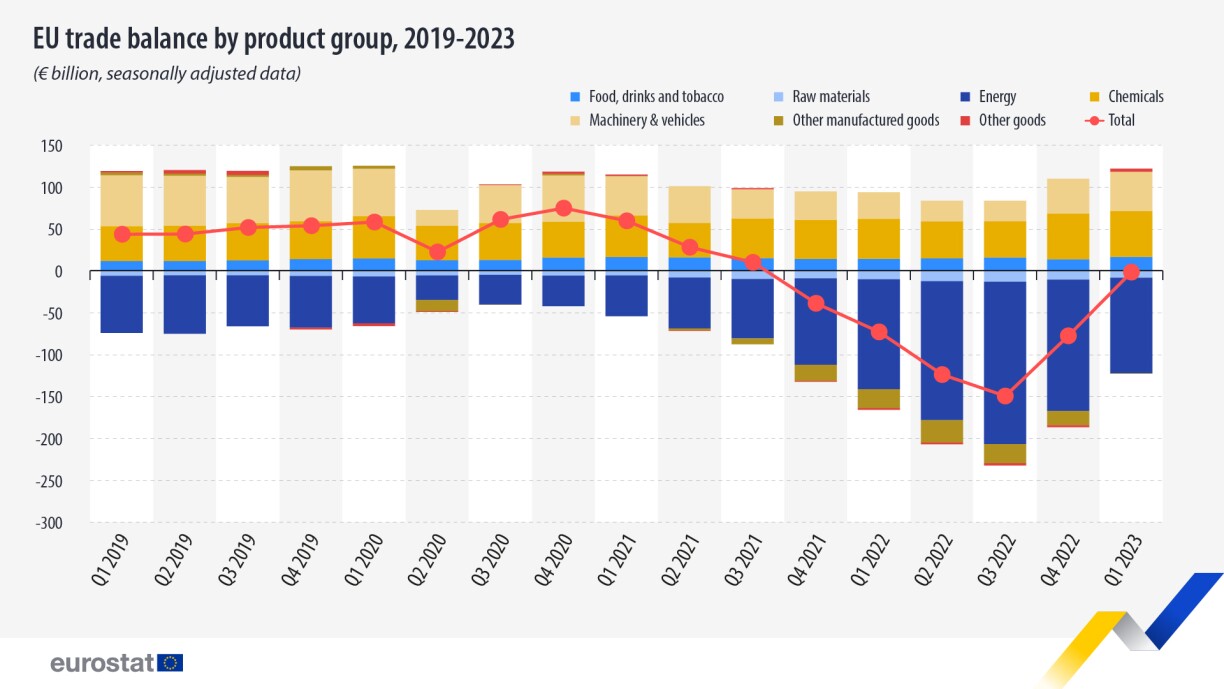
In the first three months of 2023, the European Union (EU) experienced a trade deficit of just €2 billion. This is quite a decrease compared to the large deficits of €150 billion and €78 billion in the third and fourth quarters of 2022 respectively. A large factor driving this change was the lowering of energy prices.
From the last quarter of 2021 to the third quarter of 2022, trade outside the EU significantly increased. The main drivers for this increase were the rising prices of commodities, particularly energy and food. This situation was exacerbated by Russia's invasion of Ukraine, which added more pressure to these prices. However, in the last quarter of 2022, exports increased only slightly by 1.5% from the previous quarter, while imports decreased by 7.7% due to the fall in energy product prices.
In the first quarter of 2023, both exports and imports decreased compared to the previous quarter, down by 1.4% and 11.5% respectively. The total value of exports was €656 billion and for imports, it was €658 billion.
From the beginning of 2019 to the third quarter of 2021, surpluses in machinery and vehicles, and chemicals were larger than the deficit for energy. However, the rising prices of energy products led to an increase in the deficit for energy, causing the overall balance to shift from a surplus to a deficit. In the last two quarters, the fall in energy prices helped to almost completely eliminate the trade deficit.
According to the data for the first quarter of 2023, the EU's trade balance for food, drinks, and tobacco was at €16 billion, and for chemicals, it was nearly €55 billion. These are the highest values for these product groups from 2019 through to the first quarter of 2023.
In the first quarter of 2023, the trade balance for machinery and vehicles was €47 billion, not quite as high as the peak in the first quarter of 2019 (€60 billion). However, this is nearly double the balance compared to the second and third quarters of 2022, which were €25 billion each.
In the first quarter of 2023, the EU had a trade deficit for energy products of €-114 billion and €-9 billion for raw materials.





