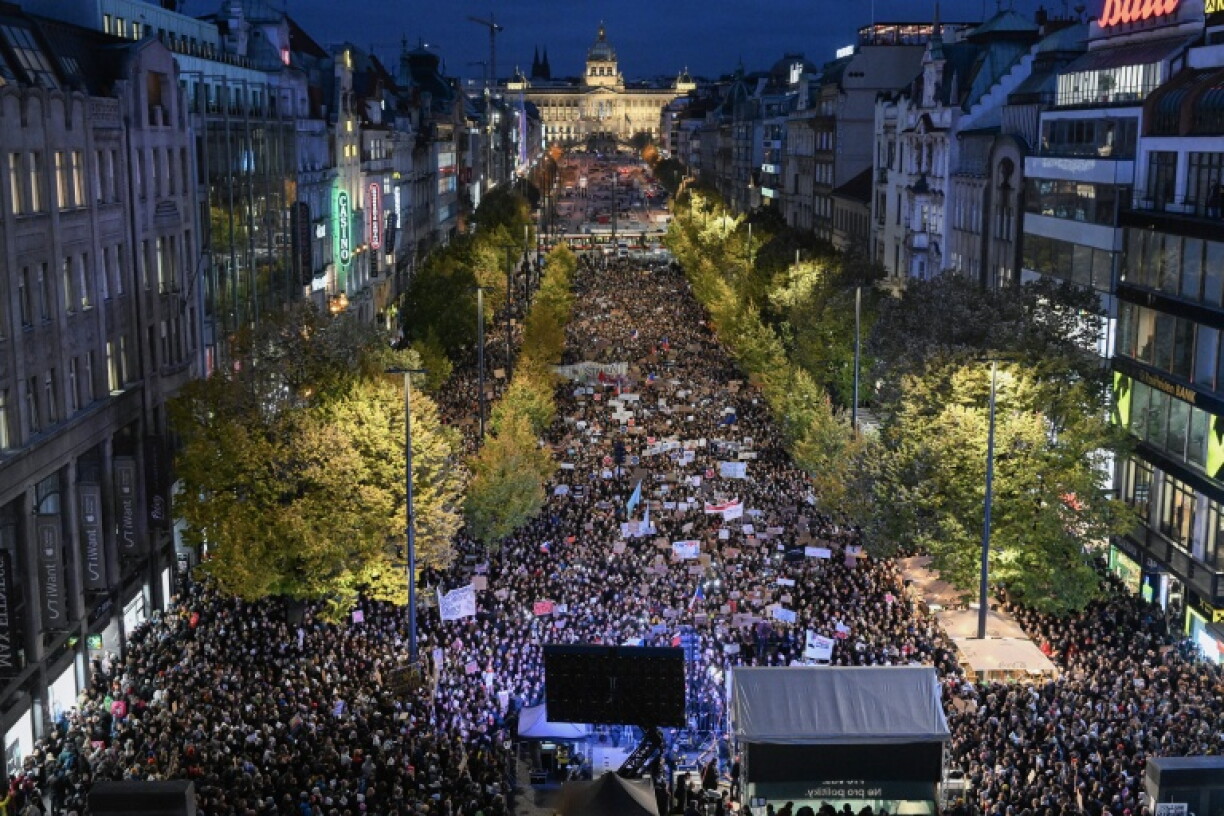
Hundreds of thousands of Czechs are expected to protest in Prague on Sunday against the nationalist government's plan to overhaul public-media funding, which critics see as a threat to press freedom.
The government of billionaire Prime Minister Andrej Babis wants to switch from funding Czech TV and Czech Radio through licence fees paid by viewers and listeners to payments from the state budget.
Opponents say the move will stifle media freedom as it will make the outlets more dependent on the state.
Babis's coalition, comprising his catch-all ANO party, the far-right SPD and the Eurosceptic Motorists, insists the plan will not affect editorial independence or programme content -- but broadcasters need to cut costs.
The proposal has already led to several large street protests since Culture Minister Oto Klempir introduced it in April.
Thousands demonstrated last month after the parliament rushed through a bill outlining the plans in a controversial overnight vote in the first of three readings.
Czech TV and Czech Radio staff then went on a one-day strike on November 3.
The same day, thousands including university students rallied across the country.
The Million Moments for Democracy group is organising Sunday's demo.
"Babis and his government obviously think they will get away with anything... that they can ignore experts, silence critics and treat democratic institutions like their property," they said in a statement.
The group has brought an estimated quarter of a million protesters to each of the three previous rallies against Babis -- two during his first stint as premier from 2017 to 2021 and one in March this year.
Its leader, Mikulas Minar, said Sunday's protest might be "the largest public gathering in Czech history", as the organisers expect 400,000 to 600,000 people.
The proposed media reform, which would slash state television and radio budgets by around 15 percent, has attracted international attention.
The European Broadcasting Union, the European Federation of Journalists, Reporters Without Borders and the International Press Institute have all criticised it.
They have accused Babis of mirroring the muzzling of public media carried out by his allies in other countries, notably Slovak Prime Minister Robert Fico and Hungary's ex-leader Viktor Orban.
Trust in the media is low in the Czech Republic, at around 30 to 33 percent, according to the Reuters Institute Digital News Report 2026.
"Public service broadcasters remain the most trusted brands, despite increasing attempts by various political actors to undermine their credibility," the report said.
Babis said last week that "nobody wants to control public media, let alone nationalise them" and that "none of what the people are protesting against... is true".
frj/fec/jj/jhb


