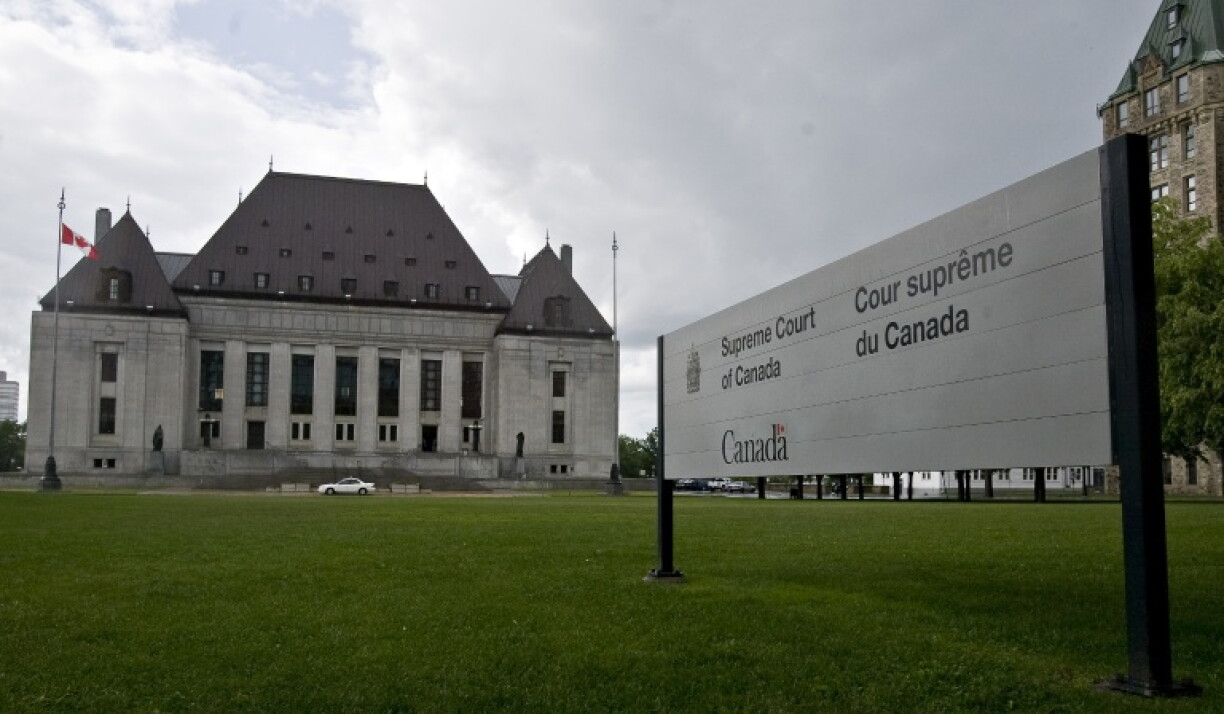
Canada's Supreme Court on Friday ruled that a Quebec law banning a range of public officials from wearing religious symbols at work was largely valid, settling a landmark case that tested Canada's constitution.
The court upheld the controversial law with one exception, ruling provincial lawmakers should be allowed to wear religious symbols in the legislature.
Chief Justice Richard Wagner wrote that the law, known as Bill 21, "is rooted in Quebec's legitimate and historical commitment to ensuring the (secularism) of the state in a free and democratic society."
The Quebec case was also seen as a major test of how far provinces can go in defying provisions of the federal constitution by invoking the so-called "notwithstanding clause."
That clause, a quirk of Canada's legal system, effectively allows provincial governments to pass laws that may breach Canada's constitution, known as the Charter of Rights and Freedoms.
Predominantly French-speaking Quebec pre-emptively invoked the "notwithstanding clause" when passing its secularism bill, anticipating it would be challenged over constitutional protections guaranteeing freedom of religion and expression.
Conservative-led provinces have also invoked the clause to defend legislation relating to transgender youth.
In 2023, Saskatchewan used the clause to pass a law requiring schools to obtain parental consent before changing the pronouns used for children under 16.
Alberta has also invoked the clause in relation to laws banning transgender girls from participating in female sports and restricting hormone therapy for individuals under 16.
Opponents of the Quebec bill immediately condemned the court's decision, saying it raised questions about the protection of any fundamental right within Canada's federal system.
Quebec lawyer Michael Bergman, who is part of a group that opposed Bill 21, said the ruling renders Canada's constitution "an empty shell."
"Because with the notwithstanding clause, a legislature of Parliament can make, by a magic wand, fundamental rights go away, disappear," he said.
The head of the National Council of Canadian Muslims, Stephen Brown, said the ruling made clear Canada's constitution was a "charter of suggestions," not a charter of guaranteed rights.
And Anaïs Bussières McNicoll of the Canadian Civil Liberties Association said Canada cannot be considered a free and democratic society "if people have to choose between their profession and their faith."
But while the court ruled that Quebec used the notwithstanding clause appropriately in the secularism case, it did not categorically preclude restricting its use in other contexts.
Prime Minister Mark Carney urged caution in reacting to the decision, voicing respect for the court's decision on the propriety of the Quebec bill, but noting his government needed time to study the ruling to understand its implications beyond this case.
"I think what's important is that all legislatures and very much including obviously parliament, are doing their utmost to respect the rights and liberties of all Canadians, including those in the minority," Carney told reporters.
The leader of the separatist Bloc Québécois, Yves-François Blanchet, said the decision marked "a major victory" for the province's legislature.
The pivotal ruling came just a month after a separatist, staunchly secular provincial government was elected in Quebec, promising to broaden restrictions on religious displays in public life.
fa-bs/dw