AI is often criticized for the energy its data centers consume, which is driving more fossil fuel use and contributing to climate change.
But it is also helping meteorologists make markedly more accurate forecasts, including for hurricanes, which are notoriously complex to predict and pose a growing threat in a warming world.
The US National Hurricane Center (NHC) began using Google DeepMind's AI model last year and is working with the company on developing its successor.
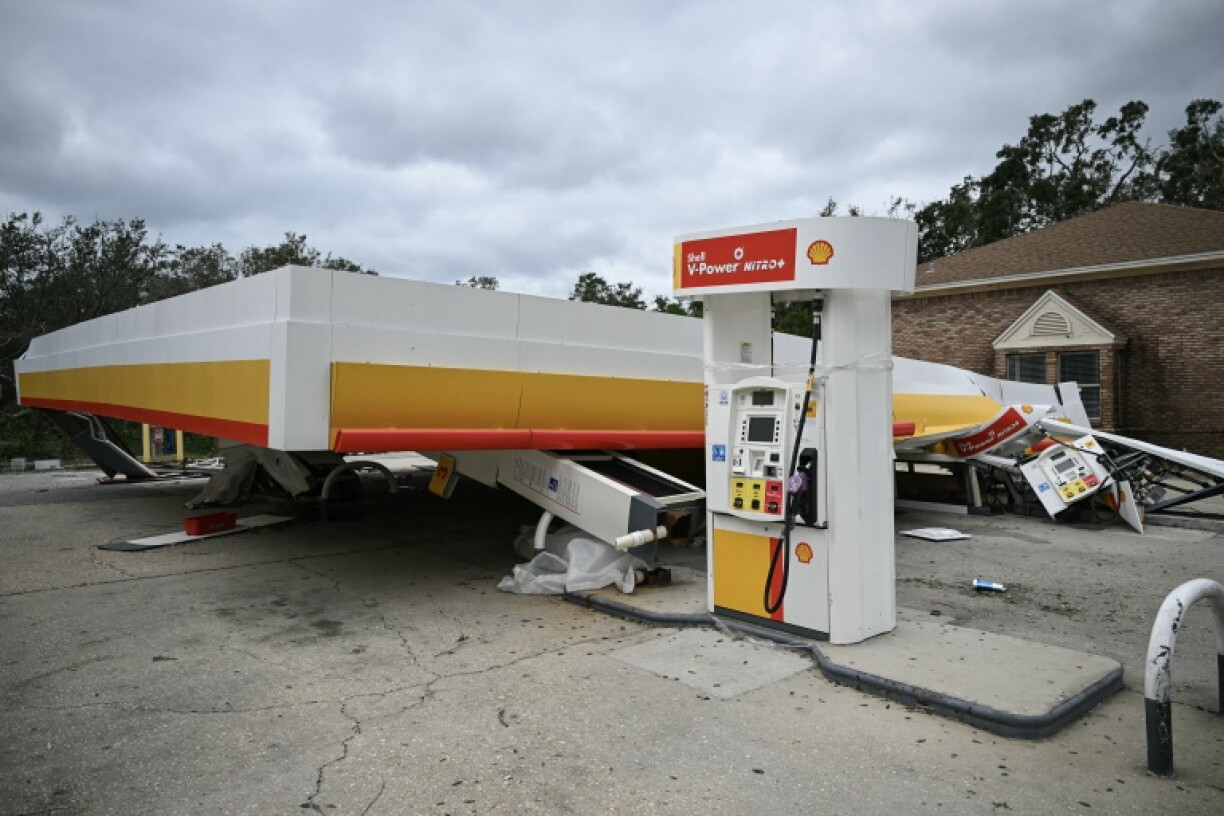
The work has come to the fore this year -- as an intense El Nino weather pattern led to a record number of hurricanes in the Pacific, and Hurricane Isaias struck the southeastern United States last month as a major storm.
Ferran Alet, a DeepMind research scientist who leads its cyclone work, explained that Google doesn't have a hurricane-specific model -- rather it is the same model used for everyday weather, pushed to its limits.
"We see extreme weather as almost like something we should strive for because it's the most challenging thing for us and then everything will follow," he told AFP.
Prior to AI, the NHC used several kinds of models to forecast tropical cyclones. "Dynamical" models use supercomputers to solve the equations of fluid motion and thermodynamics that govern the atmosphere.
Statistical models rely on historical relationships between storm behavior and variables such as location and date, and hybrids combine physics and statistics.
AI models, on the other hand, learn from large datasets, like statistical models, but on a vastly bigger scale and with the ability to pick up far more complicated patterns.
A DeepMind paper published in Nature in August found the model gave forecasters on average an extra day's worth of predictive accuracy, with three-day forecasts as good as what earlier models could provide for only the next two days.
For Isaias, DeepMind's model recognized it could become a tropical cyclone a full week before it formed.
The model can also generate 1,000 possible scenarios for each cyclone and forecast rainfall alongside the storm's track and intensity, meaning the path it will follow and how strong it will get.
"NHC began using AI models in operations in late June of 2025 and the Google Deep Mind model was added to some of NHC's track and intensity consensus aids in 2026," Dan Brown, NHC Operations Division Chief told AFP.
The NHC also uses AI models from the European Centre for Medium-Range Weather Forecasts and the National Weather Service, and has an agreement with Google to work on developing its models.
"During Isaias, the AI models performed quite well for track," said Brown, adding that "AI models appear to be good at quickly predicting shifts in complex steering patterns."
Brown singled out DeepMind and the NHC's own model, called HCCA, as two of the best-performing track and intensity aids.
The technology isn't without limitations. Brown said that individual models can "wildly flip their tracks or intensity projections from cycle to cycle," leaving hurricane specialists to use their experience and judgment to decide which models best capture a given storm, and to blend them.
He also noted that physics-based models built the baseline on which the AI models were trained.
"As for the hurricane specialist? The specialist becomes more important than ever. An algorithm can show a track probability, but it doesn't look at live aircraft and satellite data to determine the current structure of the storm," said Brown.
The gains in forecasting precision are taking place as the US data center build out is rapidly changing the composition of the electric grid, and planned newer data centers are set to be largely powered by natural gas, according to an analysis by Cleanview, increasing the United States' carbon footprint and worsening climate change.
Climate change in turn is causing hurricanes to become more powerful, carry more rainfall, and cross more slowly, thus worsening impacts.
ia-tu/mjf


